

Research HighlightsWaterhemp Resistance to Glufosinate Motivates New Research
Highlights:
- Glufosinate-resistant waterhemp causes uncertainty. Farmers may not know if a herbicide application failed or a resistant population resides in their fields.
- Research is being conducted on how environmental conditions can influence glufosinate performance on resistant and susceptible waterhemp populations.
- Farmers and applicators should be aware when applying glufosinate, as hot temperatures could reduce its effectiveness on resistant populations.
By Carol Brown
Waterhemp is an abundant weed that has adapted to resist most — if not all — post-emergent herbicides. Scientists are finding ways to help farmers reduce this pigweed species in the field and preserve soybean yield. Weed specialist Patrick Tranel is learning more about how waterhemp evolves resistance and how herbicides like glufosinate (Liberty) can remain effective for waterhemp control.
“Glufosinate is known to be a finicky herbicide,” says Tranel, University of Illinois crops sciences professor. “When a glufosinate application doesn’t control waterhemp, the answer is not black and white. Environmental conditions can influence how well glufosinate works.”
Waterhemp resistance to glufosinate is a rising concern for farmers. Its resistance to the herbicide was confirmed in Illinois last winter. Because of this, farmers don’t know whether the waterhemp populations in their fields are herbicide resistant, or if the glufosinate application didn’t work well because of other factors. Tranel has been researching glufosinate effectiveness in waterhemp through a Soy Checkoff project supported by the Illinois Soybean Association.
“If conditions are right when glufosinate is sprayed in the field, the waterhemp dies. If conditions are wrong, many of the plants die but some survive, which looks similar to what happens with a resistant population,” Tranel comments. “So it has taken some time to confirm there is true glufosinate resistance.”
Glufosinate Performance Evaluation
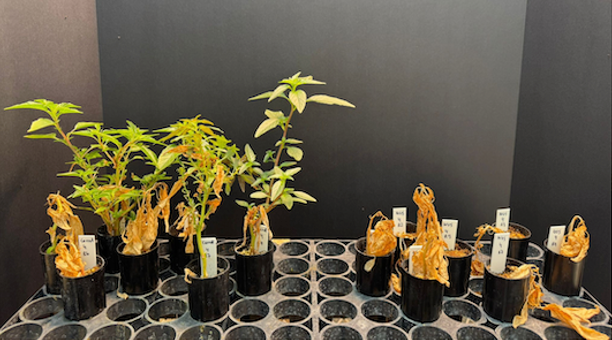
A project objective is determining how environmental conditions affect glufosinate performance with waterhemp. Tranel and his team conducted dose–response comparisons. In the greenhouse, they grew suspected glufosinate-resistant waterhemp and a known susceptible population. These were treated with glufosinate at rates below and above the labeled use rates and compared how the sensitive plants responded and how well the suspected resistant populations survived the higher dosages.
“Even in these greenhouse conditions, where we have some control of the environment, we saw inconsistent results,” Tranel says. “This led to further experiments to tease apart how the environment is influencing the response of both the sensitive and resistant populations.”

The team repeated the dose–response experiments but used growth chambers where they could control temperature and humidity. They tested the glufosinate resistance in the full range of combinations: high temperatures and high humidity, lower temperatures and lower humidity, and the combinations in between.
“As we suspected based on previous research and general observations, we found that in the sensitive waterhemp, high temperature and high humidity increased glufosinate efficacy,” he comments. “But with the resistant population, the herbicide performed worse under high temperatures. I think the waterhemp is able to detoxify the herbicide, which happens faster under high temperatures.”
Tranel and his team are looking for consistency across additional waterhemp populations, which could someday affect post-emergence glufosinate application timings.
Be Weather-Aware When Applying
“The current consensus is to spray glufosinate when plants are healthy, and when there is a lot of sunshine and humidity,” he says. “And our greenhouse experiments upheld these recommendations. But farmers and applicators should be aware of the little twist we found. If it’s really hot and they suspect a resistant waterhemp population, they might not get the best weed control. Spraying when it’s sunny and humid but cooler might be better.”
The research isn’t to the point where Tranel recommends changing recommendations, but farmers and applicators should be aware of these findings, especially as they troubleshoot situations of reduced herbicide performance.
“The most effective herbicide program to reduce weed populations continues to be using a soil-residual herbicide at full rates to reduce the weed pressure that’s exposed to the post-emergence herbicide application,” Tranel says. “Then tank-mix two or three effective options sequentially during the growing season to ensure there is more than one herbicide site-of-action in the field, especially if there is a resistant waterhemp population.”
Additional Resources
Illinois Soybean Research Review – Report from the 2025 growing season
Keeping Ahead of Weeds Through Improved Management Practices – SRIN article
Glufosinate Resistance in Waterhemp: What We Know (and What Comes Next) – War Against Weeds podcast
Herbicide Resistance information – Getting Rid Of Weeds (GROW) website
Take Action: Herbicide Resistance Management – website
Post-Emergence Waterhemp Control Recommendations for Northern Soybeans – SRIN article
Controlling Palmer Amaranth with Timely Subsequent Glufosinate Applications – SRIN article
Meet the Researcher: Patrick Tranel SRIN profile | University profile
The Soybean Research & Information Network (SRIN) is funded by the Soy Checkoff and the North Central Soybean Research Program. For more information about soybean research, visit the National Soybean Checkoff Research Database.
Published: Nov 16, 2026


