

Research HighlightsKeeping Ahead of Weeds Through Improved Management Practices
Highlights:
- An ongoing, multi-state research project keeps evolving to help farmers improve their weed management systems.
- From screening weeds for suspected herbicide resistance to testing weed control methods, scientists from across the country are collaborating to reduce risk and improve management practices of herbicide-resistant weeds.
- The team keeps abreast of emerging issues and refines management techniques so farmers to stay ahead of weed pressure.
By Carol Brown
Scientists have a love–hate relationship with weeds. For researchers, it’s an accomplishment when herbicides and technologies are successful at controlling a weed population. But it can be frustrating when weeds overcome the science, management practices fall short, and weeds become a problem in a field — again.
A long-term, multi-state weed management research program is making strides in helping farmers reduce weed pressure. Supported by Soy Checkoff funding through the United Soybean Board, the Take Action Herbicide-Resistance Management group was established more than a decade ago. The team of weed scientists continues to explore how to keep weeds from robbing farmers of soybean yield and finding strategies to postpone further resistance. The current research focuses on reducing risk and building sustainability through best management practices for herbicide-resistant weeds.
Bryan Young, a weed science professor at Purdue University, leads the project that involves weed specialists and agronomists in as many as 15 states, all in pursuit of gaining control of weeds.
“Improving herbicide stewardship is a term I used a while ago to describe this work, and it still applies,” Young says. “Our focus topics have evolved but we keep constant in management efforts, which includes studies on non-chemical weed control practices and technologies, the integrations of diverse and effective herbicide combinations, off-target impact of management practices, and a deeper investigation on the biology and herbicide resistance in our most challenging weed targets.”
Searching for Suspects
Since 2018, the team has screened more than 1,200 populations of waterhemp and Palmer amaranth sampled from growers’ fields in the Midwest and the South for resistance to glufosinate (Liberty), 2,4-D, and dicamba. They documented the weed populations with plants that survived a field-use rate of one of the three herbicides. This screening effort identified suspect populations that needed further investigation to confirm herbicide resistance, Young explains, which requires time and greenhouse studies. He created maps to illustrate by county the breadth of suspected herbicide resistance (Figure 1) for each herbicide.
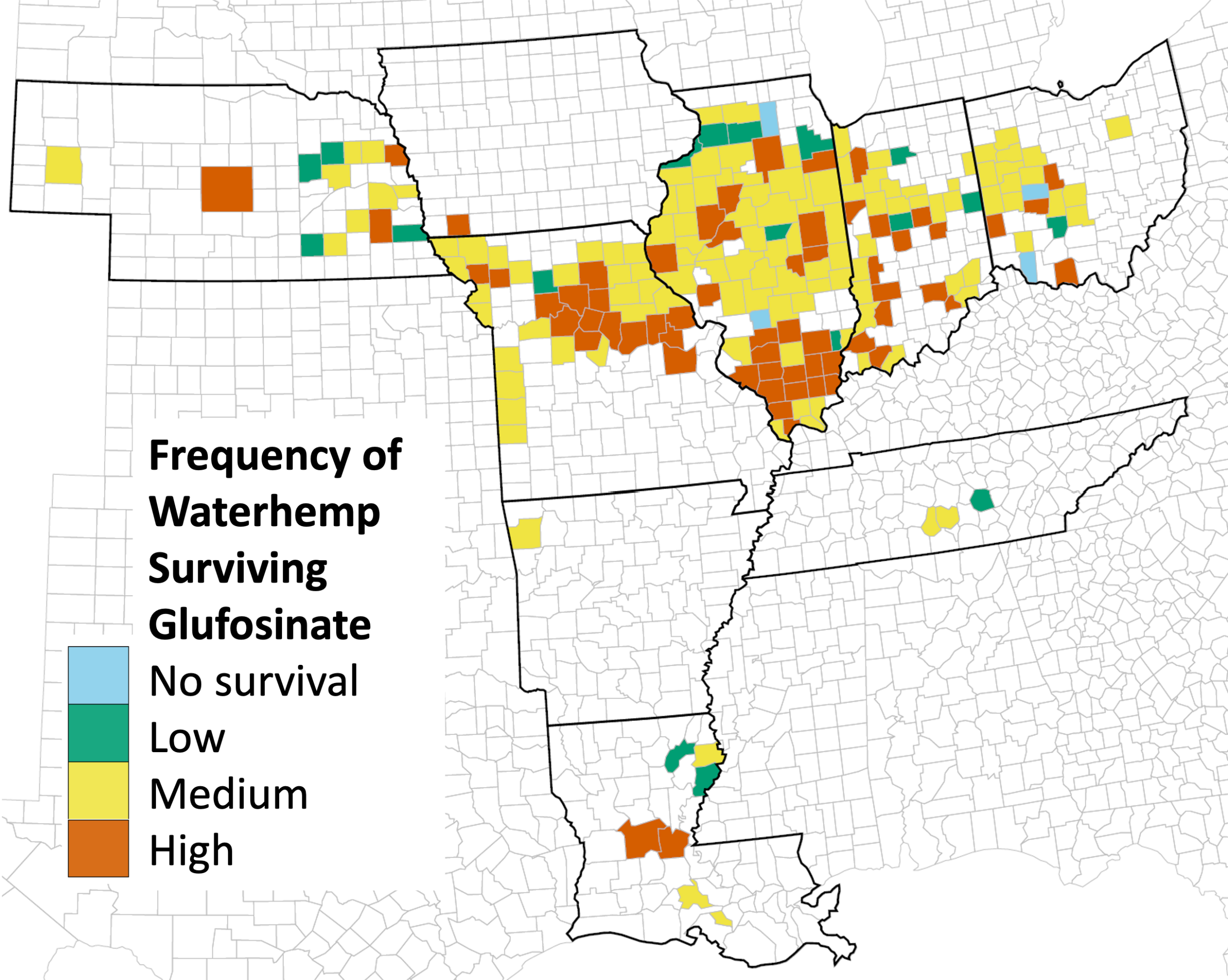
“The maps showing suspected herbicide resistance can be startling to see for a soybean farmer,” he says. “Because it shows that if farmers can control waterhemp or Palmer amaranth today with a post-emergence application of these herbicides — that’s great, but it won’t last.”
Spreading Issues with Italian Ryegrass
The team has added research on Italian ryegrass this season, as it’s becoming problematic in the Eastern corn belt and in the Midwest. Young says this winter annual weed species has been an issue in the Mid-south and in the southern states for some time.
“My weed science colleague, Larry Steckel, in Tennessee said that Italian ryegrass management was every bit as bad as Palmer amaranth, which is a significant issue,” he remarks. “In 2025, we also received calls about this weed from growers in southern Indiana up to the Michigan border.”
The team is learning how abundantly it grows in the fall and in the spring. And, since Italian ryegrass is commonly resistant to glyphosate as well as herbicide mode-of-action groups 1 and 2, they are testing other herbicide mode-of-action groups to improve fall and early spring management.
Cover Crops for Weed Control
Using cover crops as part of integrated weed management programs is also a consistent research component in this project. The team has explored many aspects of the cover crop–soybean interaction and how weed management fits into the system. With the cover crop variables including species, planting and termination methods and timing, it can be daunting for a farmer.
Rodrigo Werle, associate professor and weed specialist at the University of Wisconsin-Madison, leads this research component. He and his team have found that cover crops such as cereal rye and early planted soybeans can coexist for a short period of time, but termination timing is key for soybean yield and weed suppression.
“A rule of thumb when planting soybeans early and green, or planting into a living cover crop, is to terminate cereal rye when soybeans are at the VE growth stage, or when the rye is 30-inches tall, whichever comes first,” Werle says. “There is ample cover crop biomass to suppress weeds, but not too much to keep growing soybeans from receiving sunshine.”
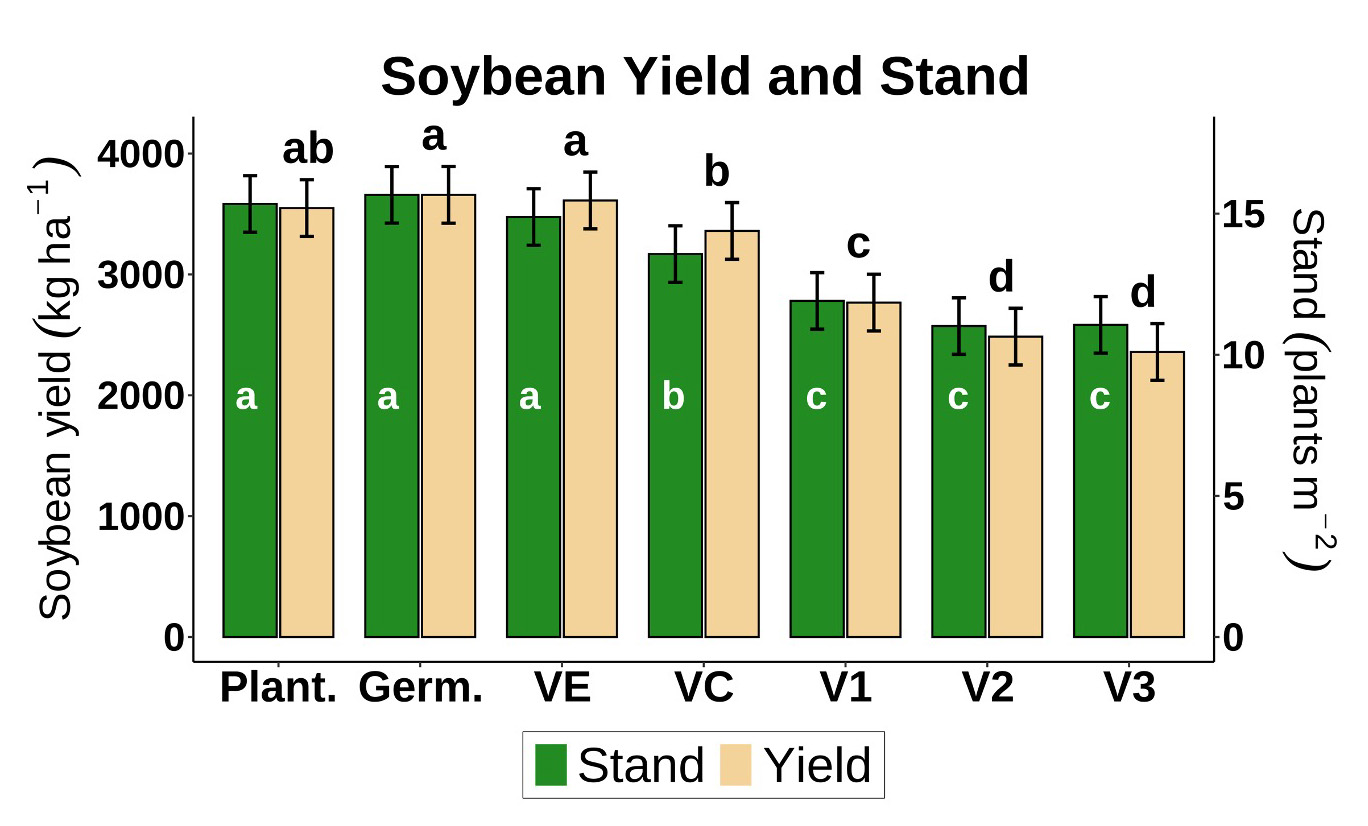
The team is exploring how early planted soybeans, pre-emergence herbicides, and cover crops can work together successfully. They encourage using an effective soil residual herbicide paired with cereal rye termination at VE, which reduced pigweed species by 70% in early planted soybeans at the time of post-emergence herbicide application, according to research led by Guilherme Chudzik, University of Wisconsin-Madison graduate student. They found that when soybeans are at VC, or cotyledon growth stage, cereal rye termination could be too late, thus the recommended VE growth stage cut off. Soybean stands and yields were reduced when cereal rye was terminated at the VC stage and later (Figure 2).
Research Ripple Effect
The team’s documentation of suspected resistance to glufosinate, 2,4-D, and dicamba in waterhemp and Palmer amaranth has been of interest to the EPA. Over the years, the team has informed the EPA of their findings.
“We have had conversations with the EPA in terms of herbicide off-target movement, especially when this was an issue for dicamba,” Young remarks. “Recently, we’ve had conversations with the agency about the Endangered Species Act (ESA) label provisions, which also pertains to off-target herbicide movement in terms of both aerial and surface routes. The ESA regulations bring rise to conversations about herbicide interactions and what happens when herbicide A is mixed with herbicide B. We hope our research, the practical science of weed management, is considered when the EPA makes determinations on new herbicide product registrations and approves product label guidelines.”
Additional Areas of Interest
Other weed management approaches have been explored within this research including mechanical weed seed destruction mills mounted on the back of combines in the chaff stream during harvest operations, which work effectively but carry a significant price tag.
The team is also looking at a wheat smother crop with soybeans. It has been used in other crop rotations, Young says, but it’s fairly new to soybeans, and the team can’t afford to rule out any viable practice that can improve weed management in regional production systems.
“The wheat is planted in between the soybean rows in the spring,” he says. “It’s like a living mulch that keeps the small-seeded weeds, like Palmer amaranth, waterhemp or marestail, from germinating. The wheat could be chemically mowed, which is when a low dose of herbicide is applied to just stunt the wheat growth, so it can take up the space and keep the weeds from invading.”
The team of weed specialists compare and contrast research findings across the country to help farmers with their weed management systems. They adjust research priorities as weeds adjust their herbicide resistance. It’s an unending cycle and will be as long as there is farming.
Additional Resources
Multi-State Researchers are Exploring Best Management Practices for Herbicide Resistant Weeds – SRIN article
Take Action – website
Using Cereal Rye to Boost Weed Control Without Hurting Soybean Yield – SRIN article
Wisconsin Researchers Explore Cereal Rye Cover Crops for Weed Suppression – SRIN article
Manage Weeds in Early Planted Soybeans in the Upper Midwest – SRIN/GROW article
Meet the researchers: Bryan Young SRIN profile | University profile
Rodrigo Werle University profile
The Soybean Research & Information Network (SRIN) is funded by the Soy Checkoff and the North Central Soybean Research Program. For more information about soybean research, visit the National Soybean Checkoff Research Database.
Published: Sep 14, 2026


