

Research HighlightsControlling Palmer Amaranth with Timely Subsequent Glufosinate Applications
Highlights:
- A Kansas researcher is focusing on Palmer amaranth management in soybeans later in the summer when the weed has grown too large for ideal spraying.
- Weed specialist Sarah Ganske conducted glufosinate efficacy trials to find how well a follow-up application improved weed control and whether timing played a role in that subsequent application.
- She and her team also explored using the Delta-T equation as a guide to spraying time.
By Carol Brown
Palmer amaranth can be a super-prolific problem in soybean fields. The weed is fast-growing and can produce up to a half-million seeds per plant. Also, it is resistant to several herbicides, which can cause large soybean yield losses for farmers.
Weed specialists across the country are researching ways to combat this aggressive weed in crop fields. From finding out how it becomes herbicide-resistant, to management strategies such as row spacing and cover crops, scientists are trying to keep a step ahead of this weed.
Over the last several decades, Palmer amaranth has been confirmed to be resistant to eight herbicide modes of action, making it even more frustrating to control.
In Kansas, weed specialist Sarah Ganske has been conducting research on managing Palmer amaranth through projects supported by the Kansas Soybean Commission Soy Checkoff funding. Ganske, an associate professor and extension specialist at Kansas State University, is wrapping up the second crop year of research that explores late-season glufosinate applications to manage herbicide resistance.
“This project started from questions I was receiving about double-crop soybeans and Palmer amaranth presence in wheat,” Ganske explains. “I expanded the research to include the full-season soybean crop. We know we have weeds every year and for whatever reason, they can grow larger than we want at the time of herbicide application.”
Ganske and her team focused on glufosinate efficacy and how the weeds performed when they were bigger than ideal for spraying time.
The two-year project was conducted near Manhattan and Hays, using glufosinate (Liberty) and 2,4-D (Enlist One) herbicides. Ganske wanted to answer the questions:
- Does a second herbicide application improve weed control?
- Does it matter when the second application is done – 3, 10 or 14 days later?
- Does it matter what is applied and in what order (glufosinate alone or combination of both)?
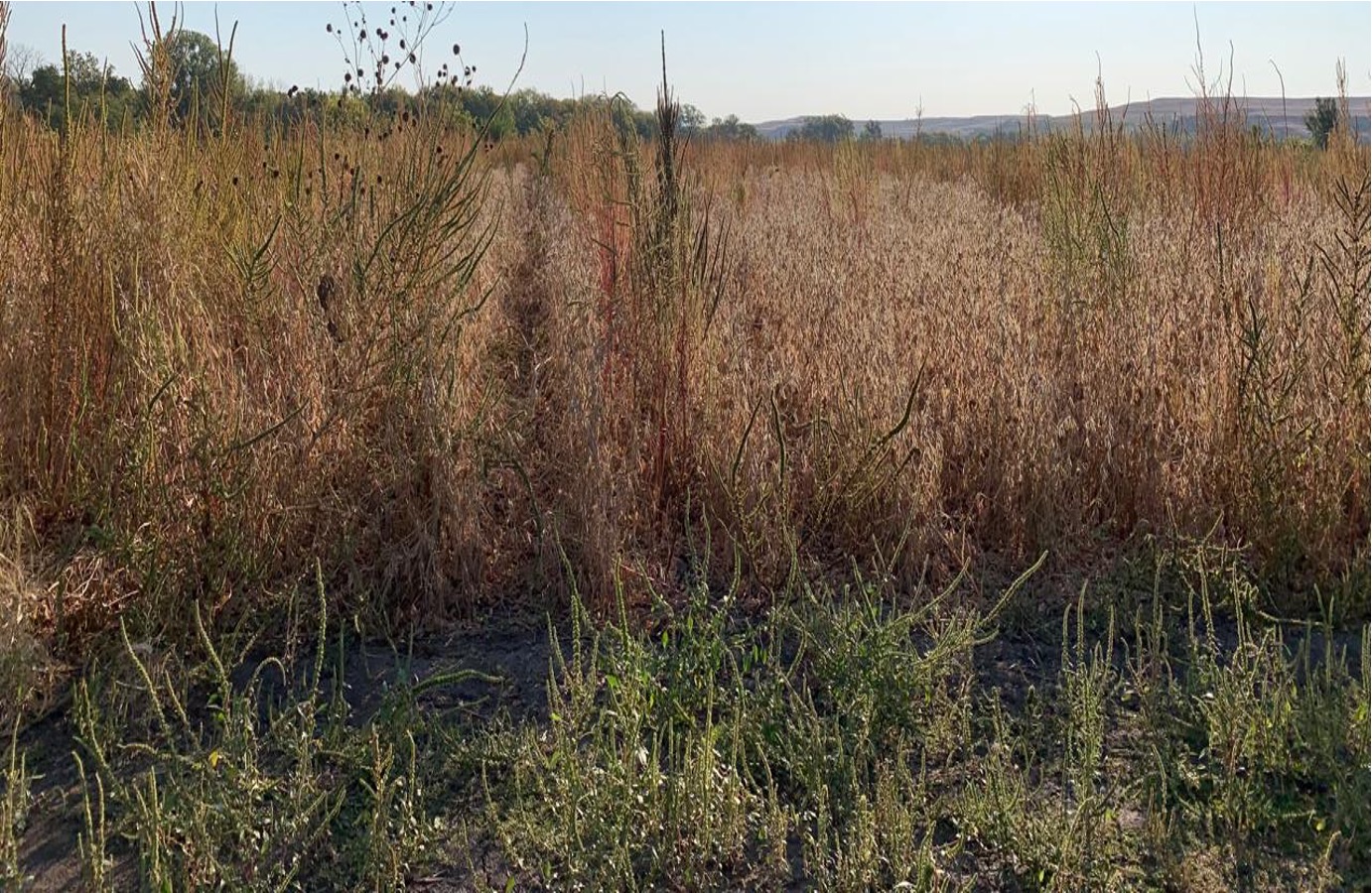
“Glufosinate is one of the few herbicides that we don’t have a lot of widespread resistance in the Palmer amaranth or waterhemp populations,” she says. “Herbicide labels and recommendations say to spray the pigweeds when they are 3- to 4-inches tall — about the height of a pop can. But what sometimes happens is they are that tall when we see them and they’re 6- to 12-inches tall when we spray.”
Glufosinate is a contact herbicide, so it needs to touch the plant tissue in order to kill it, she says, and when Palmer amaranth grows larger, they have more growing points on the plant. Applications of the herbicide may not come into contact with the lower growing points of that weed.
“We almost always recommend two post-emergence passes with a glufosinate application for this reason,” she comments. “But with Enlist soybeans, the second application timing and choice of herbicide comes into question.”
With the first pass, the team sprayed glufosinate alone and glufosinate plus 2,4-D. The sequential passes were glufosinate followed with a combination of the two on a third pass. These were applied 3, 10 and 14 days after the first pass.
“We found a consistent solution for farmers,” she says. “For nearly complete control, farmers should follow-up with a second herbicide application within the two-week window after the first pass. It didn’t matter which herbicide was in that subsequent application, nor did it matter whether it was three days or two weeks after that first pass. But making the second application within 14 days is key.”
Using Delta-T for Spraying Conditions
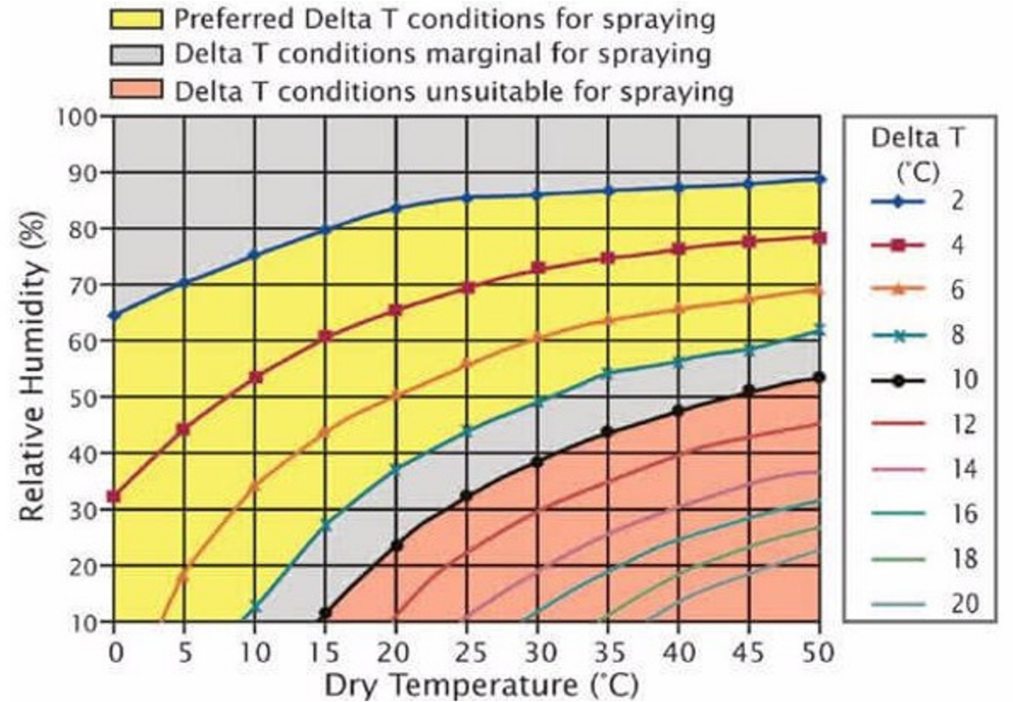
Another component of this project is tracking environmental conditions for herbicide application timings. It is known that mid-day applications are more effective than morning or late afternoon sprays, and that low humidity decreases glufosinate control. Ganske and her team compared the Delta-T equation with the 150 guideline to determine optimal spray conditions. The 150 guideline says that a glufosinate application will be effective when temperature and humidity numbers total 150 or greater.
“In math, Delta stands for difference or change, and T stands for temperature in this case,” Ganske explains. “We’re looking at the differences in temperature between the wet bulb and dry bulb reading at a weather station. These numbers are used to calculate things like dewpoint and relative humidity. Delta-T applies these numbers slightly differently.”
Delta-T isn’t a common measurement in the U.S., but it can be figured like Ganske’s team did, using a portable weather meter. They wanted to see if Delta-T was a better indicator in choosing ideal spraying times than the 150 standard for Palmer amaranth control. They looked at herbicide applications of glufosinate alone and glufosinate plus 2,4-D at spray volumes of 10 and 20 gallons per acre.
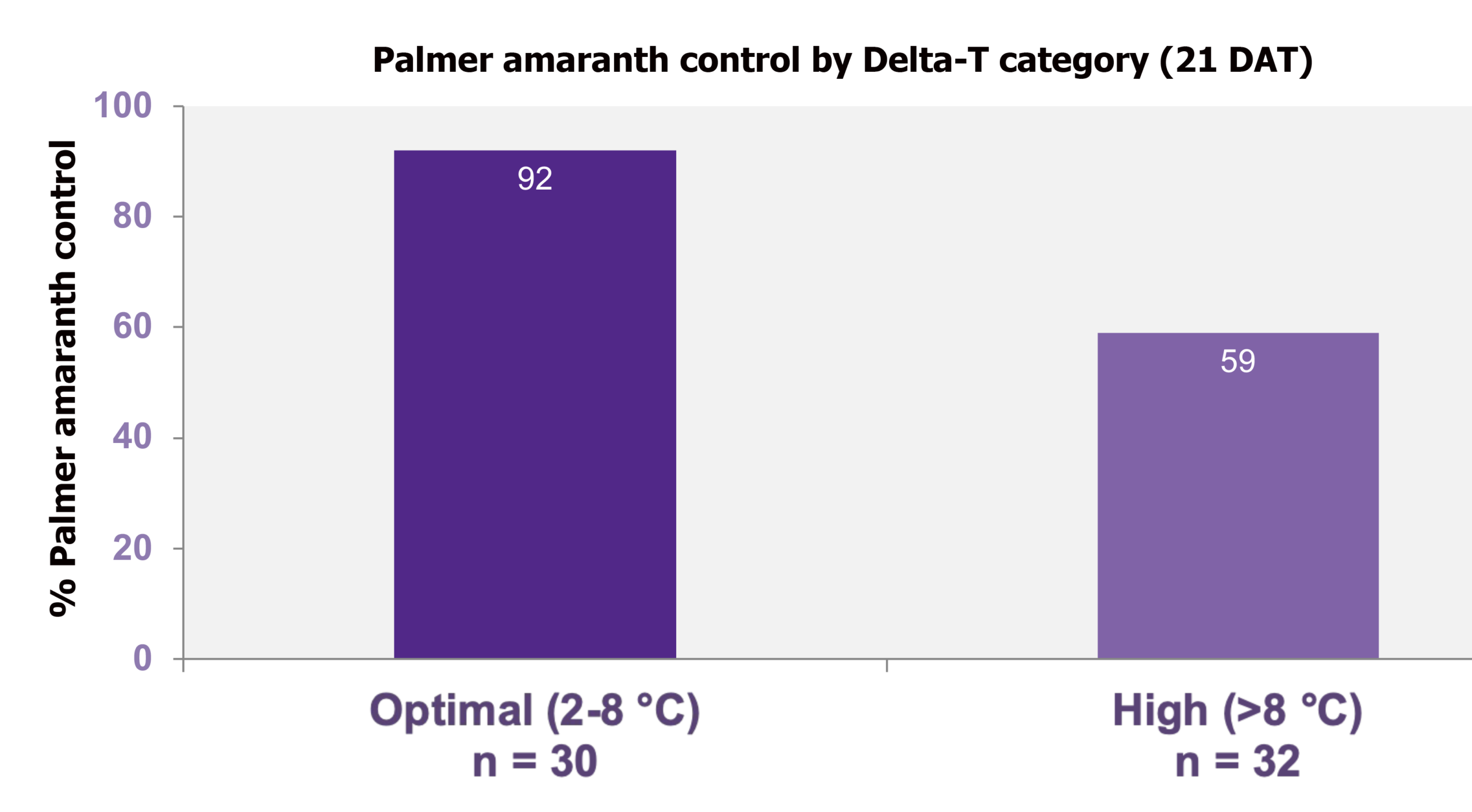
They found the Delta-T measurements are a slightly better indicator of conditions when deciding to spray in hot, dry conditions (Figure 1). And they found that the optimal Delta-T range, between 2–8° C, had better weed control than high Delta-T, above 8° C (Figure 2). At high Delta-T, the water evaporates in the droplets and is not absorbed well. In some cases, spraying at 20 gallons-per-acre (GPA) increased weed control compared to 10 GPA.
“I hoped Delta-T would be a better indicator of conditions that would lead to a successful glufosinate application, especially in Kansas, where we tend to have plenty of heat but often lack the humidity when we’re trying to apply herbicides,” she says. “In order for the herbicide to get into the plant, it has to stay in solution. Delta-T is a good way to predict how long a herbicide is going to stay in solution in the spray droplets for optimum control.”
Additional Resources
Gaining Control of Glyphosate-Resistant Palmer Amaranth in Nebraska – SRIN article
Exploring Genetic Basis of 2,4-D Herbicide Resistance in Palmer Amaranth – SRIN article
Computing Soybean Yield Loss from Palmer Amaranth and Waterhemp Interference – SRIN article
Palmer Amaranth Management in Soybeans – Take Action fact sheet
Herbicide Classification chart – Take Action document
Palmer Amaranth information – GROW webpage
Palmer Amaranth Plagues Farmers with Herbicide Resistance – GROW article
Meet the Researcher: Sarah Ganske SRIN profile | University profile
The Soybean Research & Information Network (SRIN) is funded by the Soy Checkoff and the North Central Soybean Research Program. For more information about soybean research, visit the National Soybean Checkoff Research Database.
Published: Sep 21, 2026


