

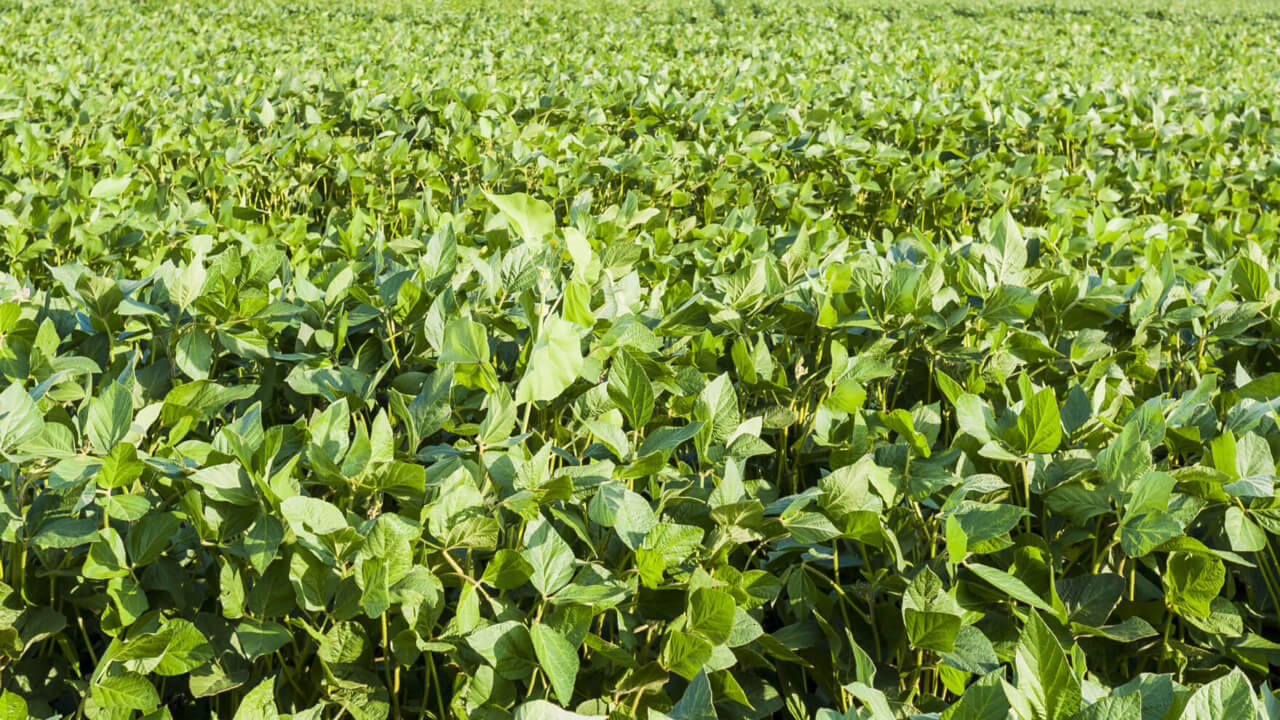
Research HighlightsFinding and Fighting Red Crown Rot
Highlights:
- As red crown rot spreads across Midwest soybean fields, it is often misdiagnosed.
- Thanks in part to trials by university plant pathologists, four seed treatments now include red crown rot on their labels.
- Research continues to identify additional measures to help protect soybeans against this yield-robbing disease.
By Laura Temple
Soybean disease identification can be tricky because many of them cause similar visual symptoms. Identification gets even harder when a disease spreads to new areas. That is just part of what makes red crown rot (RCR) challenging.
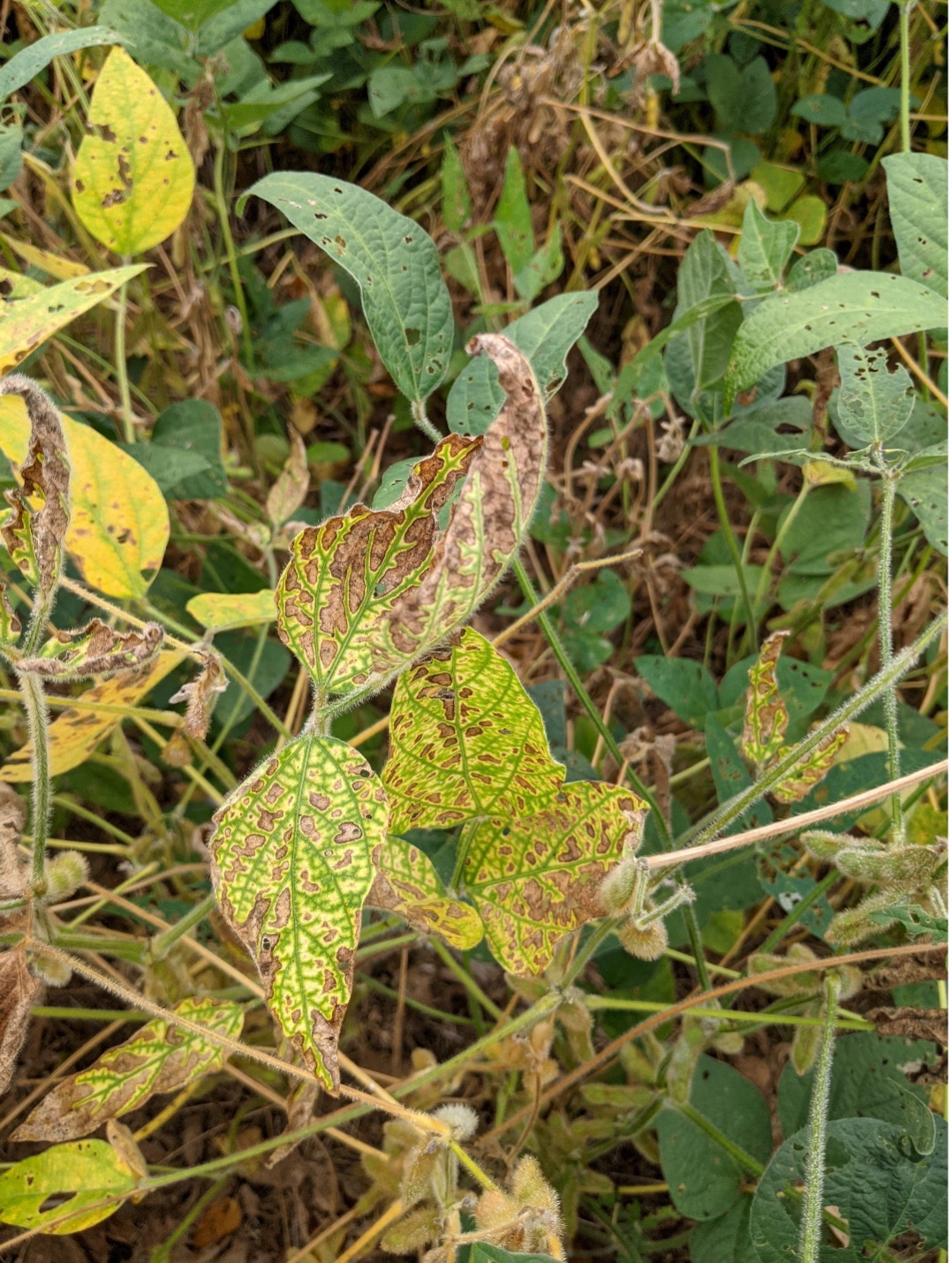
“The most obvious symptom of red crown rot is interveinal chlorosis and necrosis, when the area between leaf veins yellows and dies,” says Carl Bradley, plant pathology professor at the University of Kentucky. “This particular symptom is identical to sudden death syndrome.”
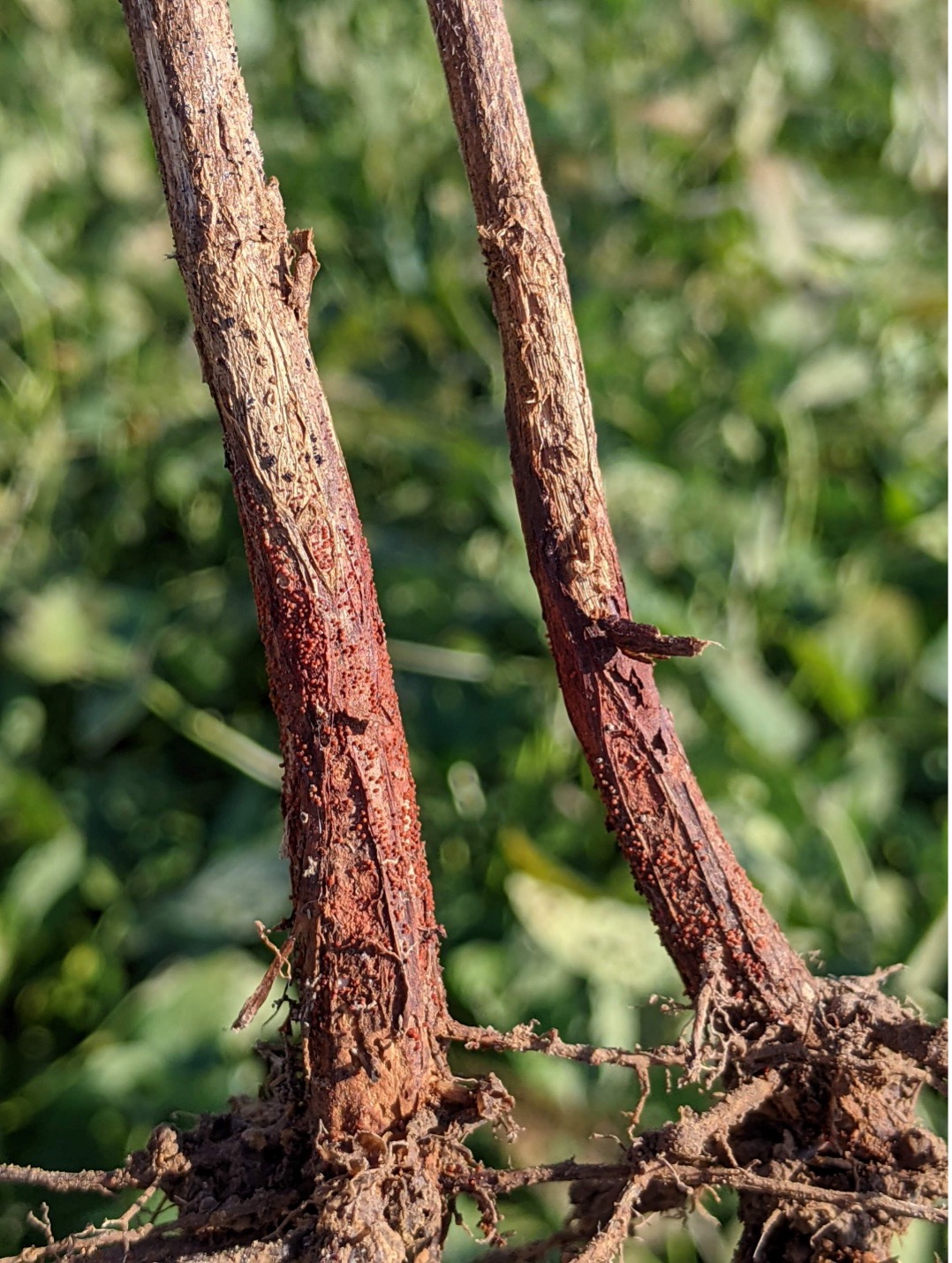
However, RCR is caused by a different soil-borne fungus than SDS, Calonectria ilicicola. The disease is named for the reddish discoloration caused at the base of the stem — or the crown of the roots.
“It can infect soybeans at any time during the season, even as soon as seeds start to germinate,” Bradley explains. “It aggressively rots soybean roots. Infected plants may have very little root system by the end of the season, which is different than SDS.”
RCR causes premature plant death, sometimes before or during soybean pod fill, as seeds are maturing, making it a disease worth fighting. The key to diagnosis is the discolored stem or orangish-red spheres, that are fruiting bodies produced by the fungus called perithecia, but they aren’t always seen.
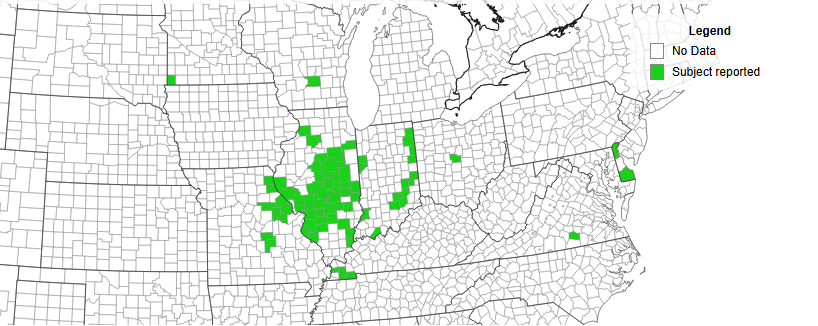
Bradley says RCR has been around for a long time. It flared in southern soybeans a few decades ago, but it didn’t become a long-term challenge. However, it was found in western Illinois in 2017 and identified in western Kentucky in 2021. Since then, Bradley has been studying the disease, monitoring its spread and exploring solutions for soybean farmers, thanks to funding from the Kentucky Soybean Promotion Board, the United Soybean Board, the Foundation for Food and Agriculture Research and industry.
The pathogen persists in the soil for years, so once it is in a field, soybean farmers can assume it will continue to be a challenge.
Assessing Seed Treatments
The search for potential solutions to manage RCR started with looking at fungicide seed treatments, because the pathogen lives in the soil.
“Seed treatments have potential to protect seeds early in the season and to delay infection as soybeans grow,” Bradley says. “When we started evaluating seed treatments, nothing was registered for activity against red crown rot.”
Thanks in part to unbiased trials managed by Bradley and others, two seed treatments have added RCR to their label, and two carry 2ee label recommendations, or state-by-state addendums. These four active ingredients help protect against RCR.
- Cyclobutrifluramin (Victrato), available commercially for the 2026 growing season
- Fluopyram (Ilevo)
- Natamycin (Ceramax)
- Pydiflumetofen (Saltro)
Bradley says three of those options come from the same fungicide class, SDHI fungicides, which inhibit fungi respiration. The other, natamycin, uses a mode of action new to field crops. Fungicides work well, but they are not bullet proof, and pathologists are watching for potential fungicide resistance.
“After seed treatments, we don’t yet have much that helps fight red crown rot,” he reports. “Systemic foliar fungicides applied during the season move through the plant xylem, which goes up and out toward leaves, not down to the roots where red crown rot infects.”
Exploring Additional Measures
Bradley notes that a few years ago, his team looked at the interaction of planting date and RCR infection. The pathogen prefers warmer soils, and some of his initial observations suggested that was more severe in double-crop soybeans. However, three years of trials showed no clear trends between planting date and RCR, meaning that planting early doesn’t guarantee protection. Other factors likely complicate RCR infection, requiring additional research to understand.
Bradley and others have started investigating experimental, unlabeled treatments, like applying other fungicides in-furrow at planting.
“Nothing is currently labelled for in-furrow activity against red crown rot in soybeans,” he says. “However, we are evaluating options that have been used for similar diseases in other crops.”
For example, triazoles from the demethylation inhibitor (DMI) fungicide class that attack fungi cell membranes, have been used in peanuts for black rot, a disease caused by the same pathogen. Bradley reports seeing some efficacy, but further trials will help determine if they are worth the cost.
Researchers are also observing differences in variety susceptibility to RCR.
“Our current focus is on stacking these practices together,” Bradley adds. “How does combining seed treatments, in-furrow treatments and less susceptible varieties impact disease severity levels?”
Starting in 2026, Bradley is looking at how increased seeding rates interact with RCR infection, especially because the pathogen is patchy in the soil.
He also has plans for future research based on suggestions from farmers, that he hopes to conduct as they learn more about RCR. How do practices like tillage or planting depth interact with RCR? How can variety resistance be accurately and efficiently characterized so that genetic material can be screened?
In the meantime, Bradley encourages farmers and agronomists in the Midwest to share any suspicious symptoms in soybean fields with local extension, especially in SDS-resistant varieties. This helps everyone understand how RCR is spreading.
Additional Resources
Red Crown Rot of Soybean – Crop Protection Network information page
Don’t Rule out Red Crown Rot – SRIN article
Red Crown Rot Map – Crop Protection Network page
Red Crown Rot: Understanding its Impact and How to Manage it – Crop Protection Network YouTube video
2026 Soybean Seedling Disease Fungicide Efficacy Guide – Crop Protection Network Guide
Meet the Researcher: Carl Bradley SRIN profile | University profile
The Soybean Research & Information Network (SRIN) is funded by the Soy Checkoff and the North Central Soybean Research Program. For more information about soybean research, visit the National Soybean Checkoff Research Database.
Published: Aug 10, 2026


