

Research HighlightsSoybean Plant Structure Links to Seeding Rate
Highlights:
- Soybean variety genetics influence plant structure and branching.
- Plant density can limit or maximize yield potential, depending on the bushiness of the specific variety.
- Research on the link between plant structure and seeding rate revealed the value of managing soybeans for consistent growth, leading to higher yield.
By Laura Temple
What determines how many soybean seeds to plant per acre?
Farmers consider local and regional planting population density recommendations, planting timing, personal experience and more. Variable-rate planting promotes adjustments depending on soil type and nutrient availability.
Among all the available data, Eros Francisco, assistant professor and extension grain crops agronomics specialist at Auburn University, noticed what he considers a critical missing information source.
“Seed companies’ catalogs don’t present a recommended seeding rates for each variety,” he says. “In Brazil, seed companies, including those who sell in both countries, recommend a seeding rate for each variety based on its plant structure.”
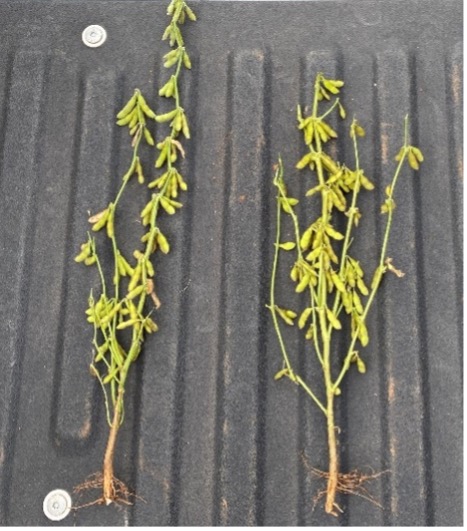
Francisco explains that some soybean varieties grow bushier than others.
“If a high seeding rate prevents a bushy-type soybean from branching and setting pods on those branches, farmers lose yield potential,” he says. “However, less-bushy soybean varieties grow mostly from a single stem, so low seeding rates limit yield potential. I believe farmers need seeding rate information by variety.”
While general recommendations about soybean seeding rate discuss plant branching, they don’t account for genetic differences between varieties. Francisco tested this concept through agronomic soybean trials funded by an Alabama Soybean Producers Soy Checkoff investment.
Comparing Soybean Structure
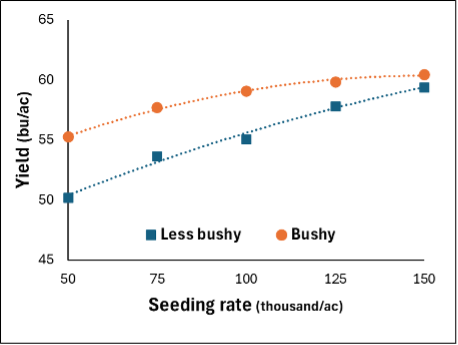
Francisco compared two varieties of similar maturity group, but with different plant structures in three Alabama locations with different soil types. He compared five seeding rates: 50,000, 75,000, 100,000, 125,000 and 150,000 seeds per acre.
“The low rates forced the varieties to compensate with their growth, while the higher rates reflected typical regional seeding rates,” he explains.
His team counted branches and pods for each treatment, in addition to capturing yield. They found that soybean plant structure should factor into seeding rate decisions.
“Bushy soybean varieties offer more flexibility than less bushy varieties,” Francisco reports. “Less bushy soybeans respond better to higher seeding rates for yield. If seeding rate needs to adjust for other factors, choose a bushy soybean variety.”
In his trials, the bushy variety produced similar yield at planting populations between 100,000 and 150,000 plants per acre. However, yield for the less bushy variety started decreasing at planting rates below 150,000 plants per acre.
As the next step in this research, he plans to screen varieties to start building specific seeding rate recommendations based on plant structure.
Consistency Key to Yields
In a separate trial investigating plant variability, Francisco and his team collected 10 adjacent plants randomly from three different spots in commercial fields to count branches and pods. They found huge variation.
“We counted from seven to 93 pods on a single plant, with an average of 53 pods per plant,” he says.
That actually represents lost yield potential.
“Farmers tend to manage yield loss, rather than yield gain,” Francisco explains. “High soybean yields, like those of yield contest winners, are built with a consistent number of pods per plant. It is very possible for commercial fields to have about 75 pods per plant, which would increase yields 25 to 30%.”
He believes putting time and attention into soybean planting is crucial to better yields. For example, consistent seeding depth supports even emergence, which leads to consistency in soybean plants.
Francisco encourages farmers to think about managing soybeans to reduce variation between plants, a mindset more common in corn crop management. Soybean seeding rate is another factor that can promote consistency in plant growth, especially with an understanding of variety growth characteristics.
Additional Resources
Soybean Plant Population Density – Science for Success fact sheet
Science for Success: Determining the Optimal Seeding Rate – YouTube video
Optimizing New Jersey Soybean Planting Populations for Yield and Profit – SRIN article
Agronomy: Rethinking Planting Depth – SRIN article
Meet the Researcher: Eros Francisco SRIN profile | University profile
The Soybean Research & Information Network (SRIN) is funded by the Soy Checkoff and the North Central Soybean Research Program. For more information about soybean research, visit the National Soy Checkoff Research Database.
Published: Jun 8, 2026


