

Research HighlightsApproaching Iron Deficiency Chlorosis Resistance With the Soybean’s Microbiome
Highlights:
- A North Dakota microbiologist is exploring the reduction of soybean Iron Deficiency Chlorosis (IDC) through the plant’s microbiome.
- The microbes in the soybean’s rhizosphere play a key role in IDC resistance through their interaction with microbes in the soil.
- Results could lead to an inoculant product for farmers with high soil pH and high levels of calcium carbonate in their fields.
By Carol Brown
For many North Dakota farmers, dealing with Iron Deficiency Chlorosis, or IDC, has become routine. Many fields in the state have high pH levels, or alkalinity, as well as high calcium carbonate concentrations, which make them prone to the disease.
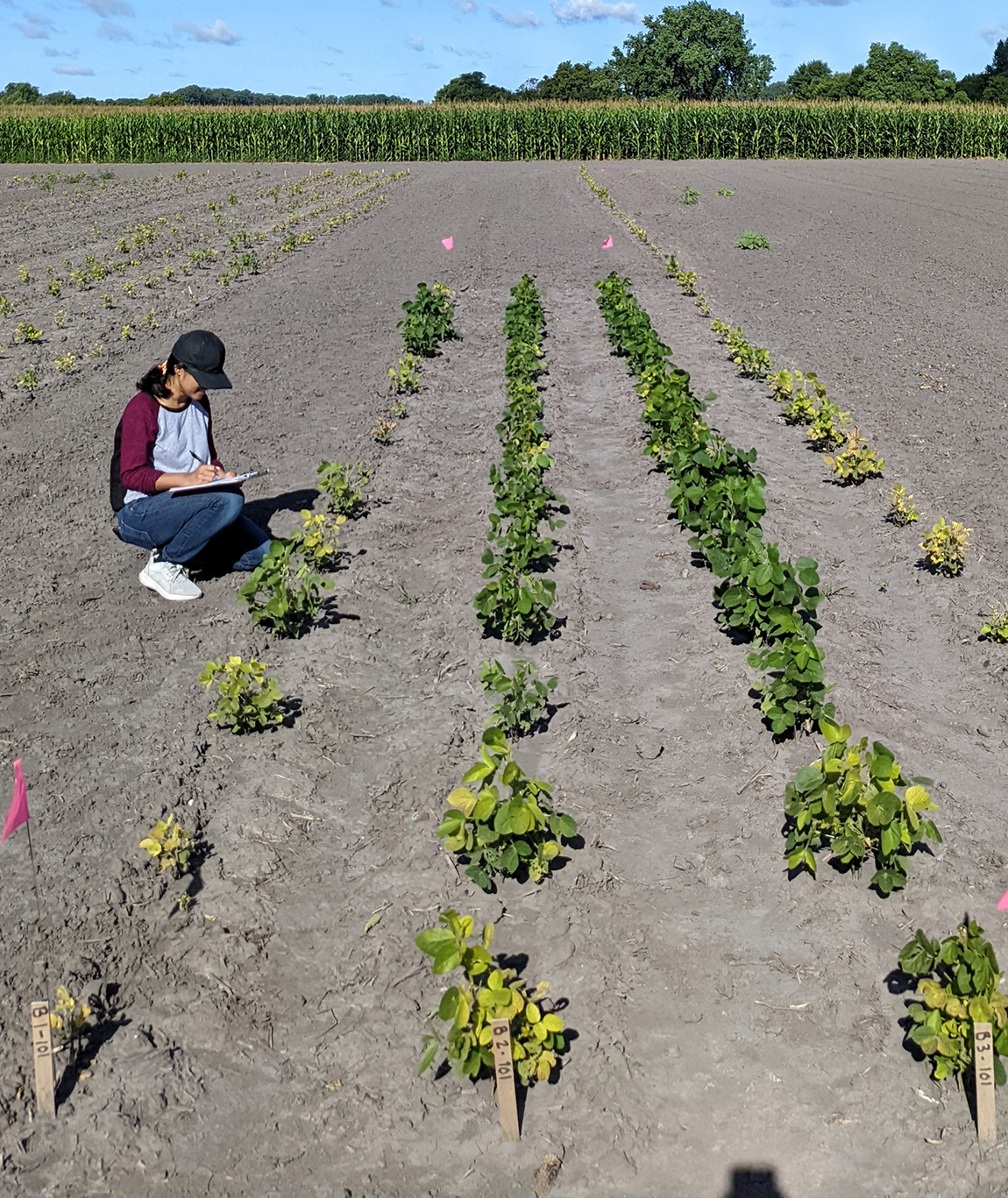
Iron Deficiency Chlorosis is caused by the soybean plant’s inability to uptake iron in the form it needs. Iron is crucial for creating chlorophyll, which makes the plant leaves green, and is necessary for photosynthesis. Without iron, the leaves yellow, which is one of the more common IDC symptoms.
To help farmers improve soybean yield under these field conditions, research is ongoing from improving soybean genetics for IDC tolerance to management practices such as higher seeding rates and applying an iron chelate fertilizer. But a North Dakota State University researcher is approaching this from a different angle: using the soybean microbiome to help with iron uptake.
Through Soy Checkoff support from the North Dakota Soybean Council, microbiologist and assistant professor Barney Geddes is conducting research on the technology of the soybean’s microbiome within the rhizosphere to combat IDC. The work has been led by Urmi Das, a PhD student in Geddes’ group.
“I’m interested in augmenting the genetics and chemical fertilizers with microbial solutions to further enhance the soybean’s resistance to IDC,” Geddes says. “Genetics have a level of effectiveness, but the resistance trait isn’t widely distributed, and the chemical fertilizers are expensive compared to what a microbial application might be.”
Geddes and his team are focused on the microbes in the soybean rhizosphere — the zone around the plant roots that meet the soil — where numerous chemical actions and interchanges take place. The rhizosphere is highly under the influence of the plant, Geddes says, and as a result, the rhizosphere composition looks very different from the rest of the soil in the field.
“The plants are able to direct the assembly of microbial communities adjacent to their roots to help them grow and be healthy. They do this by releasing some of the carbon they fix through photosynthesis,” he explains. “The plants are trying to build up a beneficial community for themselves, but that community must be built out of what’s available in the soil.”
Research Progression
Work in the Geddes lab first aimed to understand how IDC affects the way the plant assembles its rhizosphere microbiome by assessing the composition of the microbial communities in the rhizosphere with and without IDC conditions.
“Based on the growing trends in the literature, we thought we’d find a selective recruitment of beneficial microbes to protect the plant from IDC,” Geddes comments. “But we actually found the opposite. IDC was causing dysbiosis, or the plant’s inability to build its rhizosphere in the way it typically would.”
Geddes and his team began to explore adding microbes back to the plant to rebuild the microbiome and they found some could almost completely recover from IDC. Evaluating these microbes, they attempted to find whether there was one that was chiefly responsible for recovery, which could make it easier to translate to a product farmers could use.
“We found that it is a community-based effort. There needs to be multiple microbes interacting with one another to allow the soybean to tolerate the stress,” he says. “We are now exploring these microbial communities to see if our lab results are translatable to the field.”
They prepared inoculants with these microbial communities and applied them in several fields with IDC. The team saw the treatments reduced IDC in some fields, which encouraged Geddes of the potential for this technology.
Geddes acknowledges NDSU colleagues soybean breeder Carrie Dottey and plant pathologist Richard (Wade) Webster, who are working in collaboration with Geddes’ team. In the fields that had reduced IDC through the microbial inoculants, Webster found less disease and better plant vigor as well.
“Thanks to the support from the North Dakota Soybean Council over the last few years, we’ve learned a lot,” Geddes comments. “And we’re still learning how these mechanisms work. Our next step is translating that to a product that farmers can use on their fields for reduced IDC.”
Additional Resources
Variety Trials for Iron Deficiency Chlorosis in North Dakota Help Farmers Choose Seed Wisely – SRIN article
Finding the Best Management Strategy Combination in the Iron Deficiency Chlorosis Battle – SRIN article
Combating Iron Deficiency Chlorosis – SRIN article
Iron Deficiency Chlorosis – SRIN information page
Meet the researcher: Barney Geddes SRIN profile | University profile
The Soybean Research & Information Network (SRIN) is funded by the Soy Checkoff and the North Central Soybean Research Program. For more information about soybean research, visit the National Soybean Checkoff Research Database.
Published: Jul 20, 2026


