


Research HighlightsTargeted-Spray Technology Tradeoffs and Patterns
Highlights:
- Determining the value of equipping sprayers with precision weed control technology looks different, depending on cropping systems, weed spectrum and more.
- Research evaluated tradeoffs between input cost savings and weed escapes using targeted-spray technology.
- Understanding patterns in weed distribution and actual spray applications helps determine the value of precision weed control for an operation.

By Laura Temple
Targeted-spray weed control technology introduces new questions for farmers and herbicide applicators.
- How well does this technology fit within my fields?
- Do input savings offset the technology cost?
- What is my tolerance for weed escapes?
Systems that vary from the soybean–corn rotation in large Midwestern fields likely have different answers to these and other questions the technology raises. With funding from the Pennsylvania Soybean Board, John Wallace, associate professor and weed scientist at Penn State University, seeks to provide data that leads to answers.
“In our production systems, two-thirds of our fields are no-till, so fields contain lots of crop residue,” he explains. “We have diverse weed species, rather than one or two dominant weed problems like many fields in the Midwest. And our fields are very small, often 14 to 15 acres, with lots of topography.”
He took advantage of demonstrations of targeted-spray technology in western Pennsylvania, first to understand the questions it raises in less-common conditions, and then to find patterns to help farmers answer those questions.
In 2024, Wallace and his team observed and evaluated weed control following demonstrations.
Then in 2025, they conducted strip trials in commercial soybean fields near State College in central Pennsylvania. The strips compared broadcast and targeted applications of post-emergence herbicides. He plans to replicate this work in 2026 with more participating farmers.
At the same time, his team evaluated spray data from about 75 Pennsylvania fields shared by early adopters of targeted-spray technology, looking for patterns to provide additional insight.
Overall, Wallace found that understanding the tradeoffs created by this technology and weed patterns in their fields can help farmers answer their questions and determine if it makes sense for their operations.
Input Savings Vs. Weed Escapes
When looking at the economics of precision weed control technology, Wallace says the return on investment depends on a number of factors, including the strength of pre-emergence herbicide programs, timing of the target post-emergence application and targeted-spray application settings that determine the risk of weed escapes.
“In our trials, we used the lowest sensitivity rating for the targeted-spray technology system,” Wallace says. “That meant the producer was accepting some risk of weed escapes to maximize the reduction in herbicide inputs.”
Strip trial fields contained a mix of weed species, including grasses like foxtail and crabgrass plus broadleaves like velvetleaf, redroot pigweed and dandelions. For trial treatments, a tank mix of 2,4-D (Enlist), glufosinate (Liberty) and clethodim was applied about six weeks after planting soybeans. That is when weeds started breaking through the pre-emergence application of metribuzin and chlorimuron (similar to Canopy). At that point, weeds were less than 4 inches tall and soybeans were at the V4 or V5 growth stage.
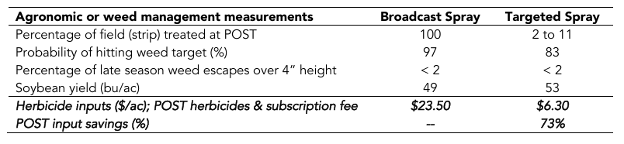
“The targeted technology only sprayed about 10% of the area in those strips,” he says. “However, those fields had a good pre-emergence program for the weed spectrum, and weather conditions activated the herbicide.”
His team then compared weed control at specific points in both strips in both broadcast and targeted-spray strips 5 days after the post-emergence application, when weeds would show herbicide response.
“We evaluated what we call the ‘hit rate,’ or the percentage of weeds that got dosed with herbicides,” Wallace says. “It was 97% in the broadcast strips compared to 83% in the targeted strips.”
Prior to harvest, they looked for weed escapes at the same points that were evaluated after the post-emergence application.
“We found more escapes in the targeted strips, but very few escapes grew through the canopy,” he reports. “Weeds were just 2 to 4 inches, so they were not very competitive, but they were still producing some seed.”
In the first year of strip trials, targeted-spray technology generated significant savings, but with more small weed escapes. Data from additional Pennsylvania fields showed less savings than the strip trials, but targeted-spray systems were typically set at a medium sensitivity, and that data wasn’t correlated with the strength of pre-emergence programs. Plus, participants said it was hard to spray on time in 2025 given their weather conditions.
Farmers and applicators can decide if or how the tradeoff between input savings and weed escapes works for their fields. With weed species easily controlled by a variety of herbicides, escapes may not be an issue. However, when hard-to-control or herbicide-resistant weeds are present, tolerance for escapes may decrease, requiring more product and cutting into potential savings.
In-Field Weed Distribution and Spray Patterns
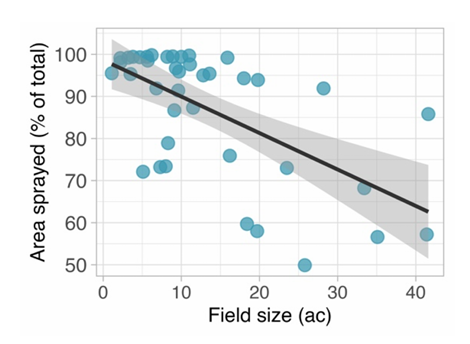
While evaluating data, Wallace noted a correlation between area sprayed with targeted-spray technology and field size: The smaller the field, the higher the total area sprayed.
“More weeds grow on field edges, which have a larger seedbank, with pressure easing over distance toward the center, regardless of field size,” he explains.

For smaller fields, like those common in Pennsylvania and many other regions of the U.S., edges comprise a higher percentage of the field. Depending on field size and shape, precision weed control technology may not significantly reduce the area sprayed.
Wallace is also evaluating patterns in weed escape data alongside precision ag data. He is pulling 6 years of historical crop yield data, which includes 3 years of soybean crops. He is also gathering spray performance data for pre-plant burndown and pre-emergence herbicide applications from fields that are implementing targeted-spray technology.
“With historical yield data, it is possible to identify areas of the field that always yield above or below the field average,” he says. “If we overlay historical yield data with targeted spray data, I expect areas with less input savings from the targeted application due to greater early season weed pressure to correlate with low yield stability zones.”
He plans to dig more deeply into this data.
“We are also interested to look for relationships between areas with less input savings from the targeted spray and areas that received a lower-than-calibrated rate when applying pre-emergence herbicides,” Wallace continues.
Topography, applicator experience, application speed and many other factors can contribute to the as-applied rate of herbicide actually being higher or lower than the intended application rate. Precision ag data allows us to identify exactly where that happens in fields.
He thinks that combining data generated by precision technologies with weed distribution and targeted spray application data will identify ways to gain efficiencies in the system and better target vulnerable areas of the field, similar to precision fertility.
“We are excited to find additional value from new tools like targeted-spray technology,” Wallace adds. “We still have lots to learn, but we are discovering how it looks different in different regions.”
Clear information about the tradeoffs and patterns will help farmers decide if and how to use it.
Additional Resources
Smart Spray Technology for Weed Management Gets a Closer Look – SRIN article
Combining Human and Artificial Intelligence for Input Decisions – SRIN article
What is Precision Weed Management? – GROW article
Three Things to Know About Spot Spray Technology Today – GROW article
Industry Speaks: Precision Spray Tech Development is Outpacing Farmer Adoption – GROW article
Meet the Researcher: John Wallace SRIN profile | University profile
The Soybean Research & Information Network (SRIN) is funded by the Soy Checkoff and the North Central Soybean Research Program. For more information about soybean research, visit the National Soybean Checkoff Research Database.
Published: Jul 13, 2026


