

Research HighlightsSoybeans + Cover Crops + Cattle = Increased Revenue
Highlights:
- Integrating crop and livestock systems by grazing beef cattle on cover crops between soybeans and other cash crops can significantly boost per-acre revenue.
- While cattle do compact soil, incorporating a form of tillage can alleviate this issue and maintain soybean yield.
- Establishing cover crops before grazing, allowing recovery between grazing and other best practices can optimize both soybean and beef production.
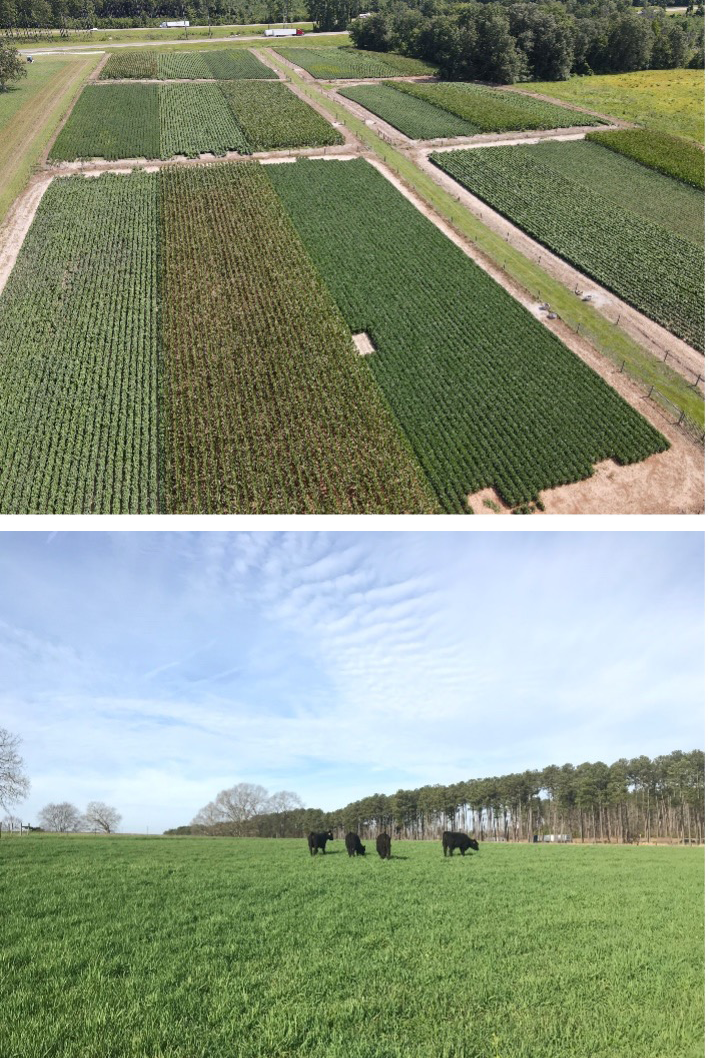
Photos: Brett Rushing
By Laura Temple
Steak and beans is a classic hearty “cowboy” meal. Ongoing Mississippi State University research shows that combining beef and soybean production by grazing cover crops can lead to hearty per-acre revenue.
“Right now, beef prices are the highlight of the ag sector,” says Brett Rushing, an extension and research professor specializing in forages, grazing management and related topics at the Coastal Plain Experiment State for Mississippi State University. “Farmers face decreased commodity prices, but beef prices are the strongest in recent history.”
That dynamic has increased the focus on livestock production.
“Overwintering feed is a big part of beef production costs,” Rushing explains. “That has renewed interest in custom or contract cover crop grazing to reduce that expense. However, putting cattle on cover crops raises questions about the soil health of grazing, like their impact on compaction, nutrient cycling and phosphorus levels.”
To address these questions, the Mississippi Soybean Promotion Board is investing in ongoing research led by Rushing and graduate student Adaline Rouse. These funds, combined with support from Mississippi Cotton Incorporated and the Mississippi Corn Promotion Board, allow them to take a wholistic look at integrating beef production with common agronomic systems across the region.
The trials combine soybean, corn and cotton crops with cereal rye as a cover crop to compare grazing cattle with no grazing. The cover crop is no-till drilled into crop residue in late September or October after harvest, grazed from mid-November to mid- to late-March, and then terminated prior to crop planting. Soybeans get planted in mid-April, corn in early April and cotton in early May.
“Grazing beef cattle on a cereal rye cover crop can roughly double revenue per acre, based on what we have been learning,” he reports. “This research is helping refine systems and identify best practices to optimize crop production, beef production and soil health.”
They plan to complete a full economic analysis after gathering three years of data in a variety of integrated crop production and beef systems. However, the research to date points to best practices that help farmers get the most out of every element in the system.
Combatting Soil Compaction
Rushing confirms that cattle grazing increases soil compaction, especially in high-traffic areas like around water troughs and feed bunks. To address this concern, his team compared tillage systems after terminating the cover crop and before planting soybeans or the other cash crops.
In no-till plots, they plant soybeans and other crops directly into terminated cover crop residue. Strip-till cuts an 8-inch strip in residue for planting, while conventional tillage creates a smooth planting bed with two passes: disking and field cultivating.
“Across all our trials, no-till soybeans following both grazed and ungrazed cover crops produce the lowest yields,” he reports. “Grazed plots fell just below the state yield average, while ungrazed plots were even lower, likely due to poor stand establishment.”
He notes that all trials seed cover crops at a grazing rate of 80 pounds of seed per acre, which creates an abundance of biomass when not grazed. Soybean stand populations were higher in grazed no-till plots.
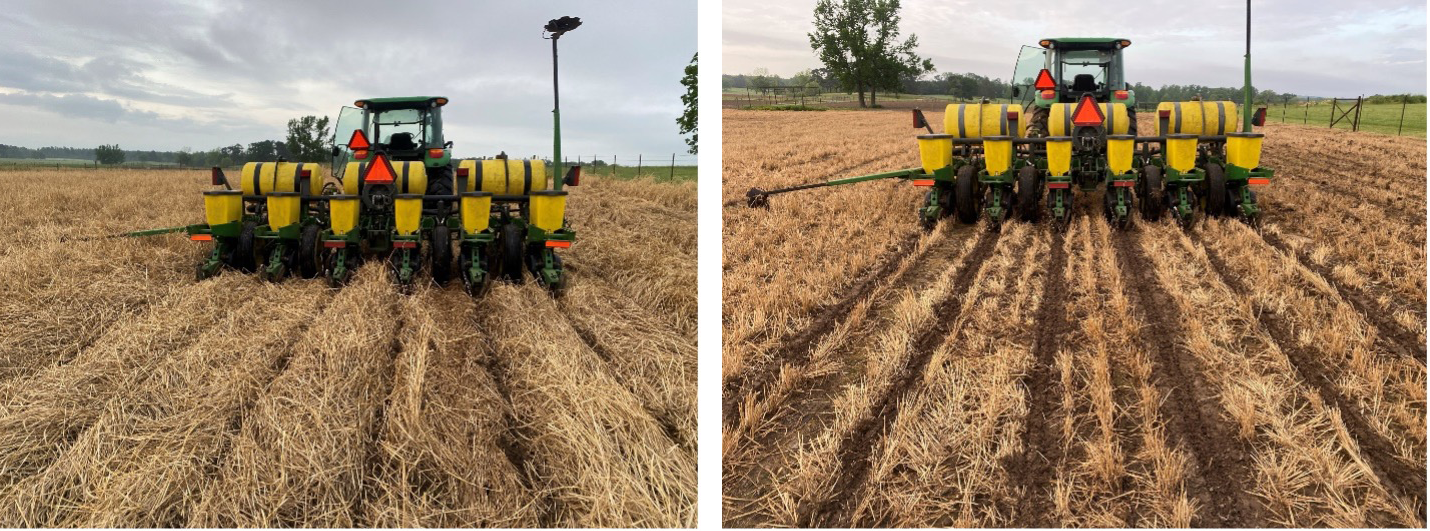
“We saw no difference in soybean yields between either tillage system, whether cover crops were grazed or not,” Rushing says.
His team uses regular soil tests to monitor other soil health factors, as well. In the fine sandy loam soil of east-central Mississippi, organic matter measures 2% or less.
“All of our systems with crops and cover crops maintain organic matter in this soil type, regardless of grazing and the nutrients cattle add,” he explains. “Given our climate and soil types, residue decomposes in a year.”
He notes that tillage increases how quickly soil microbes digest organic matter and make nutrients available to crops, but using conservation, or strip, tillage to address compaction does not decrease organic matter over time compared to conventional tillage.
To further investigate how soil type responds to these integrated systems, Rushing has included multiple locations within his research program. A site in Prairie, located in northeastern Mississippi, had heavy clay soil, where the combination of cattle and soybean production resulted in the lowest soybean yields and subsequent revenue within the study. A new site in Learned, in west-central Mississippi, has silt loam. He expects integrated systems to be more productive on course-texture soil.
Optimizing Production per Acre
To evaluate the value of integrated systems, Rushing is taking a wholistic look at both crop and animal gains and management per acre.
Trials compare different crop rotations, with cereal rye planted every fall, regardless of the previous and following crops.
- No rotation: Plots contain continuous soybeans, continuous corn or continuous cotton.
- Two-crop rotation: Plots alternate between soybeans and corn.
- Three-crop rotation: Plots use a corn-cotton-soybean rotation.
Though the three-crop rotation plots have yet to complete the full cycle for comparison, preliminary data show little statistical difference between systems. That’s promising for adding cattle to any existing crop system.
Establishing the cereal rye before initial grazing in mid-November allows for more grazing days, which means more weight gain and greater revenue. The target stocking density is about 5,000 pounds of live animal weight per acre, regardless of type of cattle, such as beef replacement heifers or steers.
“Our trials mimic a custom grazing scenario,” Rushing says. “We add cattle when cereal rye is 8 to 10 inches tall, and they graze continuously for about 5 to 7 days, until the cover crop is about 4 inches tall, before they are rotated to another paddock.”
This allows cereal rye to recover, so that each acre provides a total of about 60 days of grazing during the roughly 4 months of over wintering.
“While soybean yields remain steady, all beef cattle averaged 2.2 pounds of daily gain while grazing cereal rye,” he reports. “That represents several hundred dollars of added weight gain, roughly doubling revenue on a per-acres basis.”
While revenue doesn’t account for animal input costs, such as fencing, minerals or herd health protocols, Rushing expects the full economic analysis to be available in the fall of 2027. He believes information about integrated systems for a variety of crop rotations and tillage systems will help farmers figure out how they can incorporate grazing their own cattle or offer contract grazing to get more value from each acre within their current systems without impacting soybean and other cash crop production.
Additional Resources
Cover Crops, Grazing and Soybeans Can Be a Complicated but Workable System – SRIN article
Cover Crops Demonstrate Potential to Double as Forage – SRIN article
Soil health responses to cover cropping systems in Mississippi soybean production – Crop, Forage & Turfgrass Management paper
Soybean production and net revenue variability in an integrated crop-livestock system – Crop, Forage & Turfgrass Management paper
Grazing cover crops in continuous corn production in east-central Mississippi – Agronomy Journal paper
The effects of grazing cover crops on animal performance and soybean production – Crop, Forage & Turfgrass Management paper
Meet the Researcher: Brett Rushing University profile
The Soybean Research & Information Network (SRIN) is funded by the Soy Checkoff and the North Central Soybean Research Program. For more information about soybean research, visit the National Soybean Checkoff Research Database.
Published: Jul 20, 2026


