

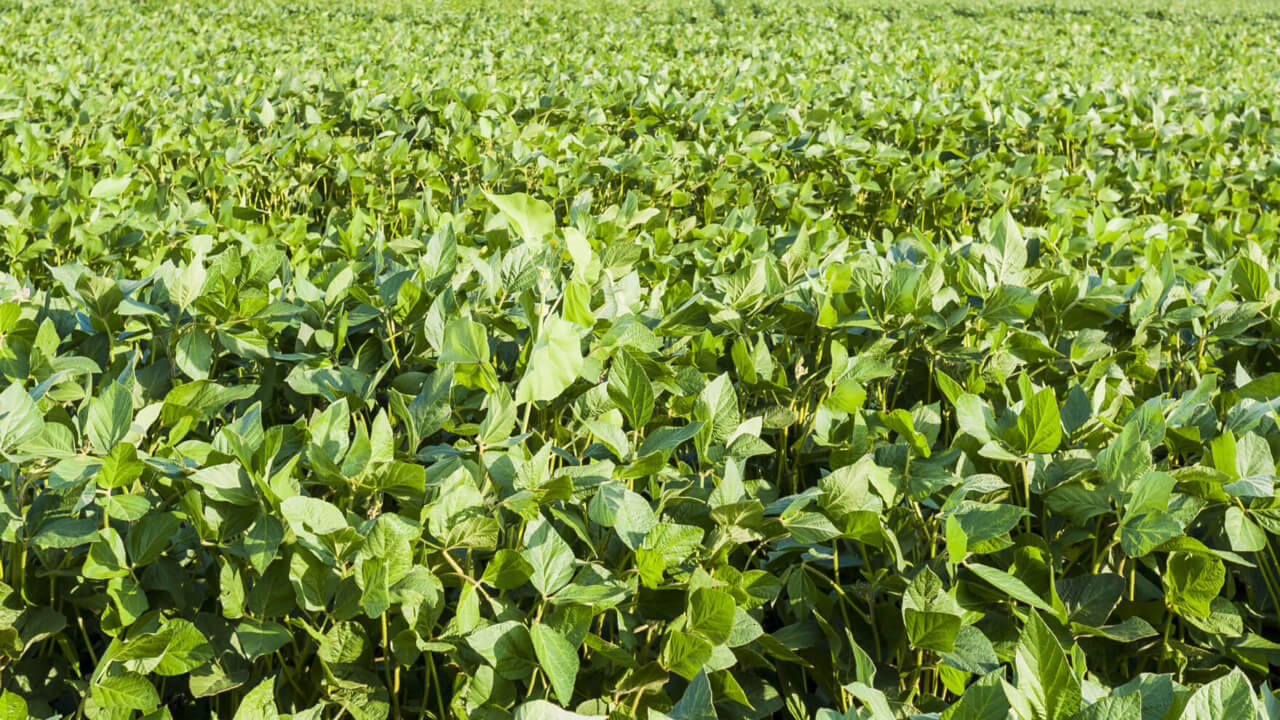
Research HighlightsSoybean Recovery from Deer Grazing
Highlights:
- Deer pressure is a major problem for soybean production in many regions, including Georgia.
- Research simulated deer feeding to track how soybeans respond based on planting date, maturity group and damage frequency.
- Early soybean plantings and indeterminate varieties appear to recover from deer damage more quickly, but the stress still leads to more green stem at harvest.
By Laura Temple
When different farmers bring up the same topic, agronomic researchers pay attention.
“I was taught that if I hear about a topic five or six times, it’s probably a good idea to research it,” says Nick Shay, assistant professor and extension grains agronomist at the University of Georgia. “When I started this role in 2024, deer pressure consistently came up in conversations with farmers.”
Based on these conversations, Shay wanted to better understand deer grazing in soybeans. With support from the Georgia Soybean Commodity Commission, he started research in 2025 to gather data that will help inform crop insurance claims and mitigation strategies.
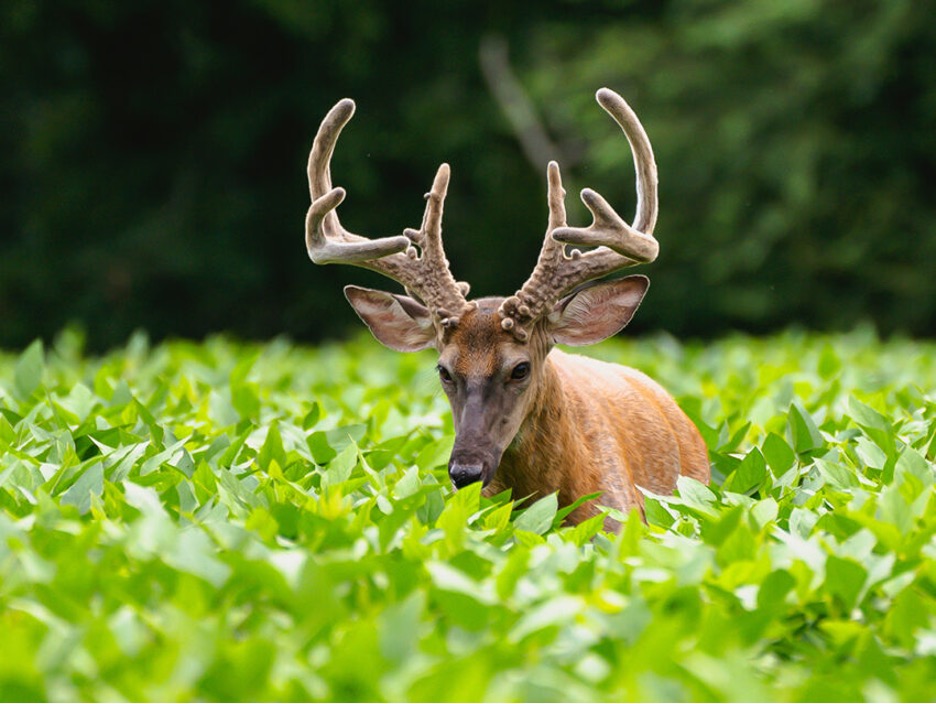
“Deer will graze in the same field several times,” he says. “Some areas have very high deer populations, with herds of as many as 100 deer in a field.”
Given the wide variability in deer pressure and the countless factors that influence how they graze soybeans, Shay decided to simulate deer damage in controlled situations to create a baseline for ongoing study. His first focus is how soybean planting dates and maturity groups interact with different deer feeding frequencies.
Simulated Deer Feeding
Georgia has four distinct soybean production systems with a wide range of planting dates, and deer tend to prefer new soybean leaf growth. Georgia farmers plant early season soybeans in March or early April and ultra-late soybeans in late July or early August. However, the majority of Georgia soybean acres are either full-season soybeans planted in April or May, or double-crop soybeans planted in June.
Shay opted to compare two common planting dates, using indeterminate and determinate varieties from different maturity groups at each planting date.
- In May, he planted an indeterminate MG 4 and a determinate MG 5 variety.
- In June, he used the MG 4 and a determinate MG 6 variety.
Each of the four plantings experienced simulated grazing at different frequencies, along with a control with no inflicted damage.
“We simulated grazing by clipping soybeans with hedge trimmers,” he explains. “The first mock feeding was done 19 or 20 days after planting, and we clipped the first trifoliate just above the cotyledon, causing 100% defoliation but allowing for regrowth.”
Subsequent feedings were mimicked once a week. Plots were “grazed” one, two, three or four times. For the first and second feedings, clipping simulated 100% grazing. For the plots receiving three or four feedings, Shay and his team clipped just new trifoliate growth, which deer prefer when vegetation is abundant.
“We tried to be as accurate as possible in simulating herbivore grazing behavior when we clipped soybeans,” Shay says. “We realize that deer grazing habits don’t necessarily follow a once-a-week schedule, but that provided a controlled way to create a response baseline.”
Initial Observations
To understand the impact of the mock feedings, Shay’s team counted nodes and pods, monitored disease pressure and seed quality, and gathered yield data. He emphasizes the need for at least one more year of data, and he believes the initial work will direct future research.
“Soybeans are amazing at recovering from stress,” he reports. “Based on what we observed, earlier-planted soybeans recover better than those planted later. And, indeterminate soybean varieties recover faster than determinate soybeans.”
However, he points out that Georgia soybeans often get planted earlier than other crops, like cotton and peanuts. Those fields often see more deer pressure.
“Soybeans appear to be more sensitive in their early growth stages,” he adds. “Once plants have abundant foliage, they seem to tolerate some grazing.”
Later planted soybeans emerge while other crops are growing, which spreads deer feeding across more fields. However, near the state’s pine forests, soybeans can be the primary source of feed for deer regardless of time of year.
“We were surprised by the response of MG 4 soybeans to grazing, even when planted in June,” Shay says. “Soybeans have ancillary fruiting structures, and we saw an increase in nodes for some ‘grazed’ plots. That didn’t always translate to yield, but it helped us learn how soybeans respond to this type of defoliation.”
His team also observed that some grazing reduced plant height compared to the control, but not necessarily yield. However, regardless of MG and grazing frequency, plots suffered from more green stem at harvest compared to the control.
“We are learning a lot from the first year of this trial,” he says. “As we gather more data that direct future research, my hope is that we will develop early season mitigation strategies to help protect soybeans from deer.”
Additional Resources
Determining Economic Thresholds for Deer Damage – SRIN article
Fitting Forage Soybeans into Deer Management Strategies – SRIN article
Meet the Researcher: Nicholas Shay SRIN profile | University profile
The Soybean Research & Information Network (SRIN) is funded by the Soy Checkoff and the North Central Soybean Research Program. For more information about soybean research, visit the National Soybean Checkoff Research Database.
Published: Jul 6, 2026


