

Research HighlightsAssessing the Value of Foliar Fungicides
Highlights:
- On-farm, large-plot research shows that applying foliar fungicides to soybeans at the R3 reproductive growth stage pays most often when diseases are present.
- Across all years and locations, automatic fungicide applications at R3 delivered profitability less than half the time.
- Scouting and applying fungicide when disease is present increases the likelihood of a positive return on investment, while reducing overuse that could lead to fungicide resistance.
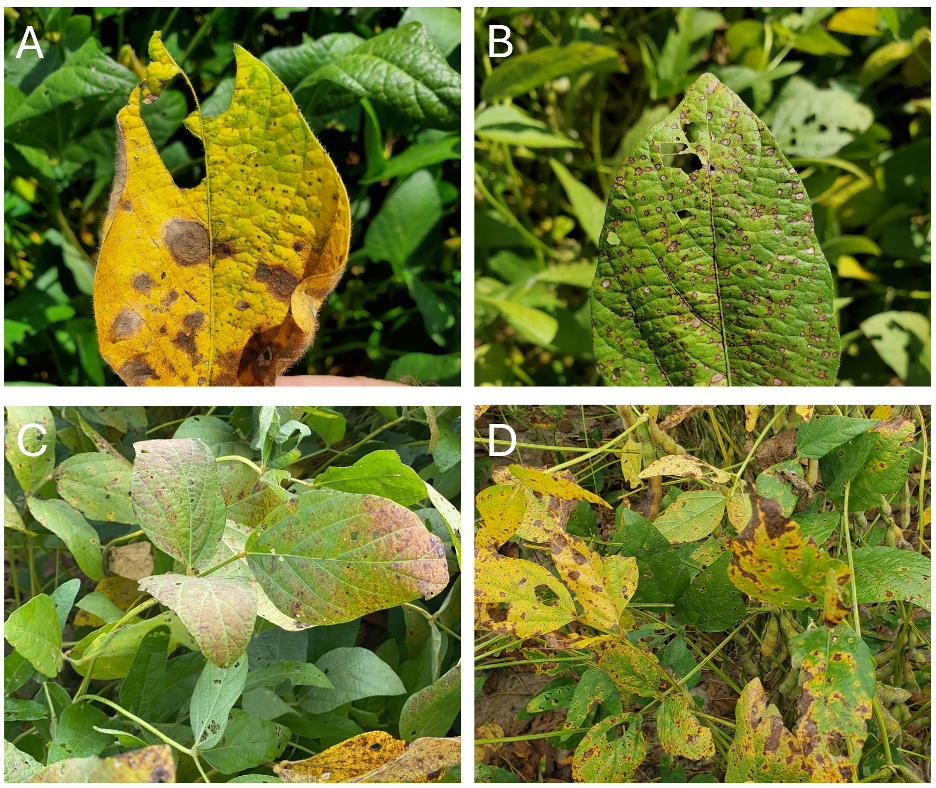
A. Target leaf spot, Corynespora cassiicola
B. Frogeye leaf spot, Cercospora sojina
C. Cercospora leaf blight, Cercospora spp.
D. Brown spot, Septoria glycines
Source: Terry Spurlock
By Laura Temple
When evaluating soybean crops from the combine cab, farmers usually focus on yield monitor colors and numbers.
When evaluating profitability as they sell those soybeans, farmers need to consider every input and ask, “Was it worth it?”
Terry Spurlock, professor of plant pathology at the University of Arkansas Division of Agriculture, has been asking about the value of foliar fungicide applications since 2020 to understand their economic return. With investments from the Arkansas Soybean Promotion Board, he has conducted on-farm, large-plot trials throughout the state.
“Many producers apply fungicide to soybeans at the R3 growth stage,” he says. “Our trials indicate that unless disease pressure is present, that application doesn’t pay. Plus, it isn’t a sound integrated pest management strategy.”
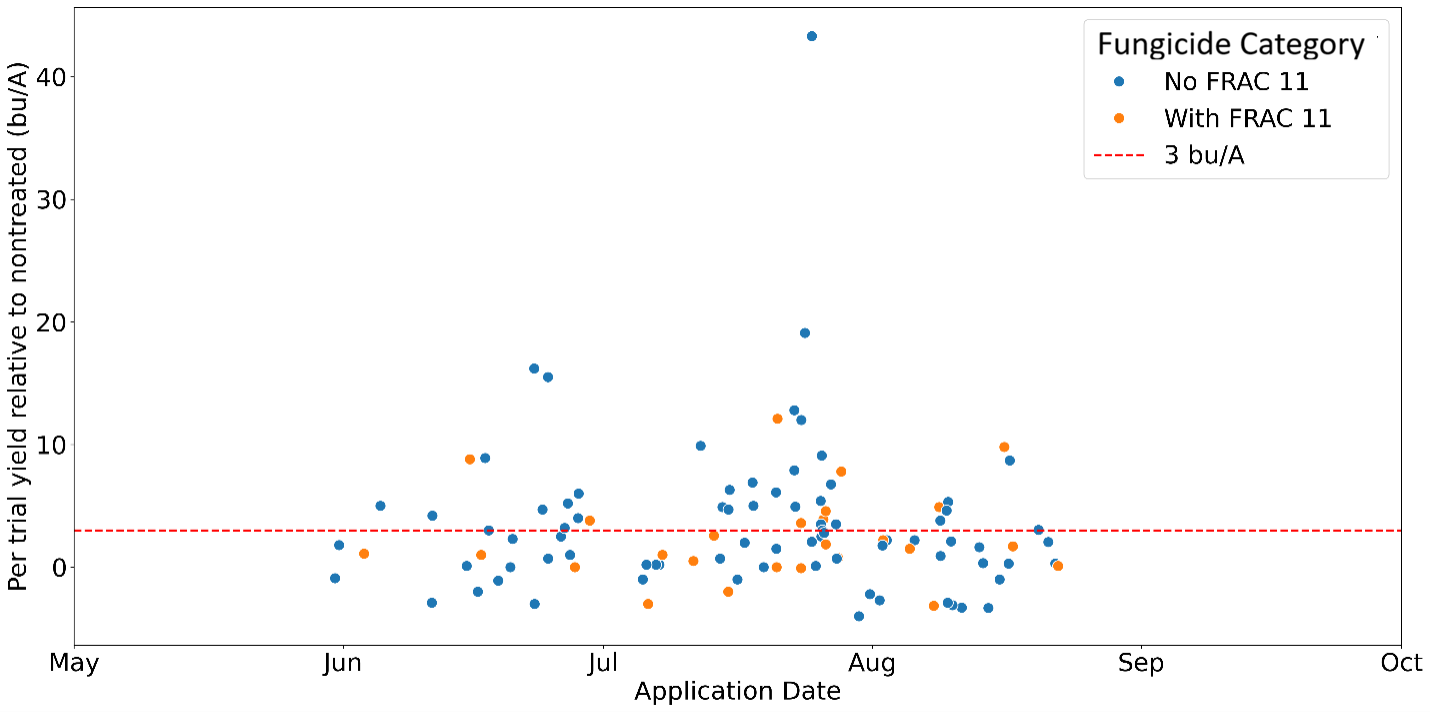
His trials show that the yield advantage from foliar fungicides averages about 3.3 bushels per acre across all years, locations and products. During his countless extension presentations and conversations with crop consultants and farmers, they agree the fungicide application cost is about $30 per acre, which translates to about 3 bushels, depending on local prices.
“With automatic fungicide applications, they are essentially running in place, per trial averages,” Spurlock says. “Applications in trials without disease, where there was no difference between treated and untreated yields, actually result in a loss, given the cost of product and application. In practice, folks also increase the likelihood for diseases to develop resistance to fungicides through overuse.”
Key diseases in his region include frogeye leaf spot, Cercospora leaf blight and target spot. This research revealed that septoria brown spot, observed in many fields, is sometimes a yield-limiting disease. Aerial blight is sporadic in soybeans, but the same pathogen causes sheath blight in rice, another major Arkansas row crop.
This research encourages farmers, crop consultants, county extension agents, industry and others to work together to understand the actual value of soybean fungicides by placing trials on farms for all to see.
Trial Design: Large Replicated Plots
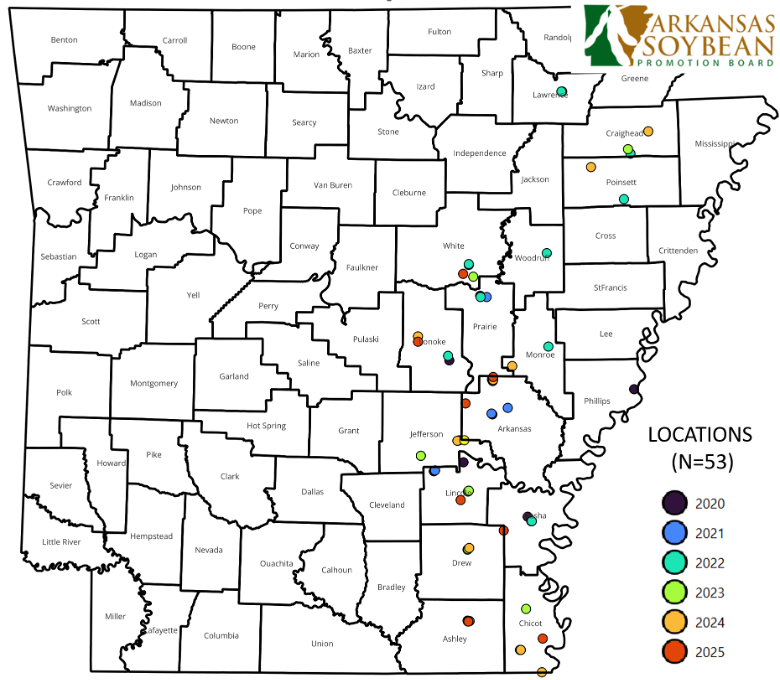
Each year, Spurlock and his team aim to have 10 to 12 trials in different parts of Arkansas. Trials compare fungicide treatments in plots of roughly 3.5 acres.
Source: Terry Spurlock
Farmers select varieties and manage the fields as normal. At R3, plots receive one of two or three common commercial fungicide treatments, usually including products with multiple modes of action. Nontreated plots show any disease development or lack of pressure.
Trials include two or three fungicide treatments and the untreated control, each replicated three times for nine or 12 total plots. Thus, each trial covers 20 to 30 acres. Some cooperating farmers host trials for more than one year, but new farmers participate each year.
Spurlock’s team scouts and rates disease pressure for each trial location just before treatment. They return to take disease ratings again between R5.5 and R6.
“We are very cognizant of hitting growth stages,” he says. “We work with great county extension agents who monitor local trials closely and help us get to each location on time.”
Trial Insight: Resistance a Real Threat
During the first few years of these trials, Spurlock says every location included fungicides with multiple modes of action that included a strobilurin from the quinone outside inhibitor (QoI) fungicide group. Trials compared these with fungicides that included triazoles from the demethylation inhibitors (DMI) and succinate dehydrogenase inhibitors (SDHI) fungicide classes, but not a QoI.
“In those trials, we saw a bushel yield increase in treatments without strobilurins, but farmers still weren’t always making money with those fungicides,” Spurlock reports.
These trials likely demonstrated common diseases developing resistance to the QoI fungicide group.
“One year, we saw fungicide failure in plots that had severe target spot,” he explains. “The product that included a strobilurin mode of action looked and yielded similar to the nontreated plots. We confirmed the target spot in that field was resistant, and it gave us a great example why we should try to protect existing fungicide technology and choose effective products.”
Trial Results: Profitability Depends on Disease Pressure
Spurlock says the robust data collected from these trials complement the small-plot trials that form the backbone of unbiased university research. Overall, these results align with small-plot research trials, strengthening the message that fungicides are more likely to protect soybean yields above the cost of product and application when disease pressure exists.
Based on those findings, trials for the past few years have not included strobilurins. Treatments in recent trials included the following active ingredients and active ingredient classes, among others.
- Difenoconazole, a DMI fungicide from Group 3, and pydiflumetofen, an SDHI fungicide from Group 7 (Miravis Top)
- Mefentrifluconazole, a DMI, and fluxapyroxad, an SDHI (Revylok)
- Flutriafol, another DMI, and bixafen, from the SDHI group (Lucento)
- Tetraconazole, a DMI (Domark)
Results from these trials contributed to the average 3.3 bushel per acre yield increase with fungicides.
“If no disease was present, farmers are probably not making money,” he says. “However, in a trial with heavy frogeye leaf spot pressure, one fungicide treatment protected yield by 43 bushels per acre above the nontreated.”
Trial Conclusions: Scout, Forecast and Apply if Needed
Based on data collected from years of trials, Spurlock offers key takeaways.
- Applying fungicide to soybeans at R3 does not mean farmers will make money with that application.
- Based on this data, in the absence of disease, fungicide applications are most likely not profitable.
- When moderate to severe disease pressure exists on soybeans, an effective product applied on-time and properly should protect yield above the cost of application.
“When Arkansas producers plant maturity group 4 soybeans in April, they usually reach the R3 growth stage in June,” Spurlock explains. “It’s usually hot and dry at that time, so oftentimes no diseases are present. In this scenario, our data suggests there is not a good reason to apply fungicide.”
He encourages farmers and crop advisors to scout fields before deciding whether or not to apply a fungicide. At the same time, university researchers are developing improved disease forecasting tools. Data gathered from these trials will be used to help develop and validate forecasting tools where appropriate.
“Our goal is to give producers as much information as possible to make good decisions, to be profitable, and to be good stewards of their tools and resources,” he says.
Additional Resources
Is there value in automatic fungicide application in soybean? – Arkansas Extension blog post
Forecasting Soybean Disease Pressure – SRIN article
Fighting Frogeye Leaf Spot — Frugally – SRIN article
Fungicide Stewardship: Maximizing ROI Through Education – Crop Protection Network video
Meet the Researcher: Terry Spurlock SRIN profile | University profile
The Soybean Research & Information Network (SRIN) is funded by the Soy Checkoff and the North Central Soybean Research Program. For more information about soybean research, visit the National Soybean Checkoff Research Database.
Published: Aug 24, 2026


