

Research HighlightsForecasting Soybean Disease Pressure
Highlights:
- Collaborative research is expanding a tool that predicts the appearance of key foliar soybean diseases.
- The Crop Protection Network’s Crop Disease Forecasting tool now includes a model for frogeye leaf spot, with models for Cercospera leaf blight and target spot in the works.
- Fungicides perform most consistently and profitably when controlling diseases, and this tool helps farmers decide if and when to apply them.
By Laura Temple
How often do you check the weather on your phone?
Regardless of accuracy, weather forecasts inform decisions like when to do fieldwork, when to scout and what to wear while doing it.
Soybean disease forecasting tools also have potential to inform decisions. Should fungicides be applied to protect the crop? If so, when? What type of fungicide should be used?
Foliar soybean diseases can be costly, but so can unnecessary or poorly timed fungicide applications. Some significant soybean diseases are developing resistance to commonly used fungicides. For example, strobilurin-resistant strains of the pathogen that causes frogeye leaf spot have been detected in more than 20 states, according to Carl Bradley, professor of plant pathology at the University of Kentucky.
“We are developing tools farmers can use to make decisions about fungicides based on disease risk, especially given the current economics,” Bradley says. “Fungicides are most useful and profitable when applied in response to a disease threat.”
He is leading collaborative research that expands proven disease forecasting tools across a broader geography and more pathogens. With support from the Atlantic Soybean Council, Mid-South Soybean Board, North Central Soybean Research Program, Southern Soybean Research Program and United Soybean Board, researchers in 11 states are monitoring spore traps and conducting fungicide efficacy trials to gather data for those tools.
Building on Proven Technology
Bradley explains that several years ago, the North Central Soybean Research Program funded research to develop a prediction tool to help farmers manage white mold in soybeans, a common disease across northern soybean-growing states. That research, led by University of Wisconsin researchers, resulted in the former Sporecaster app, now available in the Crop Disease Forecasting tool available through the Crop Protection Network.
“That team created a platform that can be used to build additional tools,” he says. “Now, our multi-state team of researchers is able to adapt and expand that technology to be used across broader areas with other important pathogens.”
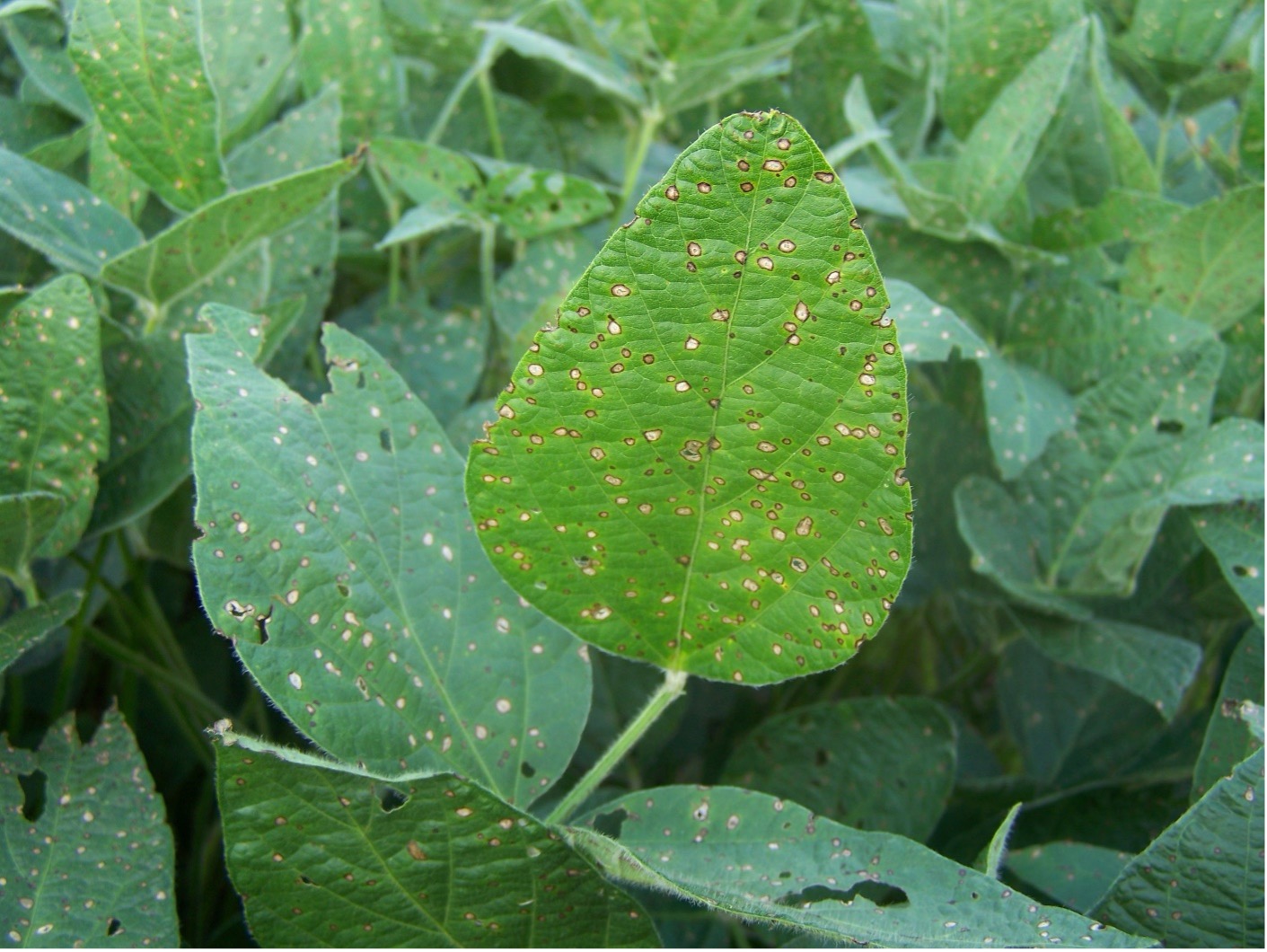
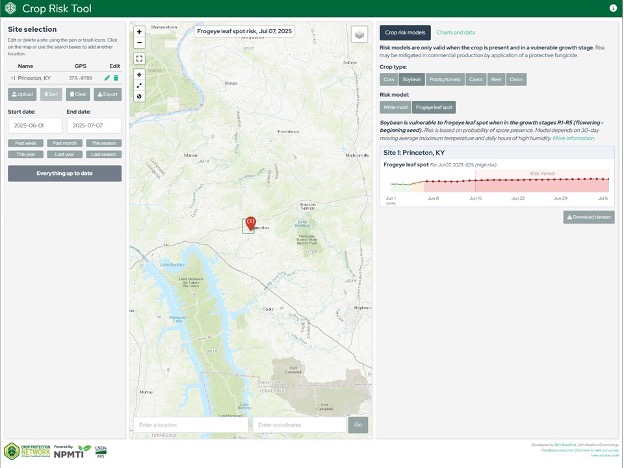
His multi-state team launched forecasting for frogeye leaf spot within the Crop Disease Forecasting platform for the 2025 growing season. This disease can be found throughout the country, and severe outbreaks in favorable conditions for the disease early or just after flowering can cause yield losses of up to 35%.
The team plans to add forecasting for Cercospora leaf blight and target spot in coming seasons.
Developing and Validating Forecasting Models
The Crop Disease Forecasting tool combines information about the presence of pathogens and environmental conditions to forecast the risk of a disease developing in a specific area.
Team members collect spores weekly from spore traps in fields containing uniform fungicide trials to monitor for pathogens that can cause leaf diseases. The same traps capture all airborne spores, allowing them to watch for multiple issues.
They adapted the first Crop Disease Forecasting model to account for weather that creates a favorable environment for each pathogen to spread, infect soybeans and cause disease. For example, the frogeye leaf spot model predicts where the disease is likely to appear based on presence of Cercospora sojina spores and warm, humid, cloudy weather.
“During 2025, we used the untreated check plots in our uniform fungicide trials to validate the frogeye leaf spot model,” Bradley says.
These small-plot trials have fungicide applied at specific growth stages, regardless of disease pressure. Results contribute to fungicide efficacy data, which helps farmers select fungicides to manage their disease pressure.
Past multi-state research projects funded by the Soy Checkoff have provided a better understanding of the prevalence of fungicide-resistant strains of important soybean foliar pathogens like Cercospora sojina. Using this knowledge, along with data about disease risk, farmers will be better able to make informed decisions about the need for fungicide applications and which products may provide the best control.
Informing Fungicide Application Decisions
When low soybean prices and high input costs tighten margins, every application decision needs to pay. Bradley believes adding forecasting for frogeye leaf spot, Cercospora leaf blight and target spot will help farmers make profitable decisions.
“Fungicides work best when they are applied to protect leaves against infection,” he explains. “Forecasting where diseases are likely to develop helps farmers target fields and timing where fungicides can be most valuable.”
He adds that some researchers participating in this effort are using this foresting tool to better understand how disease risk relates to fungicide application timings and profitability.
“We are working to define what 60% or 50% disease risk means,” Bradley says. “We hope to learn how understanding risk level informs when to spray.”
Additional Resources
Crop Disease Forecasting – Crop Protection Network webpage
Sporecaster and Sporebuster Applications Help Make White Mold Fungicide Decisions – SRIN article
Frogeye Leaf Spot of Soybean – Crop Protection Network webpage
Cercospora Leaf Blight of Soybean – Crop Protection Network webpage
Target Spot of Soybean – Crop Protection Network webpage
Meet the Researcher: Carl Bradley SRIN profile | University profile
The Soybean Research & Information Network (SRIN) is funded by the Soy Checkoff and the North Central Soybean Research Program. For more information about soybean research, visit: National Soybean Checkoff Research Database.
Published: Dec 15, 2025


