

Barney Geddes – Soybean Research Profile
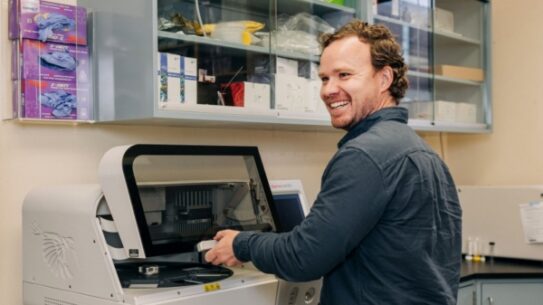
Barney Geddes, Richard and Linda Offerdahl Fellow, Assistant Professor, Department of Microbiological Sciences, North Dakota State University
Why did you decide to pursue a career that includes soybean research?
I am fundamentally motivated to broadly improve sustainable agriculture, which comes from growing up on a small, family farm in Manitoba, Canada. My family was focused on regenerative agriculture principals. When I went to university and learned about microbiology, I became interested in applying that knowledge to crop growth and sustainability. I’ve been working on beneficial microbes for my whole career, with a focus on rhizobia, which are the bacteria that fix nitrogen and are used a common inoculants in legumes such as soybean.
When I started at North Dakota State University, I wanted to ensure the work we are doing is applicable to farmers. Coupled with the desire to improve agricultural sustainability, soybean is a natural focus since it is an important crop for farmers in our region.
What research topic have you completed in the past, or are working on now, that could have or has had the most significant impact on soybean production?
With several research lines in my program, we like to focus on local agronomic issues that haven’t been solved by other means in our area. And we can look at developing microbial technologies that could help address these. One of them that is obvious to me is iron deficiency chlorosis, or IDC. We don’t have a perfect solution for farmers and many fields in the region suffer from IDC.I get excited when I see a local issue like IDC and have ideas about how to use my expertise to tackle it.
IDC research is important, but so is rhizobium inoculant technology. We have a major focus on how to improve the inoculant technology that’s currently available for farmers. Even though it’s effective and they purchase this already, I think there are a lot of gaps in the efficacy of this technology. We are spending time on how we can generate improvements.
How has the soybean checkoff enhanced your ability to find answers to production problems for farmers?
It is great to have this local support. The soybean grants from the North Dakota Soybean Council were some of the first to support my program and helped to build it to what it is today, because of their willingness to work with local researchers on local problems. I appreciate the momentum that support has given us from an early stage, and it helps us to fulfill the land-grant mission.
Within your area of expertise, what are the top two or three general recommendations you would offer farmers to improve their management practices?
It’s important to utilize microbes as part of a farmer’s management, and taking advantage of rhizobium inoculants to improve nitrogen fixation. Farmers also need to be aware of IDC and the options currently available, such as genetics, to help manage the issue.
Within your area of expertise, what do you consider to be critical soybean research needs that can impact the profitability of farmers in the future?
I think the biggest problem is that biologicals, for the most part, have not been developed fully. There are products that have shown efficacy in the lab, but when taken to the field, they don’t do what they are supposed to. I think that reflects a lack of focus on the competitiveness of the microbes. How to they compete and persist in the field environment? If we can solve that and make sure the microbes persist, we’ll have a lot more efficacy in this type of technology.
SRIN articles:
Approaching Iron Deficiency Chlorosis Resistance With the Soybean’s Microbiome


