

Vipan Kumar – Soybean Research Profile
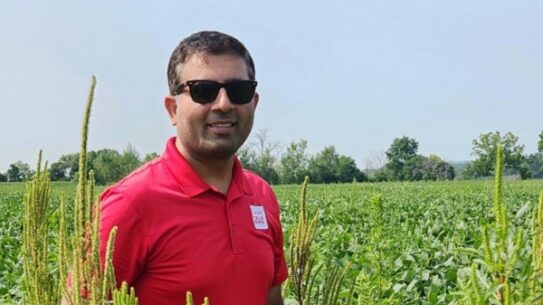
Vipan Kumar, Associate Professor, School of Integrative Plant Science, Soil and Crop Sciences, College of Agriculture and Life Sciences, Cornell University
Why did you decide to pursue a career that includes soybean research?
I earned my doctorate in weed science at Montana State University. Through my first job at Kansas State University, I learned more about problems that soybean producers face with weed resistance to herbicides. Part of my research there was to look at weed resistance in commodities, and soybeans are vulnerable to weed pressure and producers provided funding. That built my interest in weed resistance and soybeans. Now at Cornell, it’s easy to focus on soybeans and finding solutions as weed resistance issues in the Midwest are popping up in New York. It’s a natural fit for my career.
What research topic have you completed in the past or are working on now that could have or has had the most significant impact on soybean production?
I think my research on screening weeds for herbicide resistance and then finding integrated solutions for weed control will have the most impact on soybean production. For example, I’ve been involved in research on cover crop impact on weeds, harvest weed seed control and pre- and post-emergence options for Palmer amaranth control in dicamba-tolerant soybeans.
How has the soybean checkoff enhanced your ability to find answers to production problems for farmers?
The Soy Checkoff funding is very critical. Grants allow us to start research important to local farmers. Checkoff funding provides a solid foundation to help develop bigger soybean production research projects and get USDA and other funding.
Within your area of expertise, what are the top two or three general recommendations you would offer farmers to improve their management practices?
- Identify problem weed species. Then, focus on managing those weeds, consulting with experts to see if you are dealing with herbicide resistance.
- Use soil-applied herbicides, more residuals and alternate use of other post-emergence options besides glyphosate. In New York state, many farmers do not use soil-applied herbicides and rely on glyphosate, but weeds are changing and new species are becoming resistant to herbicides. With the availability of Plenish soybeans with the Enlist trait, farmers can rotate post products based on traits.
- Chemical tools for weed control are good, but they aren’t silver bullets. Integrate other tools, like cereal rye cover crops, to support weed control. And watch for new technology and tools for weed control that are being developed.
Within your area of expertise, what do you consider to be critical soybean research needs that can impact the profitability of farmers in the future?
I would like to see more research on integrated weed management, or IWM, tools because we are seeing more issues and costs with herbicides. Farmers need tools that help control weeds but aren’t very expensive. Research can help us understand the timing, fit and costs of alternative tools like high-residue cover crops or AI-based targeted spray systems. For example, I am currently heavily focused on inter-row mowing and weed seed destruction to help reduce input costs.
SRIN articles:


