

Sarah Ganske – Soybean Research Profile
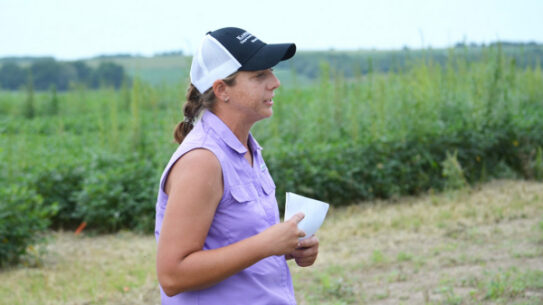
Sarah Ganske, Associate Professor and Extension Specialist, Kansas State University
Why did you decide to pursue a career that includes soybean research?
Growing up on a farm in Missouri, I watched my dad face the challenges presented by weed management issues. I was about 12 years old and have a distinct memory of hand-removing shattercane from the soybeans because the beans had gotten too tall for herbicide treatment, before Roundup-ready soybeans.
What research topic have you completed in the past, or are working on now, that could have or has had the most significant impact on soybean production?
Generally, every research project I do with soybeans is driving to figure out how weed control affects profitability on the farm. Kansas Soybean Commission has been gracious to fund work looking big-picture questions including soybean planting date and row spacing. We’ve looked at how cover crop termination timing affects weed management.
My favorite study was a series of how cover crops intercept herbicide and keep it from reaching the ground. The cover crops themselves provide weed suppression so farmers have greater weed control when both cover crops and herbicides are used.
Currently, the glufosinate research we’re working on has been important for farmers.
How has the soybean checkoff enhanced your ability to find answers to production problems for farmers?
The Kansas Soybean Commission, United Soybean Board, the North Central Soybean Research Program as well as the Multi-Region Soybean Research Collaborative have all been instrumental in funding my research program. This allows me to have data to share on extension circuits and programs, and allows me to train students. It has been an important part of our research program in Kansas.
Within your area of expertise, what are the top two or three general recommendations you would offer farmers to improve their management practices?
- Farmers should always use a herbicide at planting that has a residual weed control activity.
- Do the best to make the post-emergence applications when weeds are shorter than a pop can.
- Use multiple herbicide modes of action. Two is good, but in most cases, three modes of action are better. Sometimes less is more, but that is not the case with mixing and rotating herbicides.
Within your area of expertise, what do you consider to be critical soybean research needs that can impact the profitability of farmers in the future?
I think as weed scientists, we do a good job of trying to stay on top of what is driving yield losses and productivity related to weed management. But we need to think about the next paradigm shift for weed control. In the 1940s, there was selective herbicides; in the 90s, we had transgenic crops. We’re due for the next paradigm shift because herbicide resistance is one of the biggest challenges for sustainable crop production around the world.
SRIN articles:
Controlling Palmer Amaranth with Timely Subsequent Glufosinate Applications
Long-term Weed Management Strategies Need to be Considered in Kansas Soybeans
HERMON Project Aims to Rapidly ID and Map Herbicide Resistance for Farmers


