

Research HighlightsSoybeans that Weather Waterlogging
Highlights:
- Where fields or areas are prone to flooding, choosing soybean varieties that handle saturated soils well protects yield potential.
- In Arkansas, state soybean variety trials offer flood testing as an option, identifying varieties that retain yield despite flooding.
- Air temperature and cloud coverage while soybeans are waterlogged appears to impact crop damage.
By Laura Temple
After heavy rains, farmers know the parts of fields most likely to flood. They know the soils most likely to hold water. But they may not know how the crop growing there will handle waterlogging.
Intense rains that lead to flooding seem to occur more frequently, making saturated soils a stress some farmers need to plan for every year.
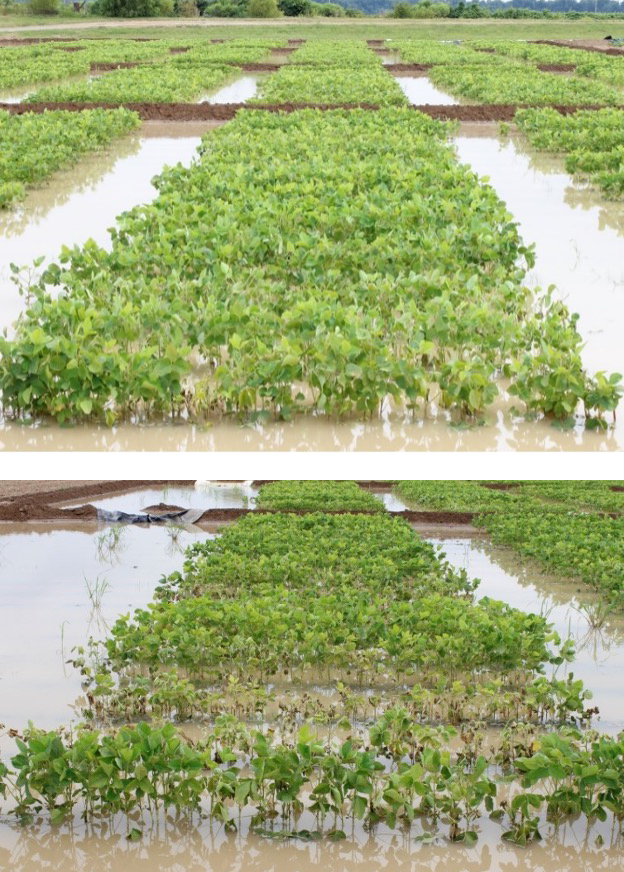
Flooding stunts and yellows soybeans. In many challenging conditions, soybeans often prove resilient. However, some varieties handle flooding better than others. To give farmers more information about how specific soybean varieties respond to saturated soils, John Carlin, director of the Arkansas Crop Variety Improvement Program at the University of Arkansas, has made flood testing an option in the state variety trials since 2018.
“Flood testing provides a key piece of information for farmers as they select soybean varieties,” he says. “In our flood trials, we’ve seen soybean yield loss as low as 20% and as high as 90%.”
As companies submit varieties to Carlin’s variety testing program, they can choose to include those varieties in flood trials. Soy Checkoff support from the Arkansas Soybean Promotion Board allows Carlin to set participation fees at a reasonable level, allowing companies to include more varieties and farmers to get more information.
“Over time, more companies have opted to include more of their varieties in the flood trials,” he adds. “For example, 63 of the 118 soybean varieties submitted for the 2026 variety trials will be included in our flooded plots.”
Early Growth Flooding
Carlin’s team plants flood trials at three of the eight research farm locations that host soybean variety trials. They aim to replicate real-field conditions, flooding plots when soybeans reach the V3 or V4 growth stage and holding the flood for about five days before draining the plots.
“That period of time is fairly realistic for the type of flooding we commonly see in Arkansas early in the season,” he explains.
Due to the amount of rice production in Arkansas, precision-leveled, 0% grade fields that hold water are common. The team uses furrow irrigation and levees to manage the artificial flooding in plots usually planted in a soybean-rice rotation.
They collaborate with the Arkansas Soybean Breeding Program, which takes visual ratings of how the flooded plots yellow, as that tends to correlate with yield loss. However, the most meaningful data comes from comparing yields in flooded plots to yields in non-flooded plots. Carlin reports the percent yield retention from this flooding in the data published online for farmers.
“We see huge differences in yield between soybean lines,” he says. “With this data, farmers can choose soybeans that retain yield well in waterlogged soils to plant in the fields most prone to flooding.”
Weather Factors Influence Flood Damage
Over the years, Carlin has noticed that the degree of flood damage in these plots depends heavily on the weather.
“If the conditions are cool and cloudy while the soybeans are waterlogged, damage is minimal,” he explains. “When the flood is held during hot, sunny weather, we see lots of yield loss.”
He theorizes that oxygen carrying capacity with water at different temperatures may cause these differences. He plans to conduct future trials to better understand how water temperature and dissolved oxygen affects flooded soybeans. In the meantime, farmers can monitor the weather while soybeans are flooded to anticipate the potential damage.
“We plant our flood trials in June, rather than in April or May like our variety trials, so that the weather is more likely to be hot when we flood the plots,” Carlin says. “We want to see a lot of flood damage, so that our data shows results under high stress.”
His variety trials tend to focus on Maturity Group 4 soybeans, the range most common in Arkansas. Other varieties from lines that perform well in these trials have a better chance of handling saturated soils well, if regional data is not available.
“Given challenging weather, these results help farmers choose varieties best suited to specific fields, especially those prone to waterlogging,” he adds. “The wide range of yield retention results highlight the value of choosing varieties with proven flood tolerance.”
Additional Resources
Arkansas Variety Testing Programs – website
How Flooding Soybeans in Early Reproductive Stages Impacts Yield, Seed Composition – SRIN article
Genetics Help Soybeans Withstand Flooding, Waterlogged Soils – SRIN article
Can Nitrogen Rescue a Flooded Soybean Crop? – SRIN article
Arkansas Soybean Promotion Board 2025 Research Annual Report
Meet the Researcher: John Carlin SRIN profile | University profile
The Soybean Research & Information Network (SRIN) is funded by the Soy Checkoff and the North Central Soybean Research Program. For more information about soybean research, visit the National Soybean Checkoff Research Database.
Published: Apr 20, 2026


