

Research HighlightsLinking Soil Practices to Soybean Resilience
Highlights:
- Long-term research shows soil health benefits from diversified cropping that boost crop resilience.
- With climate patterns shifting toward wetter springs and drier summers, soybeans will need to be more resilient.
- Iowa State University research found that soils under extended crop rotations support soybean resilience under extreme drought.
By Laura Temple
Soybeans inherently can handle stress well compared to other crops. In extremely wet, dry or hot conditions, soybean plants manage to set and fill at least some pods — often more than expected — thanks in large part to breeding efforts.
As springs become wetter and summers become more variable, especially in the Midwest, soybeans’ inherent resilience will be tested. Farmers can boost this resilience with long-term soil health practices, according to unique Iowa State University research.
Marshall McDaniel, associate professor in soil-plant interactions at Iowa State, currently oversees a long-term experiment called the Marsden Agricultural Diversification Experiment. Established in 2001, it is testing how diversifying cropping systems affects crop productivity and sustainability. Plots compare the standard Midwest soybean–corn rotation to extended rotations that incorporate small grains and forages.
“Climate models predict wetter springs and sometimes drier summers,” he says. “We asked how past soil management affects current crop resilience. Do long-term soil-health-promoting practices make soybeans more climate-resilient?”
With Soy Checkoff support from the Iowa Soybean Association, McDaniel and Ashani Thilakarathne, postdoc research associate who is now an assistant professor of soil science at the University of Wisconsin River-Falls, conducted trials to study future-climate scenarios in plots with more than 20 years of specific soil health practices.
Managing for Soil Health
To explore resilience, McDaniel and Thilakarathne compared soybeans grown on plots under two long-term crop rotations.
- The conventional, two-year system rotates between soybeans and corn, with synthetic fertilizer applied based on Iowa State soil fertility recommendations.
- The four-year system, or “grandpa’s rotation” with modern technology, follows a year of corn and a year of soybeans with oats harvested mid-summer and seeded to alfalfa for the remainder of year three and all of year four. Ahead of the return to corn, these plots receive composted cattle manure, supplemented with synthetic fertilizer to meet Iowa State recommendations. The plots in this system have been through this rotation more than five times since 2002, capturing long-term differences.
- Since 2021, these plots have been under minimum tillage, using strip-till ahead of corn, with a cereal rye cover crop ahead of soybeans.
“In ‘grandpa’s rotation,’ we apply about 85% less synthetic fertilizer compared to today’s conventional rotation,” McDaniel says. “Manure provides most crop nutrient needs.”
Creating the Climate of the Future
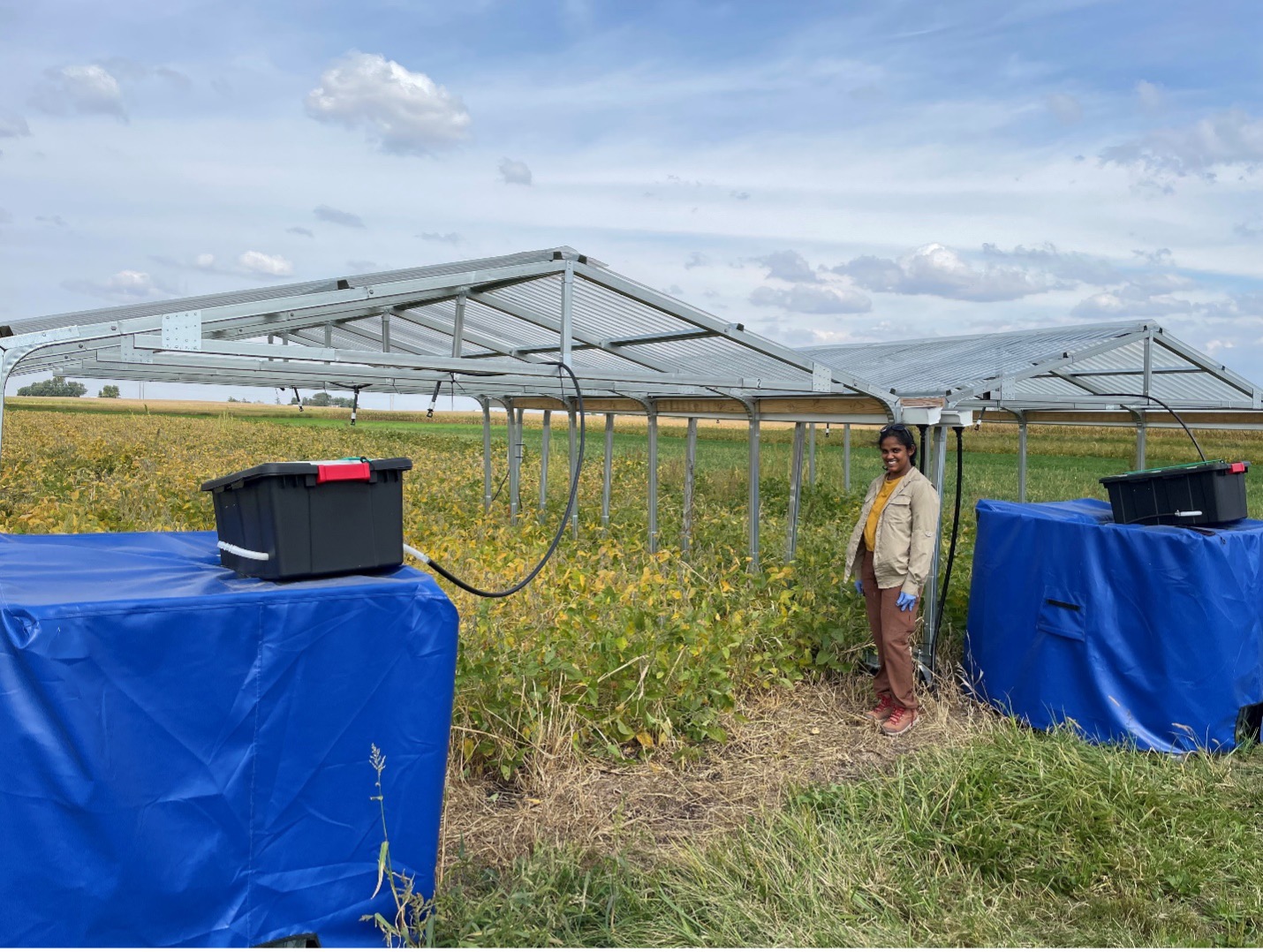
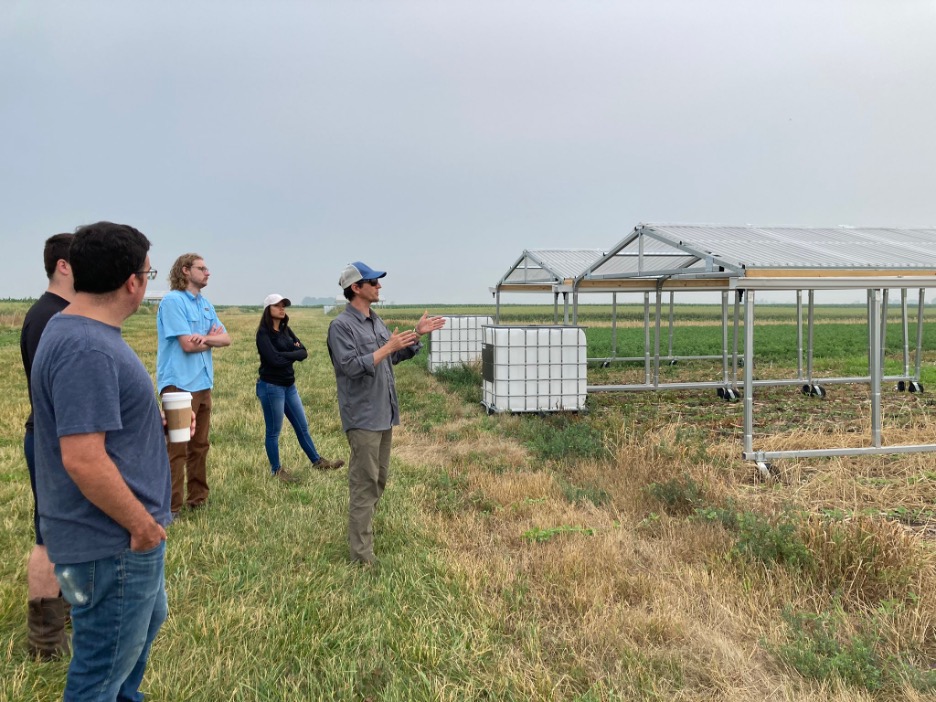
McDaniel, Thilakarathne and their team created rainout shelters dubbed precipitation exclusion and applications systems, or PEAS, to manipulate precipitation and simulate the desired weather conditions. Covered with translucent corrugated plastic and equipped with sprinkler irrigation, these shelters covered about 6 yards of six soybean rows.
Based on the weather conditions of the given trial seasons, 2023, 2024 and 2025, they simulated current and future climate conditions under the shelters.
- As a control, ambient precipitation plots received the total rainfall of the previous week through the sprinklers.
- Based on climate models for Iowa, future precipitation plots received 20% more water than the total natural rainfall throughout the spring to mimic wetter spring conditions. Beginning with the official calendar start of summer in late June, these plots received 75% less water than the total natural rainfall to simulate drier conditions.
“Because 2023 was already a very dry year, we just looked at extreme drought conditions for the first year of the study,” McDaniel notes. “We left the shelters in place for about two months, from July to September.”
That year, from July through September, they had two treatments: An irrigated treatment that received 1 inch of rain per week, and drought treatment that received no water while under the shelters.
Observing Degrees of Soybean Resilience
Based on initial observations, McDaniel and Thilakarathne found that longer rotations and manure make a difference under extreme drought conditions.
“In 2023, we saw an 11% yield penalty for soybeans grown in the plots under the two-year conventional rotation,” McDaniel reports. “However, soybeans in the plots under the four-year crop rotation showed no significant yield difference between the ambient and extreme drought shelters.”
In wetter years, crop rotation has less effect on yield. They observed small differences between the crop rotation systems in 2024 with the different precipitation treatments. In 2025, the soybeans in the four-year crop rotation again outyielded those in the conventional system.
In addition to yield, they measured soil moisture, root growth and emissions of nitrous oxide (N2O), a potent greenhouse gas released from the soils. While this data has yet to be fully evaluated for differences between crop rotation systems, McDaniel noted that all N2O emissions are higher under wetter conditions.
“I am very interested in seeing if differences show up in root biomass at different soil depths under the different rotations,” he says. “While ‘grandpa’s rotation’ isn’t as practical for many farmers today, it can help us learn quite about the impacts of long-term soil-health promoting management practices. We want to help farmers figure out ways to diversify cropping systems to improve crop resilience in the future, especially if drought conditions become more common.”
Additional Resources
Soil-Plant Interactions in the McDaniel Lab – website
Diversified Cropping Systems Enhance Soybean Resilience to Extreme Drought – ScienceDirect journal article
How Cropping Systems Can Mitigate Drought Effects – Iowa Soybean Association article
Soil Management Boosts Drought Resilience – Iowa Soybean Association article
Exploring Extended Crop Rotation Benefits for Soil Health and Productivity – SRIN article
Healthy Soil, Happy Soybeans: Insights from Multi-State Research – SRIN article
Marsden Agricultural Diversification Experiment – website
Meet the Researcher: Marshall McDaniel SRIN profile | University profile
The Soybean Research & Information Network (SRIN) is funded by the Soy Checkoff and the North Central Soybean Research Program. For more information about soybean research, visit the National Soybean Checkoff Research Database.
Published: Jun 15, 2026


