

Research HighlightsCover Crop Research Can Help Farmers Retain Soybean Yield
Highlights:
- Through a Science For Success multi-state project, researchers determined soybeans can retain yield following a cereal rye cover crop.
- Water use by the cover crop is a key factor in soybean yield potential.
- Management trade-offs are crucial in a successful soybean–cover crop relationship.
By Carol Brown
Adding a cover crop into a farming system has many benefits, but also carries a possibility of reduced soybean yield. Researchers admit there are risks with cover crops but the rewards can outweigh those risks. A recent research project, supported with Soy Checkoff funding through Science for Success, determined the risks and benefits when using a cereal rye cover crop prior to soybeans.
“Hundreds of studies done on cover crops have focused on their benefits such as environmental qualities, weed suppression, and pest management. Soybean yield reductions were a side-note in these projects,” says project leader Seth Naeve, professor and extension agronomist at the University of Minnesota. “We shifted the focus to soybeans and how a cover crop affects the crop.”
The project objective — springboarded from long-term cover crop on-farm research through the Iowa Soybean Association — was to see how farmers could produce a full soybean yield while retaining the benefits of a cover crop. The team identified that there are trade-offs between cover crop management and the risk of soybean yield loss.
“Our goal was to have scientific results that offer guidance to farmers. We wanted to do the best job we could at ‘de-risking’ using cover crops with soybeans in order to increase adoption rates,” Naeve comments. “And we wanted to show how the risks were different, based on geographical locations. For example, how does cover crop management differ between Minnesota and Mississippi?”
Research Combined Modeling with Trials
The two-year project was conducted in two phases. In Phase I, the team used data from over a 34-year period, 1990-2023, in 12 states with two locations per state, to simulate rye–soybean cropping systems. The states were in the North Central region plus Kentucky, North Carolina and Louisiana. They utilized soybean modeling data to investigate seeding and planting dates, maturity group, cover crop termination and soybean harvest dates, as well as soil types and weather conditions.
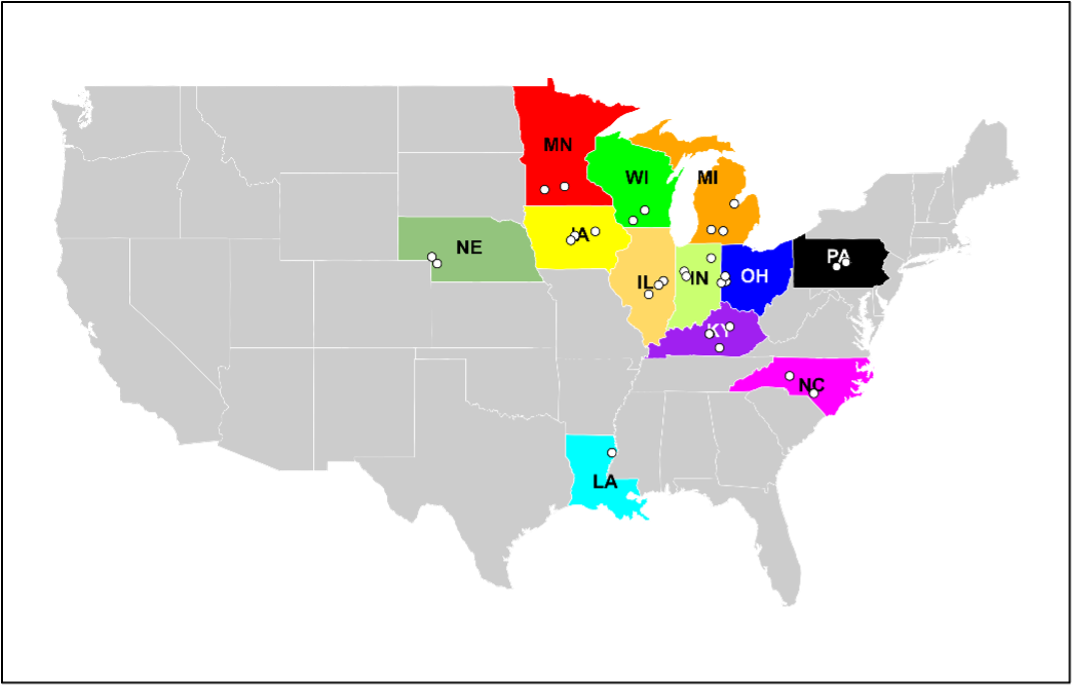
For Phase II in 2025, the team expanded the analysis to 35 simulated rye-soybean systems as well as 23 in-field trials (Figure 1). This phase was essentially ground-truthing of the Phase I simulations, comparing the simulations with the field observations. The project provided a broad, national perspective of using cover crops with soybeans.
Cover Crop Termination Timing
The team found that risks to soybean yield reductions can be reduced when the cereal rye is terminated in a timely manner and the rye biomass is kept at manageable heights. Earlier rye termination was the lower-risk option for protecting soybean yield, but the trade-off limited erosion control and weed suppression benefits, which work better with more cover crop biomass.
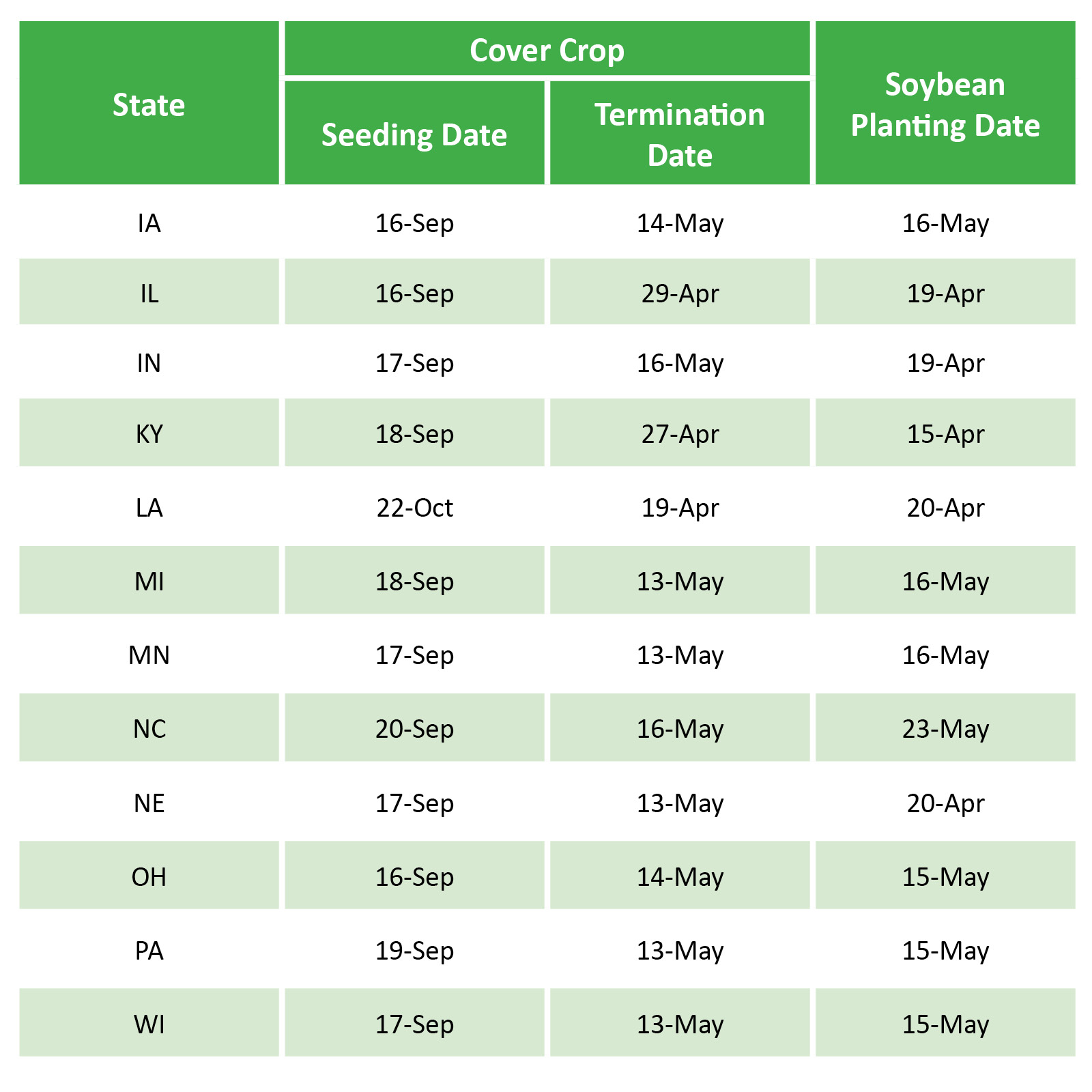
“When we refer to ‘earlier’ rye termination, the dates were not what many Midwest farmers consider early for soybean without a cover crop,” Naeve comments. “Cover crop termination dates ranged from April 19 in Louisiana to mid-May in the other states. We consider the earlier dates are within a cover crop scenario (Table 1).”
Soybean planting dates ranged from April 15 in Kentucky to May 23 in North Carolina, with the other states in between these dates. Soybeans planted into a live cover crop, or planting green, was done in a few states.
Water Use is Key
An outcome from the research revealed that water usage is key to a cover crop system.
“The challenges in cover cropping and potential soybean yield loss are almost entirely related to water,” Naeve says.
In the South, farmers have a bigger window of opportunity for soybean planting (Table 1), but the cover crops also start to grow early, Naeve says. If farmers aren’t vigilant with cover crop termination, the rye can grow profusely and take up a lot of water.
In the North, the cover crops can be slow growing in the spring, so farmers might not see the environmental benefits before termination due to less biomass. But the cover crop doesn’t get out of control and take up a lot of water.
“For northern farmers, when there is plentiful rainfall and a lot of water in the profile, the cover crop offers relatively little risk in terms of yield loss. But there is the concern of not being able to get into the field to terminate the cover crop and plant soybeans,” he says. “In dry years, farmers can terminate cover crops and plant soybeans earlier, reducing the yield loss risk from a cover crop. As long as the farmer can terminate the cover crop early to keep water use low, the subsequent soybean crop yield penalty could be avoided.”
Farmers can retain soybean yield potential with proper cover crop management. The potential for soybean yield reduction is real, but also conditional. Larger amounts of cover crop biomass can increase water use, leaving less water for soybeans at planting and emergence.
Early rye termination lowers the risk of a soybean yield loss. Delaying rye termination, especially where soil moisture is low, can increase their benefits such as reduced soil erosion and weed and other pest suppression. But the cover crop also uses more water, which could lead to reduced soybean yield.
Farmers should have established goals for using cover crops such as reduced soil erosion, improved water infiltration, or weed suppression, and be aware of the trade-offs within their crop management system for the best results in the field.
Additional Resources
Science For Success – website
It Takes Time: Long-Term Cover Crop Results – SRIN article
Long-Term Research Incorporates Cover Crop Questions to Uncover Solutions – SRIN article
Cover Crops in Iowa Long Term Study Results – Iowa Soybean Association guide
Meet the Researcher: Seth Naeve SRIN profile | University profile
The Soybean Research & Information Network (SRIN) is funded by the Soy Checkoff and the North Central Soybean Research Program. For more information about soybean research, visit the National Soybean Checkoff Research Database.
Published: Nov 2, 2026


