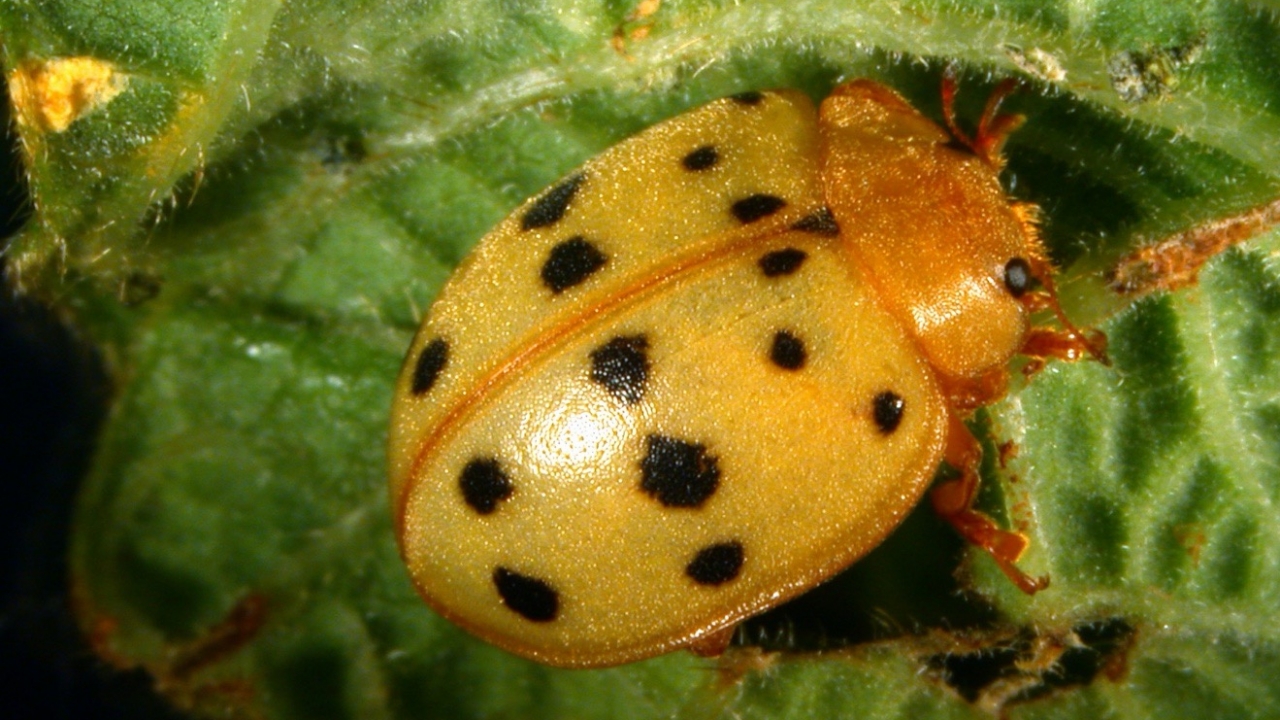
Mexican Bean Beetle
Overview
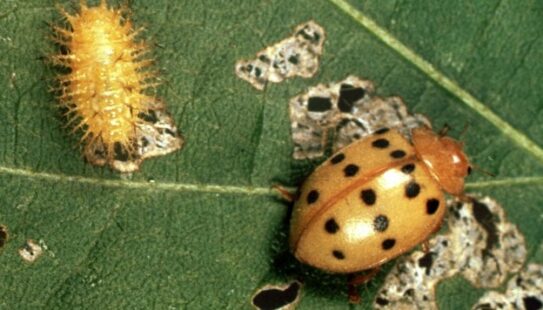
The Mexican bean beetle, Epilachna varivestis, is a species in the lady beetle family. It is native to Mexico, but it now lives throughout the Eastern, Midwest and Southern U.S. It feeds primarily on bean crops, including soybeans. However, they may also feed on alfalfa, clover species, peanut and some vegetables.
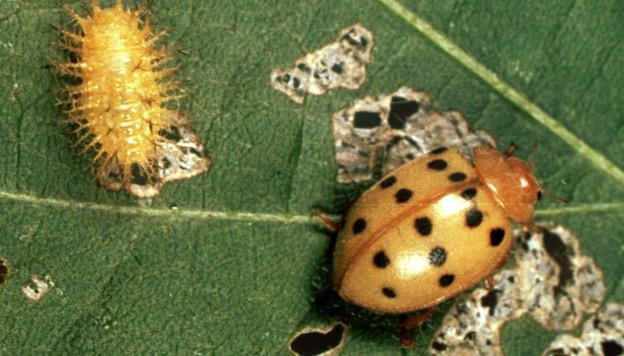
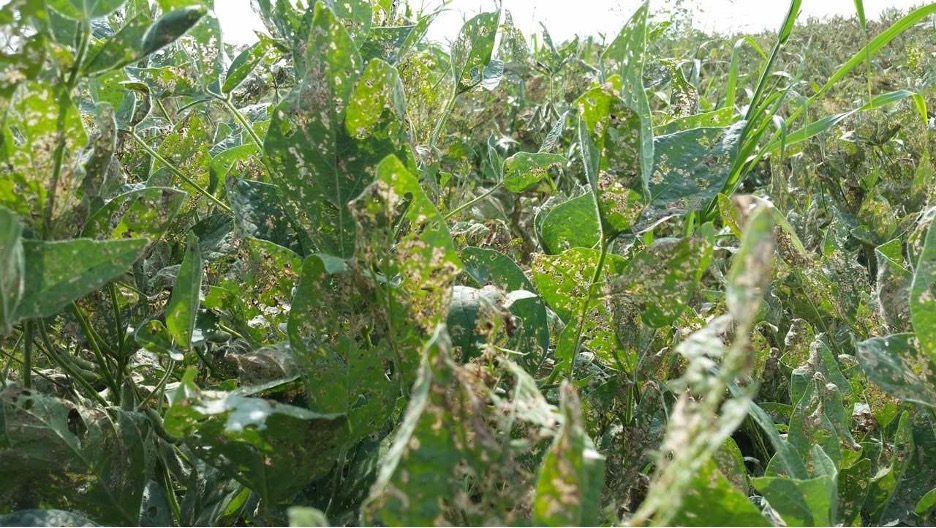
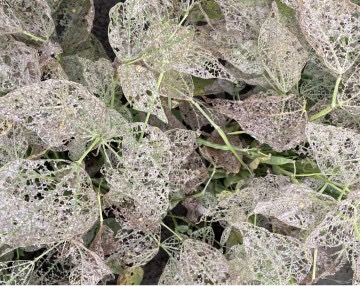
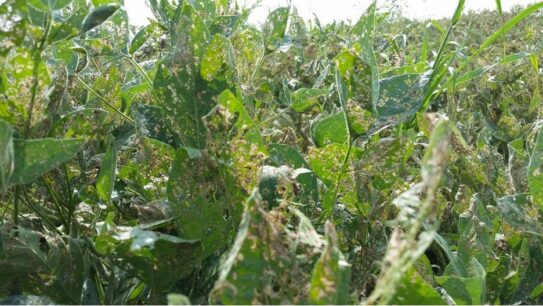
Both the larvae and adults feed on crops, eating the underside of plant leaves which makes them appear lacy. Severe defoliation tends to occur in late summer. Mexican bean beetle can also feed on soybean pods. Though this feeding rarely causes economic damage directly, damaged pods may be more susceptible to disease pressure.
Life Cycle
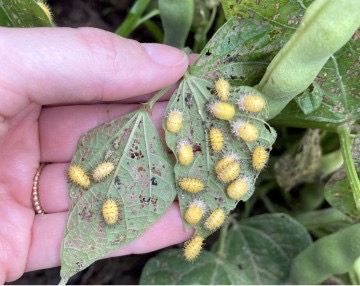
Adult Mexican bean beetles overwinter in wood areas. They move to soybeans as they emerge in the spring. Females lay clusters of eggs on the underside of soybean leaves. Those eggs hatch into larvae that go through four stages. Then, they transform into pupae, usually on the underside of leaves. Typically, Mexican bean beetles produce as few as one or as many as three overlapping generations during the growing season, depending on the region. All four life stages can often be found in soybeans at the same time.
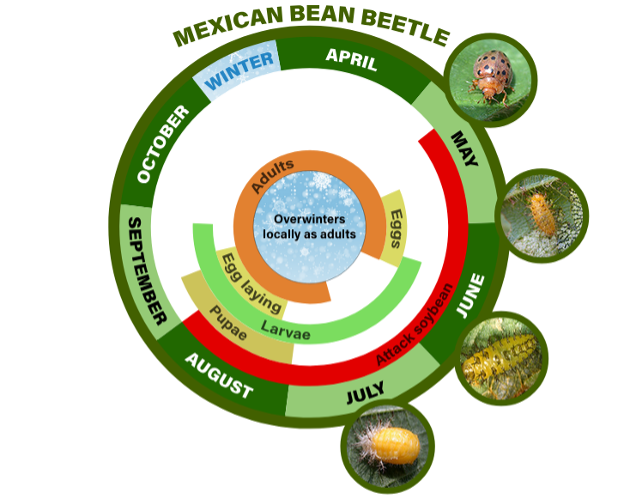
Mexican bean beetle life cycle. Source: Purdue University

All four Mexican bean beetle life stages: Eggs, larva, pupa and adult.
Credit: Clemson University – USDA Cooperative Extension Slide Series, Bugwood.org
Scouting
Identification
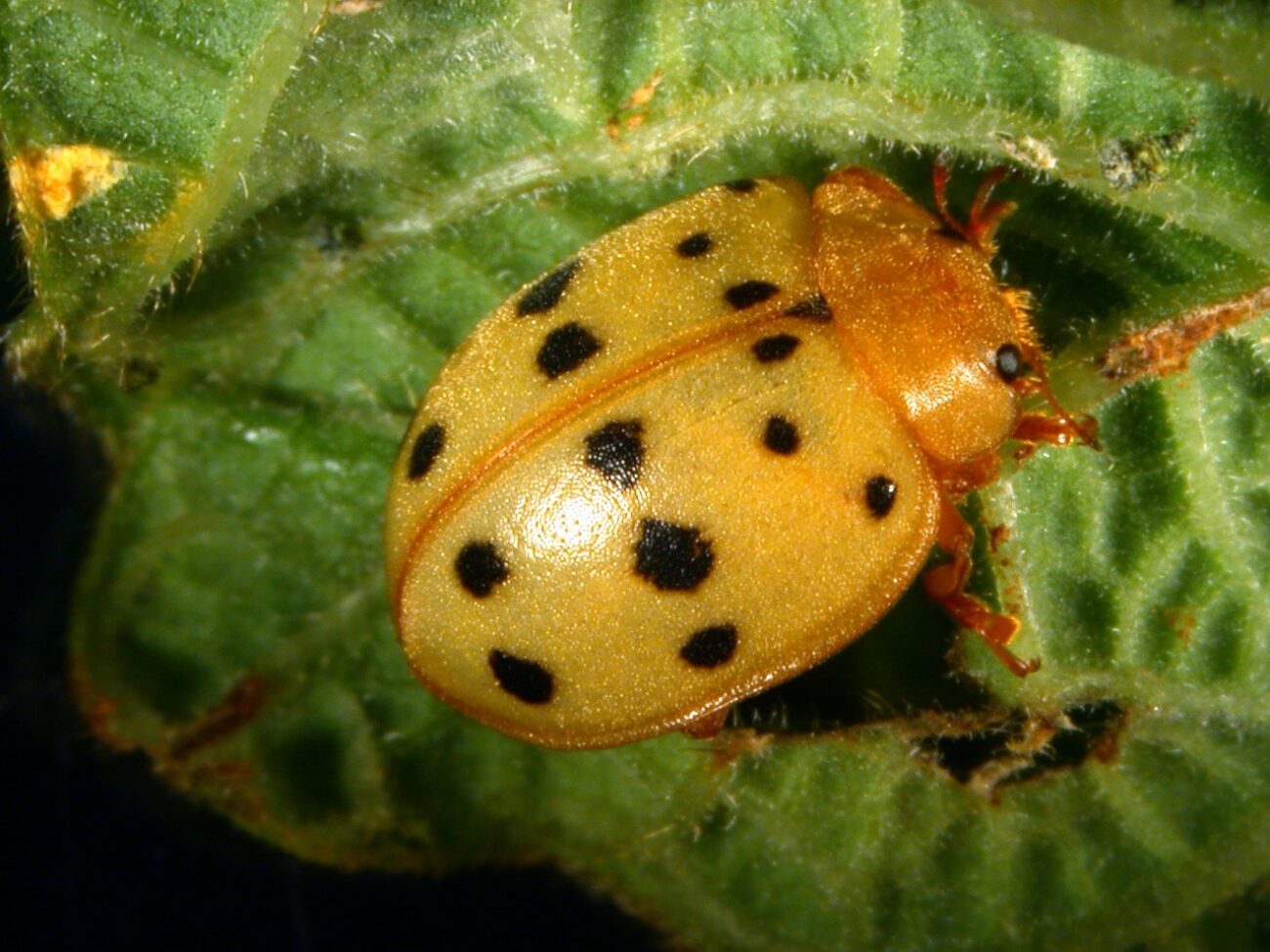
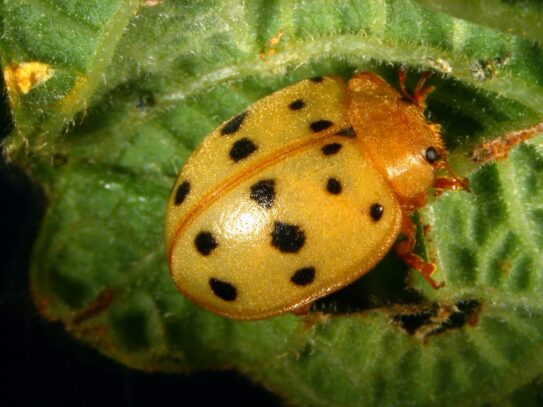
Adult Mexican bean beetles are copper ovals with 16 black spots on their backs. They measure about 8 millimeters, or 5/16 inch, long, by 6 millimeters, or ¼ inch, wide.
Clusters of small, yellow, oval Mexican bean beetle eggs typically contain 40 to 50 eggs each.
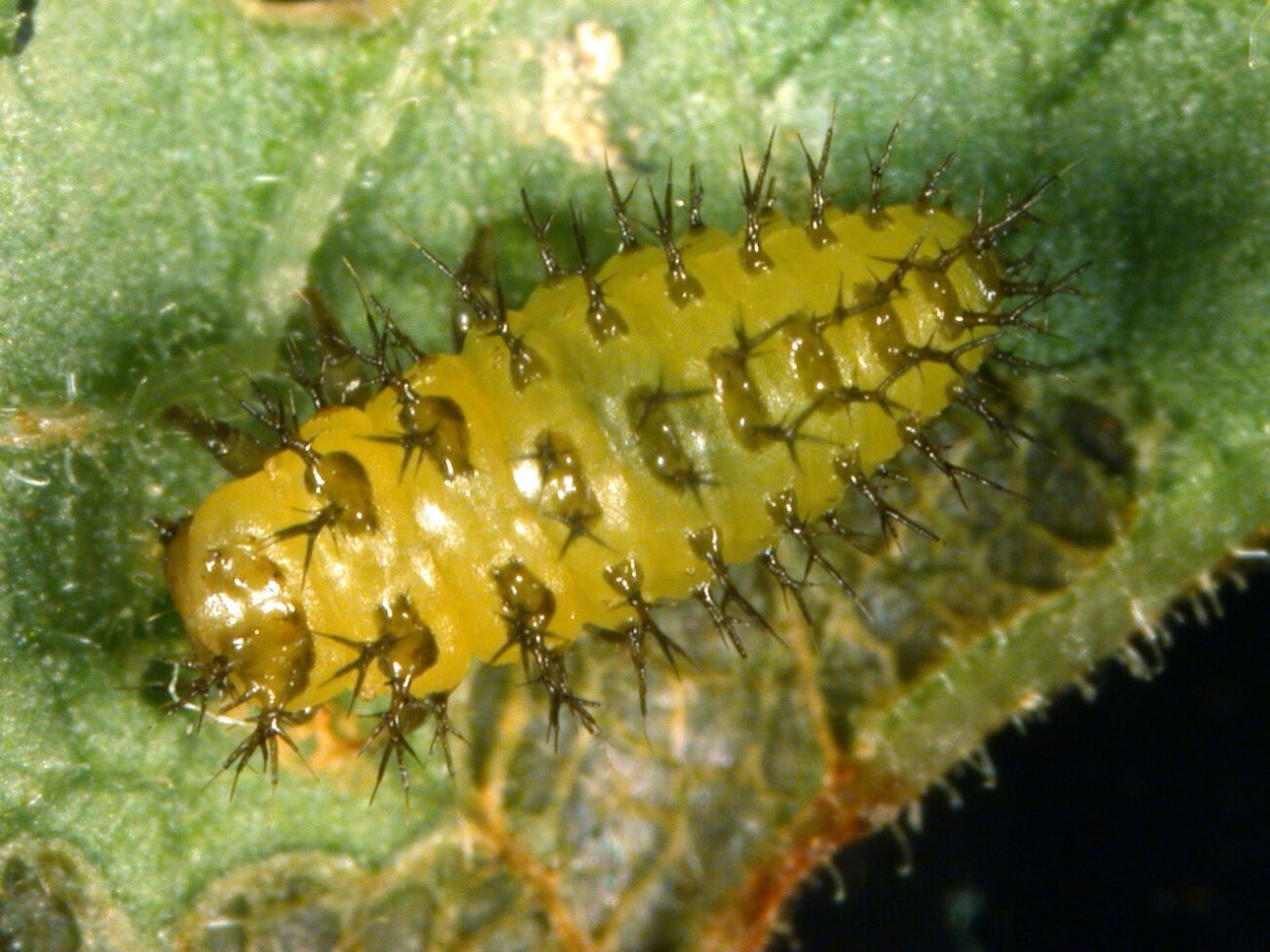
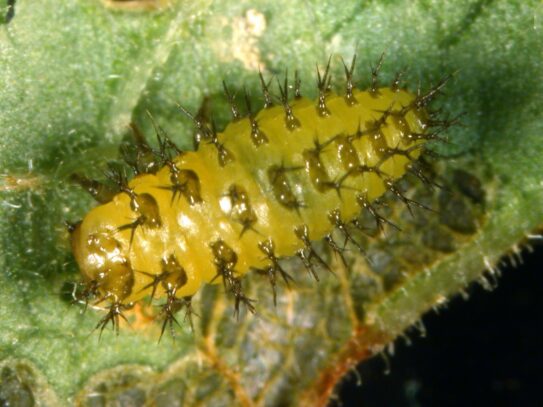
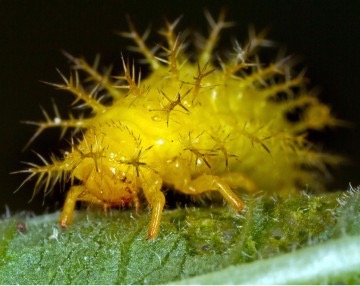
Bright yellow larvae have branched, black-tipped spines on their backs. By the time they reach their fourth stage, they measure about 8 millimeters, or 5/16 inch, roughly the same size as adults.
Bright yellow or yellowish-orange pupae attach to the underside of leaves.
Sampling
The threshold for Mexican bean beetle treatment is the same as any defoliator. Consider both soybean growth stage and percent of leaf defoliation to determine if treatment is warranted.
Later in the season, during or after reproductive growth stage R6, check soybean pods for feeding damage, as well.
To determine population size, choose one of these methods:
- Sweep net: Take 20 sweep net samples in five areas of a field.
- Ground cloth: Shake two rows of plants on either side of the ground cloth in multiple spots.
Regardless of method, count adults and larvae separately.
Biological Control
Biological Control
A species of parasitic wasp, Pebiobus foveolatus, native to India serves as a natural predator of Mexican bean beetle larvae. Because it is not native, it must be introduced to soybean fields every season, but it provides very effective control
Chemical Control
Several insecticides are labeled for Mexican bean beetle control. If an application is warranted, it is usually later in the season, when both third- and fourth-stage larvae and adults feed at the same time. Pay attention to the pre-harvest interval of the chosen insecticide, and be sure harvest is far enough away that treatment can be made. Note that if high numbers of eggs and/or pupae are present, reinfestation could occur if the chosen treatment does not have residual activity.
Resources
Mexican Bean Beetles (Soybean), Purdue University
Mexican Bean Beetles Make an Appearance, Ohio State University Extension
Mexican Bean Beetle, University of Illinois Extension
Mexican Bean Beetle in Soybean, North Carolina State University Extension
Mexican Bean Beetle (Epilachna varivestis), Cornell Integrated Pest Management
Mexican Bean Beetle, Maryland Department of Agriculture
Images provided by J. Obermeyer, Cornell University, and Ohio State University