


Research HighlightsHERMON Project Aims to Rapidly ID and Map Herbicide Resistance for Farmers
Highlights:
- A multi-regional Soy Checkoff research project is developing a herbicide-resistance test that can provide results faster than traditional means.
- The Herbicide Resistance Monitoring Network, or HERMON, is a group of scientists from 10 land-grant universities collaborating to develop a DNA-based test using a section of a weed’s leaf.
- A recent guest on the “War Against Weeds” podcast was lead project investigator Eric Patterson who discussed HERMON with hosts Sarah Lancaster and Joe Ikley.
By Amy Sullivan, GROW
Traditional herbicide-resistance testing takes months and often outpaces the time farmers have to make decisions about what to spray in their fields. But what if that turnaround time could be shortened?
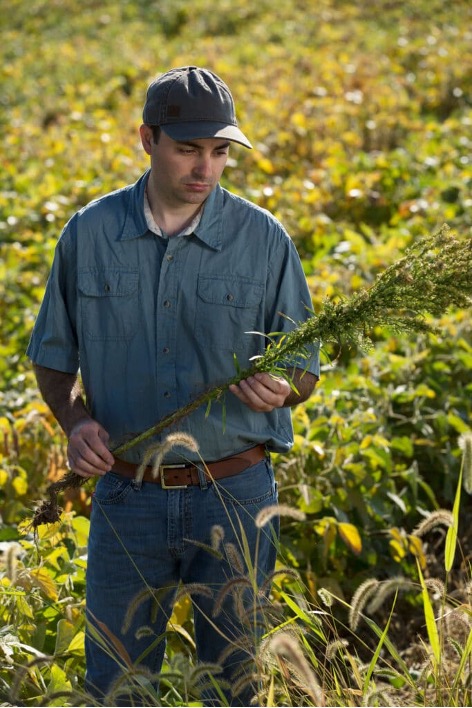
Funded by the United Soybean Board, the Herbicide Resistance Monitoring Network (HERMON) is developing rapid, DNA-based herbicide-resistance testing in soybean production. Through HERMON, farmers might only wait a few weeks to find out if that worrying pigweed or ragweed is herbicide resistant, according to the HERMON project’s principal investigator Eric Patterson of Michigan State University.
Patterson recently hopped on the War Against Weeds podcast, to shed light on the HERMON project. The podcast hosts, Sarah Lancaster, assistant professor and extension specialist at Kansas State University; and Joe Ikley, North Dakota State University Extension weed specialist; note that there are no herbicide modes of action that have evaded herbicide-resistant weeds. That means that every weed in every cropping system could develop herbicide resistance.
Patterson explains that traditional herbicide-resistance testing begins when a farmer notices a weed not responding to herbicides. The farmer has to wait for that weed to go to seed, and then send those seeds to a weed scientist or diagnostician like Erin Hill at Michigan State. The researcher then grows the seeds and applies different rates of herbicides to measure weed response. If a farmer sends suspected herbicide-resistant seeds to a diagnostician in the fall, they won’t get a response until spring, at the earliest.
With HERMON, though, screening for herbicide resistance mutations in a weed’s DNA via a fragment of weed leaf could shorten that testing timeframe. “We could report back to the grower that season whether it’s likely that it’s herbicide resistance,” Patterson theorizes to Lancaster and Ikley.
But developing rapid, DNA-based herbicide-resistance testing will take a lot of research and time, Patterson explains. Luckily, the Herbicide Resistance Monitoring Network comprises several land grant universities helping develop that rapid testing. Those universities include: Kansas State University, Michigan State University, Mississippi State University, Penn State University, Purdue University, Texas A&M AgriLife Research, University of Arkansas, University of Illinois, University of Missouri, and University of Wisconsin.
HERMON also aims to develop flexible collaboration between growers, land-grant universities, and industry to track and tackle herbicide-resistant weeds that don’t care about state borders.
That collaboration begins with farmers sending suspected herbicide-resistant weed seeds to their nearest cooperating HERMON university. HERMON universities will test those seeds for herbicide resistance, and develop a catalog of herbicide-resistant weed seeds between each of the universities for further research. HERMON is also teaming with the Southern IPM Center to build up-to-date, real-time county-level maps illustrating where herbicide-resistant weeds plague farmers.
“Herbicide resistance is a problem that’s not addressed on an individual farm in an individual state by an individual researcher, and we need to come together to tackle this problem,” Patterson says.
To hear more about the HERMON project, listen to the War Against Weeds podcast episode featuring Patterson here.
Additional Resources
War Against Weeds podcast – featuring Patterson and HERMON
Getting Rid of Weeds (GROW) website
Take Action website
Michigan Researchers Lead National Project to Combat Herbicide-Resistant Weeds in Soybeans – SRIN article
Meet the Researchers:
Eric Patterson University profile
Joe Ikley SRIN profile | University profile
Sarah Lancaster University profile
The Soybean Research & Information Network (SRIN) is funded by the Soy Checkoff and the North Central Soybean Research Program. For more information about soybean research, visit the National Soybean Checkoff Research Database.
Published: Feb 23, 2026


