


Research HighlightsImproving the Soybean Cyst Nematode Fight Through Genetic Advancements
Highlights:
- An elite team of scientists continues to explore soybean genetics for improved resistance to soybean cyst nematode.
- Through a Soy Checkoff research project, they are identifying resistance genes, stacking traits for the best resistant combinations, and searching for nontraditional ways to fight SCN.
- Genetics work conducted in previous decades is now available in current soybean varieties, and the team’s goal is to continue to feed the soybean genetic pipeline for improved farmer productivity.
By Carol Brown
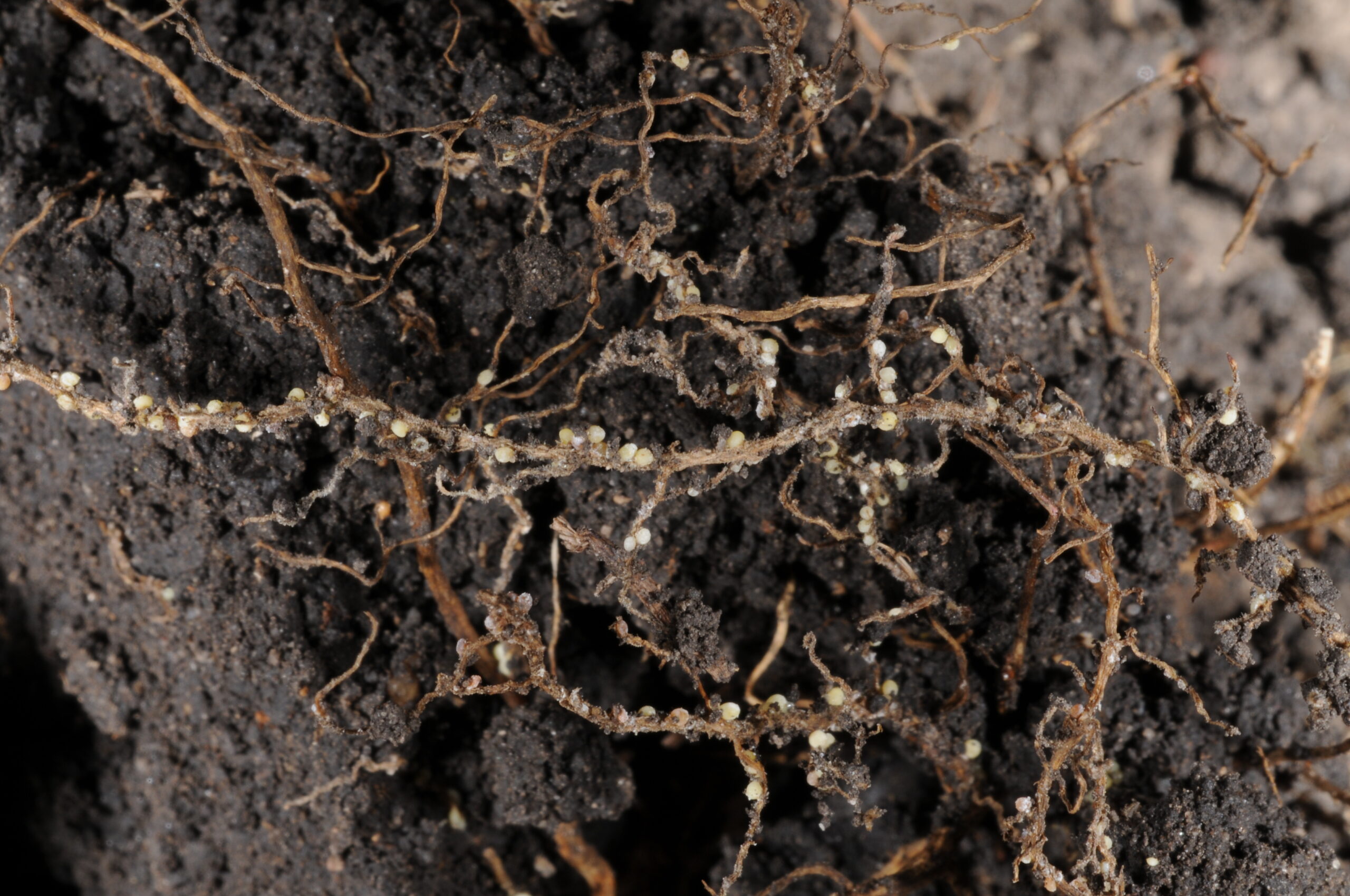
Since first being detected in the United States 75 years ago, scientists have advanced the knowledge around soybean cyst nematode, or SCN, by studying the genetics of the soybean plant and of SCN itself. Researchers have also explored management practices that can be implemented to reduce the impact of what is now the most yield-robbing disease in soybean production nationally.
An elite team of scientists continues to make discoveries in soybean genetics to fight SCN and they have been doing so for nearly 20 years, supported by Soy Checkoff investments from the United Soybean Board.
“Our team is comprised of Matthew Hudson at the University of Illinois, Andrew Scaboo at the University of Missouri, and I’m at the University of Wisconsin,” says Andrew Bent, the principal investigator for the project. “Andrew Scaboo took over from Brian Diers when he retired from the University of Illinois. The transition has been smooth, as Andrew is an outstanding talent in modern molecular breeding and SCN efforts.”
Hudson is a genetics and genomics expert, Scaboo’s expertise is plant breeding, and Bent is a geneticist and cell molecular biologist. Each scientist is highly regarded on their own but when brought together, their relationship and results are synergistic. They are tackling the improvement of SCN resistance in soybeans.
Identifying cqSCN-007
“Our first strategy centers on the genetic locus cqSCN-007, which was identified about 20 years ago by Brian Diers and his colleagues as a novel source of SCN resistance,” says Bent. “His team looked at Glycine soja, or wild soybean, for new genetic capacity and discovered cqSCN-006 and cqSCN-007. These sources may not work as well as Rhg1, but they can significantly improve SCN resistance. SCN resistance is quantitative and each extra bit of resistance can translate to a few extra bushels of yield per acre.”
In 2021, the team successfully defined the gene at cqSCN-006 that causes SCN resistance, and now they are working to define the 007 gene, which Bent says is “being a bear.” But by using new gene editing technologies like CRISPR, the project is now moving faster.
“We can’t understand how 007 works nor can breeders manipulate it as well for growers if we don’t know what the gene is and what protein it encodes,” he comments. “We hope to have the gene identified within the next year to so that we can start learning how it works.”
Plant breeders are already breeding cqSCN-006 and cqSCN-007 into new soybean varieties that will be released in the upcoming years. But they only have the originally discovered versions to work with. When the causal genes are discovered, DNA sequence-based surveys can be conducted of thousands of diverse soybean and wild soybean accessions to identify different and potentially better versions. Knowledge of the gene also allows targeted gene editing to alter the expression or the sequence of the protein. Because it is a native soybean trait, and only a few DNA bases get altered, the edited products would not encounter the full regulatory expense of traits that are developed using transgenic methods, such as herbicide resistance.
Making Rhg1 Genes Work Better
Two of the main sources of SCN resistance in soybeans are variants of the same Rhg1 locus: rhg1-a found in Peking-type soybeans, and rhg1-b in PI 88788-derived varieties. Breeders and growers historically preferred rhg1-b as it is genetically simpler to work with, but nematodes are gradually evolving to overcome rhg1-b resistance, Bent says. However, rhg1-b can still contribute significant SCN resistance in many fields. SCN virulence, or the ability to overcome genetic resistance, is highly variable and can differ from location to location. Typically, virulent populations emerge within a single field and spreads, reducing the effectiveness of specific resistance genes such as rhg1-b. Virulence is typically measured with an HG type test, where SCN are assessed for their reproductive ability on known resistant soybean varieties. This test is another research area being studied by Scaboo.
In many fields, rhg1-b has been working successfully by itself for 40 years and research results shed light as to why it has performed well as a solo act.
“We learned, through previous Soy Checkoff funding research, there are actually three different causal genes that are tightly linked at Rhg1,” Bent says. “Rhg1 encodes three different proteins and nature brought the three genes into very tight linkage to make its own little resistance stack.”
The rhg1-b resistance had been the best defense available to farmers and was in 95% of the soybean germplasm listed as SCN-resistant. SCN experts have been campaigning for farmers to alternate soybean varieties between Peking and PI 88788 types of SCN resistance in crop rotations to keep SCN infestations down and slow the evolution of a grower’s local SCN population. Bent says this works because nematodes that overcome rhg1-a often don’t overcome rhg1-b, and vice versa.
Bent’s team is working to further understand how each of three Rhg1 genes contributes to SCN resistance. This includes a substantial partnership with Corteva scientists and breeders. Some of the UW-Madison lab’s newer USB-funded work has demonstrated that two of the three rhg1-b genes still contribute to resistance against HG 2.5.7, one of the most prevalent types of SCN populations that are getting better at overcoming rhg1-b.
“This exciting result tells us we’re on the right track focusing on these genes, the encoded proteins and how they work,” he says.
Farmers could see improved germplasm in five to 10 years through this research. Bent notes that plant breeding is a long process and farmers are just now benefitting from plant breeding research from the previous decade.
“Soy Checkoff support for research is crucial and impactful,” he comments. “For example, three or four of our team’s discoveries from grower-funded projects have been adopted in the soybean breeding industry and have improved the breeding process for SCN resistance as well as other traits.”
Stacking QTL Combinations
Although rhg1-a and rhg1-b have been successful against SCN, the nematode populations can evolve over the years and become problematic, even on formerly resistant soybean varieties. The team is looking at how to regain the upper hand. Stacking the resistance from Rhg1 with other loci should improve SCN resistance.
“We want to learn about other quantitative trait loci, or QTLs, that we can stack with Rhg1. What are the best combinations for fighting SCN?” Bent says. “The goal is to have seed companies releasing varieties with alternative resistance types, so that growers can rotate SCN resistance sources within soybeans. This will improve resistance durability.”
Scaboo and his Missouri team are testing all possible combinations of at least five QTLs to identify soybean lines with those genetic combinations and then find which ones work best with each other.
“We’d like to recommend a ‘recipe’ that only exposes nematodes to certain modes of action of resistance and doesn’t expose them to others in a particular year,” Bent says. “SCN testing requires expertise, money, time, and a lot of labor. I don’t think anybody in the public sector does this better than Scaboo’s lab.”
Precision Ag Chemical Applications
The fourth strategy is led by Matt Hudson at the University of Illinois. His team is exploring chemical treatments that are applied mid-season to enhance SCN resistance, independent of genetics.
“These chemical treatments could be applied with variable rate delivery, possibly with a drone, in parts of a field with heavy SCN pressure to stimulate more SCN resistance,” explains Bent.
The team completed greenhouse trials with products that are already commercially available and licensed for agriculture use to identify the most promising chemical options. They are now focusing on the fungicide Actigard as the main chemical, alone or in combination with others, and have found increases in SCN resistance without obvious negative impacts on soybean yield.
This season they conducted a small plot trial, and the data are being analyzed. Next year, they’ll continue the lab and small-plot trials to better understand treatment effectiveness and strengthen the logistics that a farmer would use at the field level.
Bent notes there is a nice, productive collaboration amongst the team and the objectives. Ideas are shared; the strategies and findings overlap in places, especially between the cqSCN-007 and QTL testing projects, which helps the team accelerate their overall efforts.
“Our team stays hungry and we don’t take our work for granted,” he comments. “We’ve been doing this for a long time and we continue to produce useful findings.”
Additional Resources
Breakthrough Discovery Opens New Doors in SCN Management – SCN Coalition article
Novel Discovery Could Fortify Farmers’ Defenses Against SCN – SCN Coalition article
Researchers Continue to Strengthen and Refine Soybean SCN Resistance – SRIN article
Research Supports 70 Years of Progress in the Fight Against Soybean Cyst Nematode – SRIN article
Rhg1, cqSCN Loci and Epigenetic Determinants of Resistance to Soybean Cyst Nematode – SRIN article
Making Advancements for Soybean Cyst Nematode Through Plant Breeding – SRIN article
Meet the Researchers:
Andrew Bent University profile
Andrew Scaboo SRIN profile | University profile
Matthew Hudson University profile
The Soybean Research & Information Network (SRIN) is funded by the Soy Checkoff and the North Central Soybean Research Program. For more information about soybean research, visit the National Soybean Checkoff Research Database.
Published: Feb 9, 2026


