

Research HighlightsBuilding a Microbial Team to Fight Sudden Death Syndrome
Highlights:
- Soil microbes could offer solutions to help soybeans protect against sudden death syndrome.
- Research has identified multiple bacteria species that suppress Fusarium virguliforme, the pathogen that causes SDS.
- Combining bacteria that suppresses the pathogen causing SDS with other bacteria could create a biological seed treatment with a better chance of success.
By Laura Temple
Soybeans, like all plants, look for help to manage challenges as they grow.
“Plants ‘recruit’ soil bacteria to help them,” explains Asela Wijeratne, associate professor of bioinformatics at Arkansas State University. “These bacteria heavily populate the rhizosphere, the zone of soil immediately around the plant roots.”
Research investigating bacteria around soybean roots seeks to identify microbes that help the plants withstand infections.
“Bacteria already associated with soybeans could provide a way of biocontrol for major diseases,” he says.
Wijeratne’s current research aims to find microbial solutions to fight sudden death syndrome in soybeans, caused by the soil-borne pathogen Fusarium virguliforme. With a Soy Checkoff investment from the Mid-South Soybean Board, he is studying bacteria active against SDS, but with a fresh approach.
“Prior research shows that single microbial isolates don’t work well in the field,” he says. “They get out-competed by other microbes in the soil. More recent research indicates that a consortium — or a community — of bacteria is more likely to survive.”
He is collaborating with Scott Mangan, associate professor of ecology at Arkansas State University. Their goal is to develop a combination of existing bacteria that could become a seed treatment to manage SDS.
Identifying Bacterial Isolates
Soybean genetics and soil type represent two of the factors that influence what microbes the plant attracts to its roots. Wijeratne and his team collected rhizosphere soil from four different soybean cultivars with varying levels of SDS tolerance, grown in soil from Arkansas and soil from Iowa. From that soil, they extracted and isolated 450 bacteria.
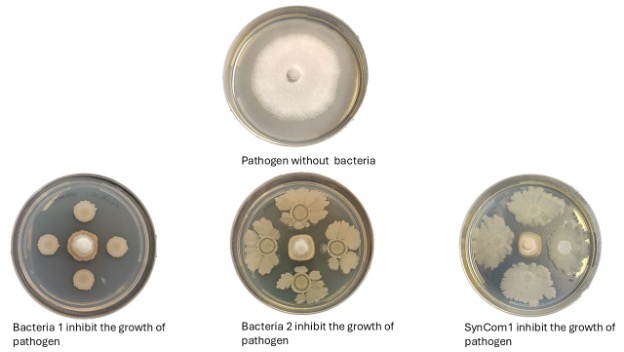
These growth plates show how isolated bacteria and bacterial communities inhibit the growth of Fusarium virguliforme, the pathogen that causes sudden death syndrome. Source: Asela Wijeratne
“We looked at the whole population of microbes, because different soils have different bacteria,” he says. “Overall, we saw quite a bit of overlap among the species likely to address SDS, which indicates potential to find options that work in many regions.”
With the help of DNA sequencing, his team identified about 100 bacteria isolates more likely to manage against SDS. They fully sequenced those bacteria, selecting about one-third of them to test for suppression of F. virguliforme.
“In lab petri dishes, 11 of the 33 isolates we tested suppressed the pathogen that causes SDS,” Wijeratne reports. “Using genetic technology and existing research, we catalogued their beneficial characteristics.”
Creating Microbial Communities
With that foundation, Wijeratne’s team developed a machine learning model to predict combinations of bacteria, including those with activity against SDS, most likely to work well together to support soybeans.
In creating the combinations, they aim to avoid antagonism between competing bacteria and to include those known to produce anti-fungal compounds. They also consider requirements to culture and store the bacteria.
“We initially created three synthetic communities of five bacterial species that tested in the lab,” Wijeratne says. “So far, two are working well.”
While the team continues testing bacteria isolates and developing more combinations, they are moving forward with the two promising treatments. They are working to make these synthetic communities into seed treatments.
“We need to formulate the bacterial communities to survive and work with the soybean seed,” he explains. “Each species has slightly different requirements, adding complexity to creating a seed treatment.”
For the next step, Wijeratne plans to conduct greenhouse tests, using local native soil to see how the synthetic communities interact with existing microbes. Eventually, the treatments will move to field trials.
“Managing SDS is not predictable,” Wijeratne says. “Using existing bacteria in communities could protect against this costly disease, while providing other benefits to soybean production.”
Additional Resources
An Overview of Sudden Death Syndrome – Crop Protection Network publication
Reducing Soybean Sudden Death Syndrome with Management Tools – SRIN article
Investigating the Variability in the Pathogen Behind Sudden Death Syndrome – SRIN article
Delaying Onset of Sudden Death Syndrome Could Protect Soybean Yield – SRIN article
Meet the Researcher: Asela Wijeratne SRIN profile | University profile
The Soybean Research & Information Network (SRIN) is funded by the Soy Checkoff and the North Central Soybean Research Program. For more information about soybean research, visit the National Soybean Checkoff Research Database.
Published: Apr 6, 2026


