


Research HighlightsSilencing Cercospora Genes Fights Soybean Disease
Highlights:
- Novel research that interferes with key gene expression in pathogens is discovering new solutions for soybean disease control.
- Sequences of ribonucleic acid, or RNA, that match those in pathogens can silence the corresponding genes and prevent infection into soybeans.
- Technologies like nanoparticles and adjuvants can improve how the RNA remains on and in soybeans, improving its efficacy.
By Laura Temple
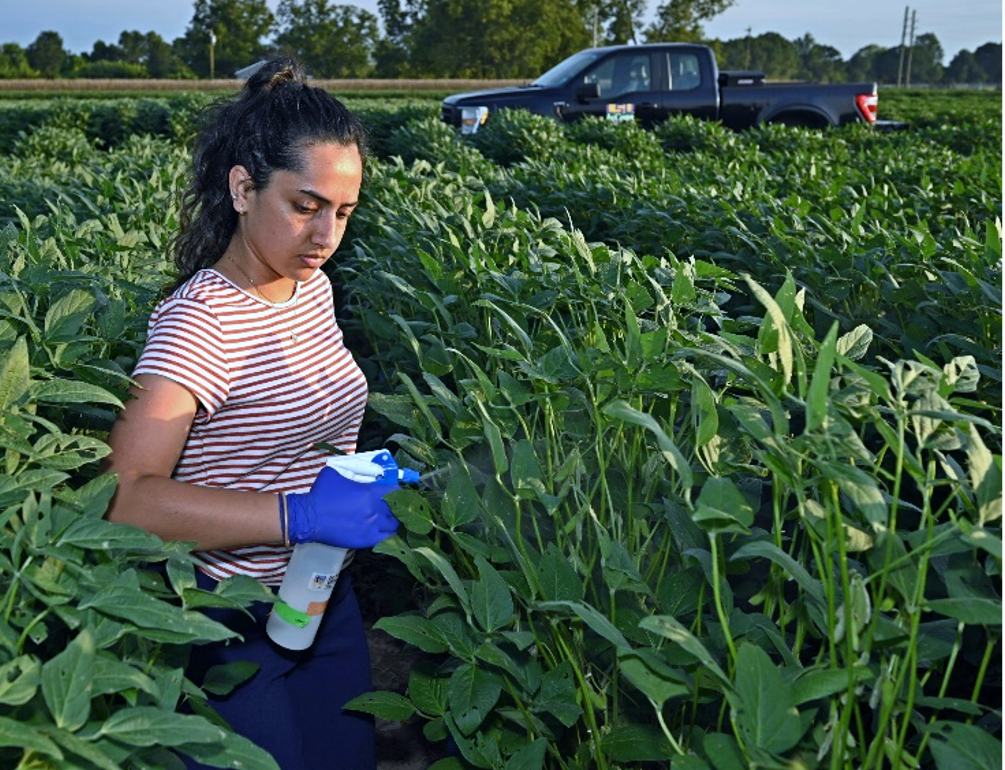
Like all living things, fungal pathogens contain genes that can be triggered on or turned off to help them survive and thrive. Unique Louisiana State University research is exploring how to interfere with such genes in major pathogens to protect soybeans.
“My research focuses on silencing genes to create non-toxic, target-specific solutions to help farmers protect crops against diseases,” explains Zhi-Yuan Chen, professor of plant pathology at Louisiana State University. “A preventative approach to disease management makes the most sense in reducing crop yield loss, but pathogens are developing resistance to commercial fungicides.”
He is working on Cercospora leaf blight, a very prominent soybean problem in Louisiana, with Soy Checkoff support from the Louisiana Soybean and Grain Research and Promotion Board. Related funding from the Mid-South Soybean Board supports this work and includes looking at other soybean diseases, as well.
Genetic Fragments Prevent Infection
Chen and his team identify and create molecules that mimic sequences of ribonucleic acid, commonly known as RNA, found in Cercospora flagellaris, the pathogen that causes Cercospora leaf blight.
He explains that RNA can be fragile. It most often occurs as a single strand, but to make the molecules used to fight disease more stable, his team creates double-strand RNA (dsRNA) to spray on soybean leaves. These dsRNA sequences can be applied to soybeans to “turn off” genes in Cercospora, suppressing disease development.
Chen thinks some of the applied RNA stays on leaf surfaces, while some of it moves into the plant.
“When the pathogen encounters and interacts with the small interfering RNAs derived from the dsRNA, the important functions of the pathogen become suppressed, making it ineffective in causing disease,” he says. “The concept is similar to the Pfizer vaccine used to fight COVID-19.”
His team screened different species of Cercospora and found they have very similar conserved genes, meaning many protein sequences remain the same across species. They learned that the most effective dsRNA sequences targeting Cercospora leaf blight also suppress other diseases, such as frogeye leaf spot cause by Cercospora sojina, a close relative of Cercospora flagellaris.
These dsRNAs can successfully silence genes in Cercospora pathogens and suppress disease development with one spray in greenhouse trials or two sprays 10 days apart in field trials, demonstrating the potential of this approach for disease control. Plus, combining multiple target sequences into treatments prevents the pathogens from developing resistance.
“We’ve seen up to 70% to 80% reduction in fungal growth in soybeans treated with RNA compared to untreated soybeans,” Chen reports. “That isn’t statistically different from the 80% to 90% reduction in fungal growth that commercial fungicides provide.”
Technology to Stabilize Fragments
As the next step in this research, Chen’s team is addressing the limiting factors they have observed.
“Our goal is for a single application of dsRNA-based, non-toxic biopesticide to provide the performance and cost comparable to commercial fungicides,” he says.
However, sunlight or ultraviolet rays can break down dsRNAs, and rain can wash them away.
He is exploring the potential for nanoparticle delivery, encapsulating dsRNA molecules to protect them. Using such a delivery system could also allow for a slow, controlled release of the dsRNA, keeping material on soybeans longer.
Chen is also investigating the potential for adjuvants to keep dsRNA in place better and to enter soybean plants more easily.
“Adjuvants mixed with commercial chemicals help active ingredients stick to leaves better and loosen leaf wax for better penetration,” he explains.
These technologies help reduce effective application rates of dsRNA and increase its stability on soybeans without sacrificing efficacy. Keeping the cost of large-scale production and application of dsRNA technology similar to commercial fungicides would make it a competitive solution to fight Cercospora leaf blight and other soybean diseases.
Additional Resources
Cercospora Leaf Blight – SRIN information page
LSU AgCenter researchers attack Cercospora on multiple fronts – LSU AgCenter article
New frontier in plant disease management: dsRNA studied to combat fungal infections in soybeans – LSU AgCenter article
Scientists advance dsRNA fungicide for soybean – LSU AgCenter article
Cercospora Leaf Blight of Soybean – Crop Protection Network information page
Cercospora Diseases of Soybean and Their Management – Crop Protection Network YouTube video
Meet the researcher: Zhi-Yuan Chen SRIN profile | University profile
The Soybean Research & Information Network (SRIN) is funded by the Soy Checkoff and the North Central Soybean Research Program. For more information about soybean research, visit the National Soybean Checkoff Research Database.
Published: May 11, 2026


