

Research HighlightsStudying Soybean Yield with Applied Fertilizer After a Cover Crop
Highlights:
- A multi-year research project in Illinois explored the impact of nitrogen and sulfur on soybeans after a cereal rye cover crop.
- After three crop years, soybean yield decreased slightly after a cover crop, but additional fertilizer improved soybean yield in only one of three locations.
- Looking beyond yield, farmers should include their entire production system along with environmental benefits from cover crops for improved productivity and profitability.
By Carol Brown
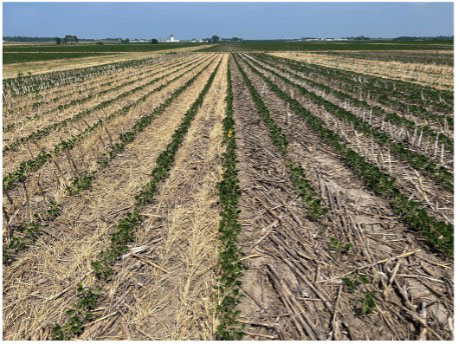
Cover crops are known for their many environmental benefits including reduced soil erosion, improved water infiltration, weed suppression, increased soil biological activity and organic matter over time. But some farmers have experienced a yield drag when growing soybeans after a cereal rye cover crop, therefore are reluctant to adopt them.
Through a multi-year project supported by the Soy Checkoff through the Illinois Soybean Association, Giovani Preza Fontes explored impacts on soybeans following a cereal rye cover crop. Preza Fontes is an assistant professor in crop sciences and an extension agronomist at the University of Illinois Urbana-Champaign. He was hoping to learn more about soybean yield and the influence that cereal rye had on the crop’s nitrogen (N) and sulfur (S) usage.
“There is a common perception that soybeans are more resilient with cereal rye, because soybeans meet their nitrogen requirement through the soil and biological nitrogen fixation,” Preza Fontes explains. “So farmers don’t usually apply nitrogen to soybeans. But in Illinois, and other Midwestern states, farmers are seeing yield penalties on soybeans after a cereal rye cover crop under certain conditions.”
Preza Fontes’ team looked at factors that could explain this through research trials of different treatment combinations:
- cover crop plots with and without cereal rye
- fertilizer treatments:
- 40 lbs. N as urea, broadcast at planting time
- 20 lbs. S as gypsum, broadcast near planting time
- Combination of 40 lbs. N and 20 lbs. S
- an untreated control with no fertilizer.
The trials were conducted at the University research farm near Urbana in 2023, and they expanded with additional locations near Perry and Monmouth in 2024 and 2025, for a total of seven site years. His team included master’s student Sofia Canafoglia, who helped manage all the field and lab work activities for the project.
Inconclusive Fertilizer Answers
“We took soil and soybean tissue samples at each location, and saw an early-season effect from the fertilizers,” he says. “The soybeans that were supplied N and S tended to have a greener canopy and produced more leaf area, but that difference basically disappeared by mid-season.”
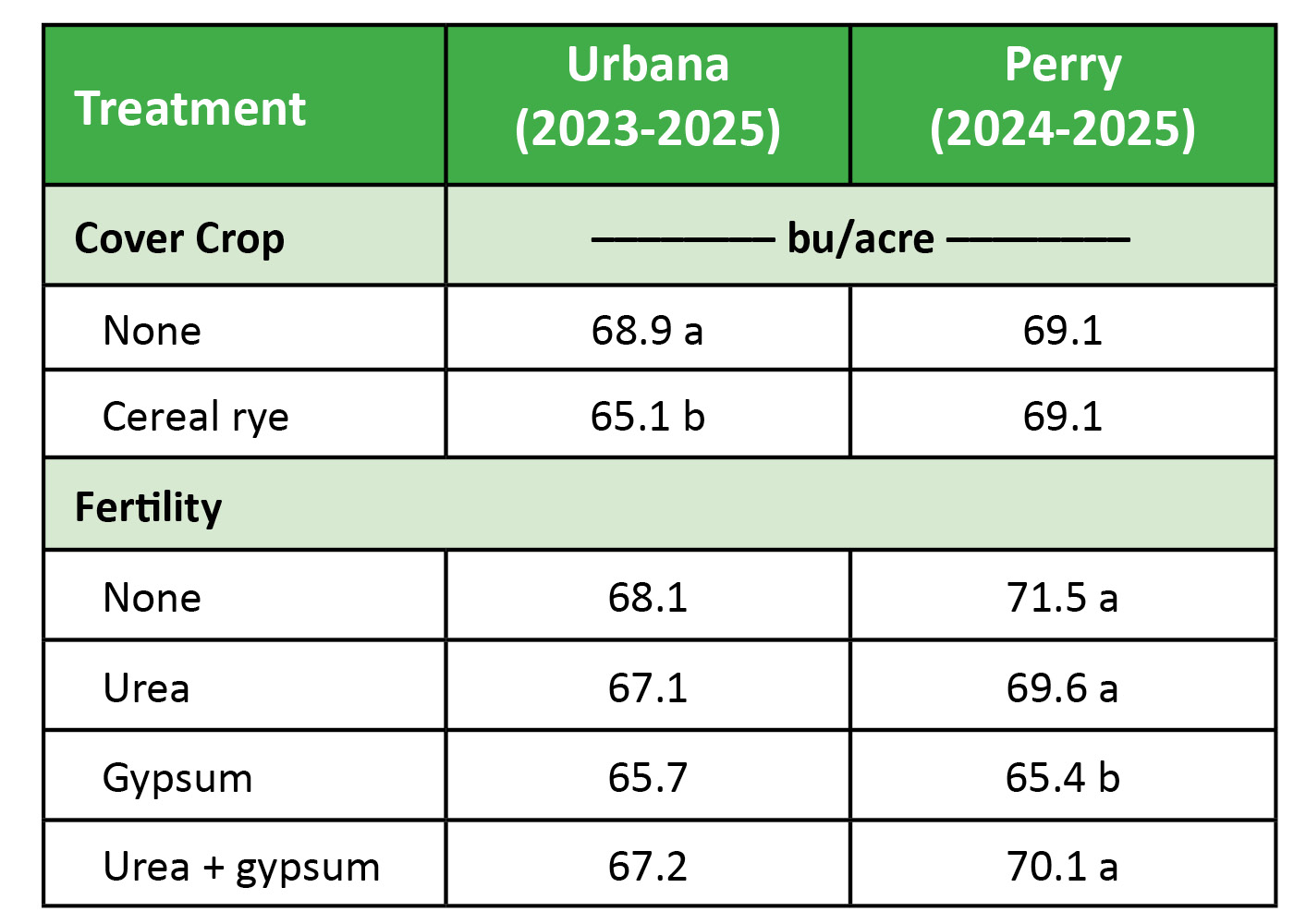
Nor did the additional N and S transfer much to the yield monitors. They measured soybean yield at Urbana across three years and saw approximately 5% lower yields on the plots with the cereal rye cover crop (Figure 1). The fertilizer applications had no yield impact.
At the west-central trials near Perry, Preza Fontes found that the cereal rye cover crop did not lower yields. “Interestingly, lower yields were found on the sulfur-applied plots compared to all the others,” he comments. “These results were unexpected and it is not clear why yields decreased with sulfur application.”
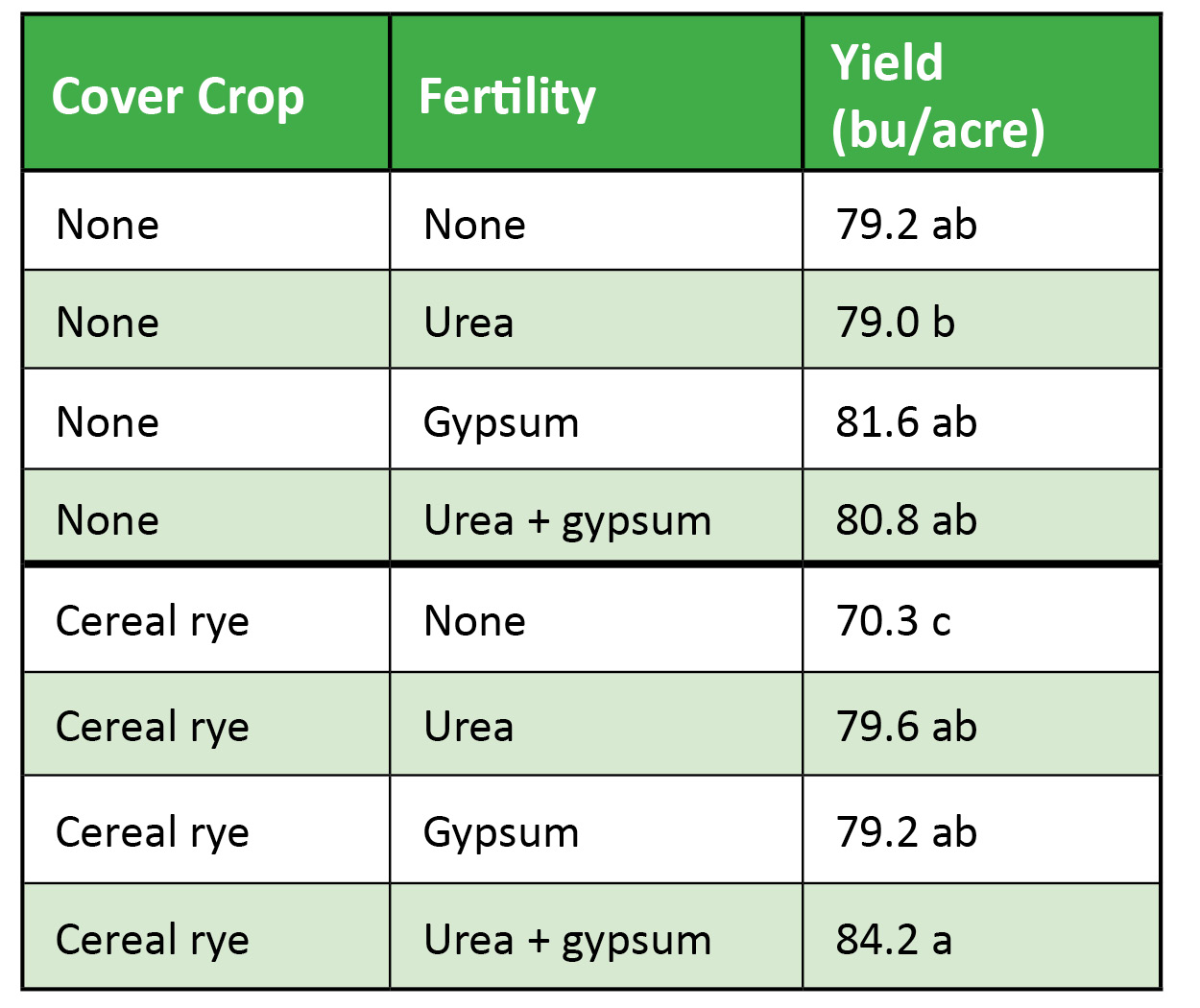
In contrast, at the northwestern trials near Monmouth, the team found that soybeans following cereal rye cover crop yielded about 11% less than with no cover crop, but applying N and S eliminated that yield gap and produced the same at 79 bushels per acre (Figure 2).
“Overall, these results suggest that fertilizer applications of N and S may not consistently provide additional yield benefits when using a cereal rye cover crop prior to soybeans,” he says. “In other words, fertilizer benefits may be site-specific, and adding reference strips in a field with and without N and S can help identify situations where yields can increase.”
With the environmental benefits of a cover crop, it can be an economical trade-off when adding them to the rotation. Crop yields may reduce in the first few years after adoption, but soil organic matter and good biological activity are increasing, water infiltration is improving and soil compaction is decreasing, all of which can lead to increased yields in the long run.
Preza Fontes points to research done by his peers in Wisconsin that illustrate the benefits of a cereal rye cover crop after no-till soybeans, including weed suppression, which can also save farmers money by reducing herbicide passes.
“Putting a dollar amount to these environmental benefits is difficult,” he comments. “I suggest that farmers look at their profitability of the entire system rather than just yield. Over time, they could erase a yield penalty when using cover crops. It’s hard to put a price on soil health and water quality.”
Additional Resources
Nitrogen Fertilizer and Soybean Yield: What We Learned from Multi-Year Trials in Illinois – University of Illinois Dept. of Crop Sciences article
Webinars Discuss Research Results and Recommendations for Conservation Management Transition – SRIN article
It Takes Time: Long-Term Cover Crop Results – SRIN article
Refining Cover Crop Seeding Rates and Planting Dates Can Boost Farmer Confidence – SRIN article
David Wessel on Cover Crops in Illinois – SRIN YouTube video
Nick Harre on Cover Crops in Illinois – SRIN YouTube video
Meet the researcher: Giovani Preza Fontes SRIN profile | University profile | University web page
The Soybean Research & Information Network (SRIN) is funded by the Soy Checkoff and the North Central Soybean Research Program. For more information about soybean research, visit the National Soybean Checkoff Research Database.
Published: Apr 27, 2026


