


Research HighlightsSoy-Based Ingredients in Coatings are Proving their Value
Highlights:
- Soy oil-based ingredients in coatings such as resins, waxes, solvents and dispersants can replace petroleum materials with successful results.
- A soy-based solvent can replace a suspected carcinogenic material and lower the volatile organic compounds in certain coating products.
- Through research supported by the United Soybean Board, soy-based primers and wood coatings have been proven to provide equal or better performance, including corrosion and scuff resistance.

By Carol Brown
There are a host of choices in the paints and stains department at the local home improvement center. From interior and exterior solvent-borne or latex paints, wood stains and varnishes, they all have a chemical recipe for top performance.
Soybeans are helping to make some of these products safer for the user and the environment. Through a multi-year research project supported by the Soy Checkoff through the United Soybean Board, scientists at Stonebridge Coatings Laboratory have been researching how to replace petroleum products with soy-derived materials in paints and coatings.
Debora Hense is the owner and technical director at Stonebridge, an independent lab in Howell, Michigan. She and her team are currently assessing the use of soy solvents in coatings to reduce volatile organic compounds, or VOCs, to meet regulatory limits.
“One solvent used today, Para-chlorobenzotrifluoride (PCBTF), manufactured only in China, is now being regulated by multiple agencies as it’s a suspected human carcinogen,” says Hense. “This has the coatings industry in a scramble to find alternatives. We have had successful results replacing this solvent with a soy oil-based product, reducing the amount of VOCs.”
There are legal limits to the amount of VOCs that can be in paints and coatings, so lower VOCs are advantageous, therefore making the product more desirable within the industry. Stonebridge scientists have already successfully replaced formulations with soy-based materials in wood floor coatings and alkyd primers.
Searching Across the Coatings Industry
With the success of soy-based materials in these products, the coatings industry continues to test soy in more coating formulations. Soy oil has been used for years already in certain products, such as deck sealants and coatings on paper and cardboard packaging.
Supporting Stonebridge in identifying new opportunities for soy materials is Omni Tech International, a long-time USB partner focused on industrial applications of soy. Kris Weigal, director of business development at Omni Tech, works closely with Hense and the Stonebridge team.
“On behalf of USB, Omni Tech works with companies outside the feed, food and fuel sectors,” Weigal explains. “We identify promising soy-based coating ingredients and rely on Stonebridge to evaluate them in real-world formulations – an important advantage since Stonebridge is an independent testing lab.”
Weigal shares Stonebridge’s data with the coatings technical community by presenting at industry conferences and trade shows to increase awareness of soy-based resins, solvents, dispersants and additives. Because Stonebridge develops and validates the replacement formulations, coating manufacturers can shorten their development timelines and integrate soy-based alternatives faster, increasing the demand for soybeans.
Good News for Farmers and Consumers
There are several advantages when soy-based ingredients replace these petroleum products. In most cases, the soy raw materials serve as a pound-for-pound replacement, Hense says, such as with soy pigment dispersants, soy coalescing solvents and soy-based resins. Soy is a domestic, renewable, economic and environmentally friendly source — all pluses for the industry.
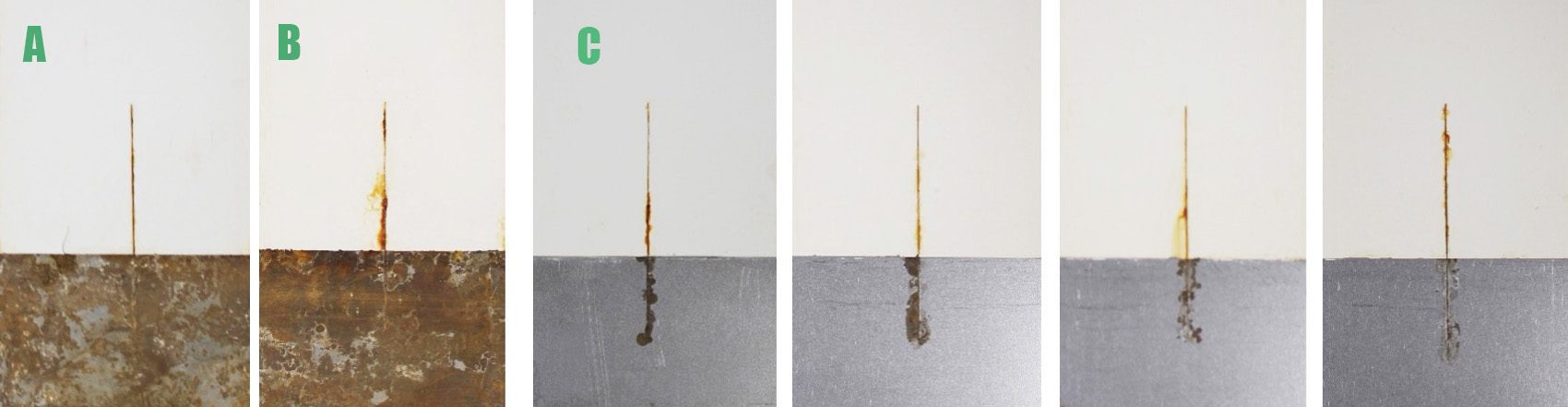
The products with soy-based ingredients are performing just as well, if not better, than those with a petroleum base. For example, Hense and her team explored solvent-based formulations for painting on metal and saw improved corrosion resistance with the soy-based paints. They painted steel samples with two commercially available primers and primers developed at Stonebridge with soy-based resins and solvents formulated to reduce the VOCs. They then exposed the samples to a salt spray for 1,000 hours to corrode the metals. The paints were then removed to expose the metal underneath. The soy-based paints had much better corrosion protection than the others (Figure 1).
Because Stonebridge is an independent company, the results in their testing can inform the industry, which is opposite from other companies that keep formulations in their products private. Stonebridge Labs test for specific industry standards for a particular product, whether it needs to withstand and prevent corrosion or needs to have flexibility or hardness.
Soy-based ingredients continue to prove their merit in new coating developments and looks to play a promising part in the future for both the agriculture and coatings industries as well as the consumer.
Additional Resources
Stonebridge Coatings Laboratory website
Bio-resins with Soy Oil Could Create a New Product and Market for Soybeans – SRIN article
Industrial Uses – United Soybean Board webpage
The Soybean Research & Information Network (SRIN) is funded by the Soy Checkoff and the North Central Soybean Research Program. For more information about soybean research, visit the National Soybean Checkoff Research Database.
Published: Mar 30, 2026


