

Research HighlightsWhat to Plant First: Soybeans vs. Corn
Highlights:
- In the “Battle for the Belt,” planting date trials compared soybeans and corn side-by-side over multiple locations and years to learn how the crops handle the same conditions and help farmers plant both crops for optimum yield.
- Results show that conditions can dictate planting priority between soybeans and corn.
- Soybeans adapt to manage risky planting conditions better than corn.
- Corn thrives and yields best when planted in good conditions.
By Laura Temple
Every spring, as soon as conditions are good (enough), farmers head to their fields. With a given number of acres to prepare and plant, and an unknown amount of time to get it done — thanks to unpredictable weather — they need to make the most of days suitable for fieldwork.
But how should they prioritize planting, especially when it comes to corn and soybeans?
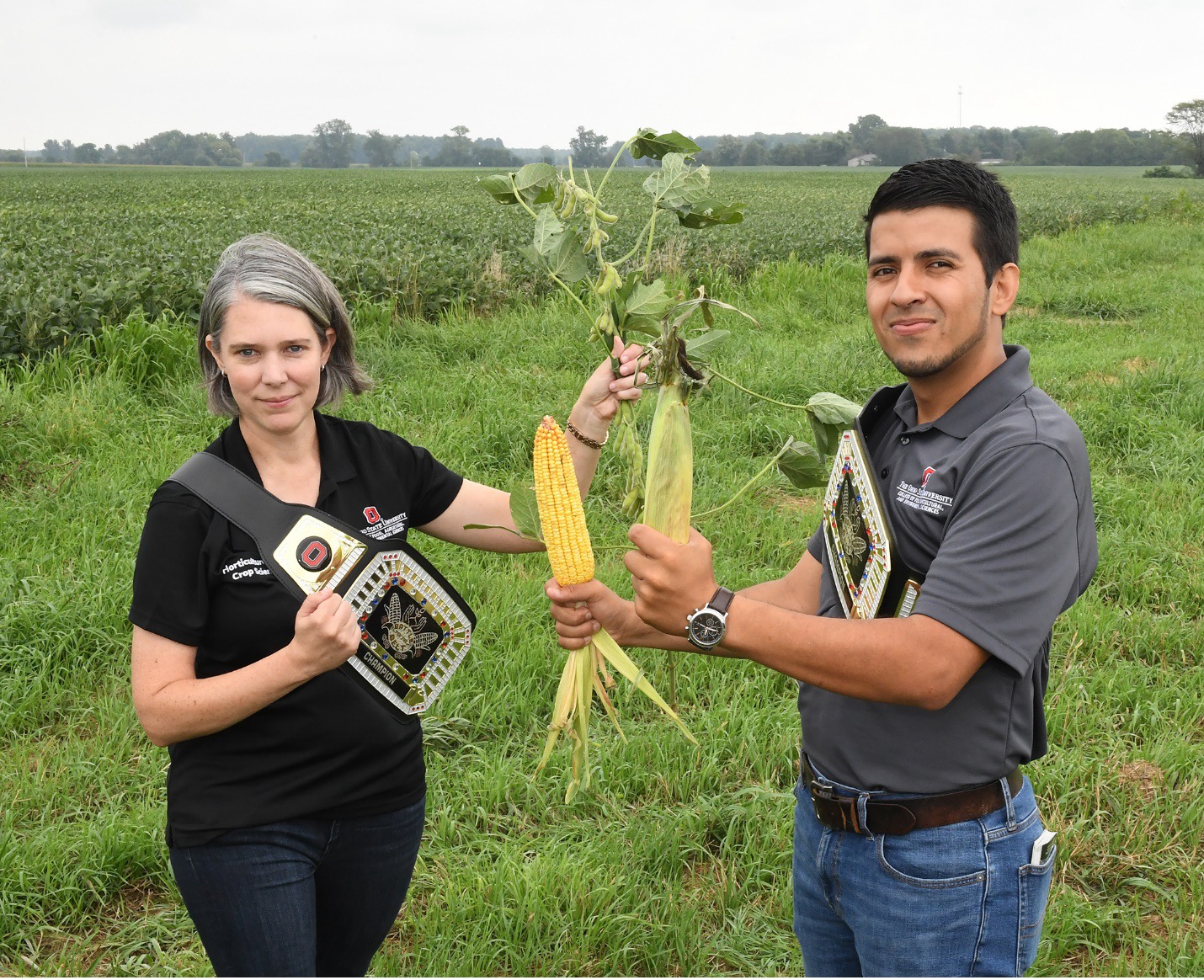
A team of Ohio State University researchers set out to answer this question with a project they dubbed “Battle for the Belt.” It aims to identify factors for farmers to consider as they determine planting order for soybeans and corn. This multi-year research has been possible thanks to support from Ohio Soybean Council, an Ohio State University internal and the North Central Extension Risk Management Education Center.
“Farmers need to pay attention to timely planting,” says Laura Lindsey, professor of soybeans and small grains at Ohio State University and one of the research project leaders. “Timely planting doesn’t cost any extra, but it really does optimize yields.”
However, she acknowledges that in Ohio, the best time to plant both crops is mid-April to mid-May. On average, only half those days are suitable for fieldwork.
“It’s least risky for farmers to plant both crops as the same time,” she says. “But much of the time, that’s not possible.”
In many areas of the U.S., ideal planting timing for corn and soybeans overlaps. And often, weather narrows fieldwork windows during that date range.
Many studies have looked at planting dates for a given crop. This research project, started in 2023, includes both corn and soybeans in the same trials.
Side-by-Side Evaluation
Every season, the team planted soybeans and corn in adjacent plots at university research farms in northeast, northwest and west-central Ohio. They planted on five different dates, each two or three weeks apart, depending on weather conditions. The planting dates ranged from as early as March 25 to as late as June 20.
“This design allowed us to observe how the crops handled the same conditions,” Lindsey says.
The research team shared those observations as the crops grew throughout the season. Their short weekly videos showed the role planting dates played in how soybeans and corn responded to the growing conditions all year.
- In 2023, the cold, wet spring was followed by a dry summer.
- In 2024, conditions were very wet early, but by June, crops faced serious drought conditions, rated D4 or exceptional drought by the U.S. Drought Monitor.
- In 2025, the team completed their earliest planting in late March, but then they weren’t able to plant again until later in April. They crops received good rains through July, but August and September were dry.
In addition to comparing yield, the consistent monitoring allowed the team to see differences in weed, insect and disease pressure based on planting date
“Corn and soybeans definitely respond differently to the same conditions,” Lindsey reports.
The Diva and the Adapter
Overall, the research team found that planting early exposes crops to riskier conditions and more weather challenges.
“Corn likes good soil temperature and moisture conditions at planting, so I call it the diva,” Lindsey says. “Soybeans don’t care as much about bad weather.”
For example, during 2023 when it was wet and cold early, followed by dry weather, she says the soybeans at most planting dates didn’t look good, but they yielded fine. However, the corn planted the first week of June, under the best spring conditions that season, yielded best. The following year, soybeans planted on March 25 yielded the same as those planted in mid-May, but soybeans plated in mid-June yielded 20 bushels per acre less.
“If planting early or late, plant soybeans under the riskier conditions,” she advises. “Plant corn when the weather is ideal.”
Lindsey says their results show that corn yield nosedives when planted under poor conditions or late in the season. Soybean yield declines more slowly, giving farmers more flexibility and less risk for planting early or late.
Soybeans adapt better to weather conditions. For example, in some of these trials, the first and second soybean plantings emerged at the same time. Lindsey mentions that seed treatments help soybeans handle riskier conditions, especially early in the spring.
The team also noted how planting dates interacted with pest pressure.
- Low plant populations of soybeans may not need to be replanted, but they do need good weed control.
- Earlier-planted and later-planted soybeans tend to experience more bean leaf beetle pressure.
- In 2025, green stem occurred more frequently in soybeans planted earlier.
- Tar spot incidence and severity in corn can differ across planting dates, given that different planting times lead to varying weather conditions at the most vulnerable growth stages. Some conditions lead to disease development more often than others.
While these trials focused on yield, Lindsey says the team plans to add economic considerations to the data that has been gathered. This information will further arm farmers as they decide how to best use days suitable for fieldwork to prepare for and plant crops before, during and after the optimum planting window.
Additional Resources
Battle for the Belt playlist 2023 – YouTube video
Battle for the Belt playlist 2024 – YouTube video
Battle for the Belt playlist 2025 – YouTube video
Corn–Soybean Planting Order Could Impact Farm Revenue – SRIN article
Evaluating Early Soybean Planting to Fit Fieldwork Logistics – SRIN article
The Best Soybean Planting Date – Science for Success fact sheet
Science for Success: Soybean Planting Date – YouTube video
Planting Soybeans Early – Science for Success fact sheet
Meet the Researcher: Laura Lindsey SRIN profile | University profile
The Soybean Research & Information Network (SRIN) is funded by the Soy Checkoff and the North Central Soybean Research Program. For more information about soybean research, visit the National Soybean Checkoff Research Database.
Published: Jan 5, 2026


