

Research HighlightsSoybeans Maintain Performance Across Diverse Herbicide Management Strategies
Highlights:
- With herbicide-resistant weed populations rising, farmers need effective management strategies that control weeds without reducing soybean yields.
- North Dakota weed specialist Joe Ikley is finding that applying varying rates of two common herbicides does not impact soybean yield.
- A two-year research project is being conducted at seven sites, measuring applications of metribuzin and sulfentrazone at different rates plus a tank mix of the two active ingredients. The team measured crop safety, weed control and soybean yield at harvest.
By Carol Brown
Herbicide-resistant weeds present a growing challenge and researchers are working to ensure that current weed management practices remain effective and sustainable. A North Dakota weed scientist is finding little to no soybean injury after two common herbicides were applied at rates higher than typical field practice, yet still within labeled limits.
In a research project conducted at seven locations across the state, Joe Ikley and his team are evaluating soybean crop safety after applying metribuzin and sulfentrazone in separate trials. They also conducted weed control trials with these two herbicides at five locations, focusing on kochia, foxtail species and waterhemp.
“We had no soybean injury across the treatments, nor were yields reduced in either trial,” says Ikley, an associate professor and extension weed specialist at North Dakota State University.
The project is in its second year, with results for 2025 coming in after harvest this fall. The research is supported by Soy Checkoff funding through the North Dakota Soybean Council.
The two herbicides were applied at rates most farmers in North Dakota would use — 1x, or a quarter-pound of active ingredient per acre of metribuzin, and an 8-pound active ingredient of sulfentrazone. The team also tested applications at 2x the rate, or one-half pound per acre metribuzin or one-quarter pound sulfentrazone respectively, to look for plant injury as well as effective weed control. They also tested a tank mix with the two rates of herbicides.
“These rates are still below the maximum labeled limits,” Ikley emphasized. “We wanted to evaluate performance under realistic conditions that farmers might encounter if they adjusted rates within label guidelines for their particular soil types.”
These two active ingredients are in several commercial herbicides, and metribuzin is one of the older herbicides on the market, Ikley says. With weeds becoming more herbicide resistant, Ikley and his team wanted to make sure farmers could apply more of these soil-residual herbicides without a penalty in reduced plant growth or yield.
“We had some soybean injury associated with the higher rates of metribuzin within the first four weeks of soybean growth at the North Central Research Extension Center (REC) at Minot and at a cooperator’s field at Glyndon,” he comments. “We measured soybean yield at harvest of these research plots and did not see a reduction.”
Seeing injured plants after a herbicide application can be unsettling, but Ikley reminds farmers that the soybean is a resilient plant and can recover.
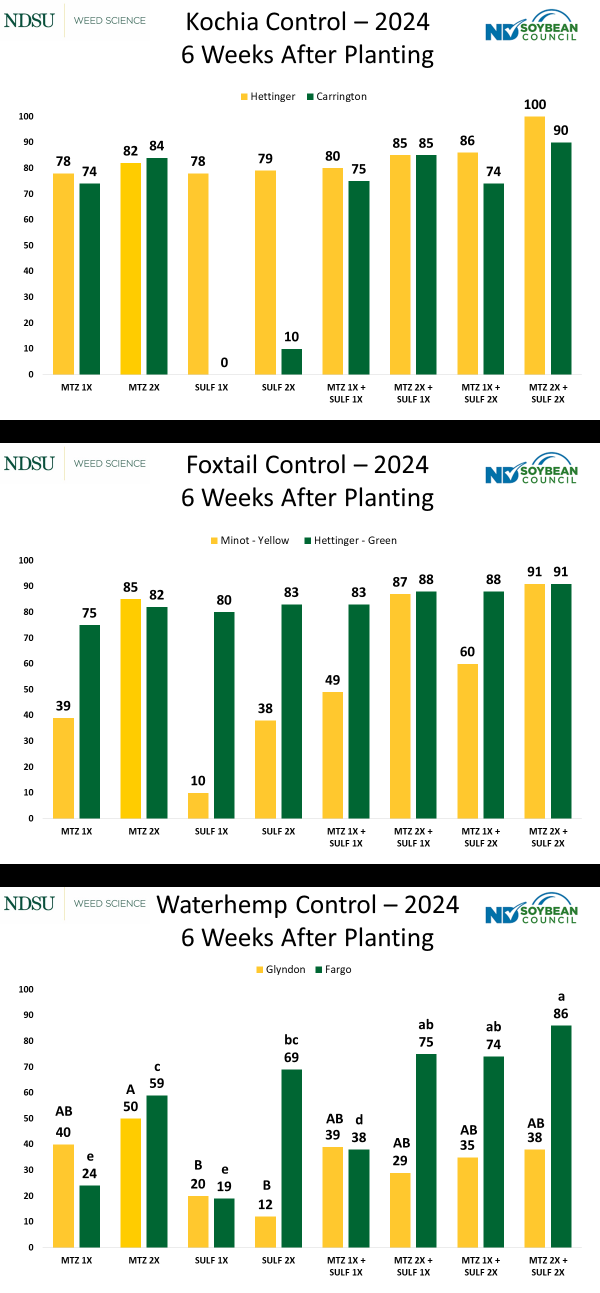
Abbreviations: MTZ = metribuzin; SULF = sulfentrazone; 1X = lowest rate tested for each herbicide (280 g ha-1metribuzin, 140 g ha-1 sulfentrazone); 2X = highest rate tested for each herbicide (560 g ha-1 metribuzin, 280 g ha-1sulfentrazone). Source: Joe Ikley
Weed Control in Different Soils
A component of the research is testing the varying herbicide amounts across the state on a range of soil types, which makes a difference when it comes to residual effectiveness. The weed control trials were conducted at a university research site in Fargo, at the RECs in Carrington Hettinger and Minot, as well as two farmer cooperator farms.
“The locations we chose each have a different soil characteristic — from heavy, clay soil to sandier soils with both low and high pH,” Ikley explains. “Residual effects from the herbicide applications perform differently based on soil types, so knowing how well they control weeds along with possible plant injury are crucial.”
The team evaluated weed presence at six weeks after soybean planting at each site. They focused on the control of particular weeds at the different plots and compared weed control percentage for each herbicide at 1x and 2x applications as well as the combination of the two at both rates.
The team evaluated kochia control at Carrington and Hettinger, foxtail at Minot and Hettinger, and waterhemp pressure at Glyndon and Fargo (Figure 1).
Another factor in the trials is out of Ikley’s control: weather. In 2024, the rain patterns in all the locations were different than this spring. In some trials, weather can be a scientific spoiler, but here it plays a key role in the outcomes.
“The beautiful part of having many different sites across the state is so we can see how the herbicide residuals perform under wet and dry conditions in the different soils,” he says. “We have trials in an array of soil types and across the weed spectrum. The different environments can maximize the amount of data we can capture.”
Ikley will continue to process the data coming in for this crop year to compare with 2024 results. He is optimistic that results will be similar and show soybeans are far more resilient than many might expect. Even with varying herbicide applications they have seen strong performance and stable yields.
Additional Resources
North Dakota Weed Control Guide – North Dakota State University publication
Wild World of Weeds Workshop – NDSU weed science webpage includes information and presentations from this trial and previous Soy Checkoff-funded trials
Mike Schlosser on Weed Management in North Dakota – SRIN YouTube video
Meet the researcher: Joe Ikley SRIN profile | University profile
The Soybean Research & Information Network (SRIN) is funded by the Soy Checkoff and the North Central Soybean Research Program. For more information about soybean research, visit the National Soybean Checkoff Research Database.
Published: Jan 12, 2026


