

Research HighlightsReducing Soybean Sudden Death Syndrome with Management Tools
Highlights:
- Research trials in Kansas explore SDS severity with soybean row spacing, plant populations and resistant varieties.
- After one crop year of data, results showed SDS was more severe with narrow rows and high plant populations.
- An SDS predictive model is being developed from 10 years of data to help farmers with management decision-making.
By Carol Brown
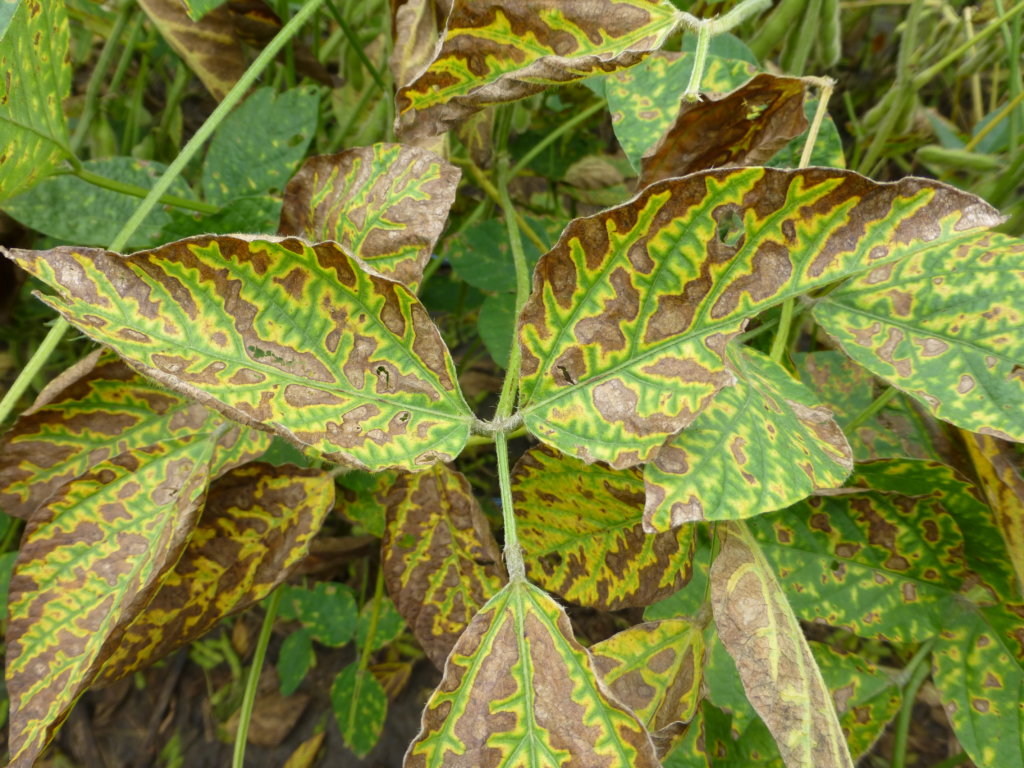
Sudden death syndrome, or SDS, is an impactful soybean disease. The pathogen that causes SDS, Fusarium virguliforme, lives in the soil and infects soybeans through their roots. The troublesome disease is common across Midwestern soybean growing states.
Rodrigo Onofre, assistant professor and plant pathologist at Kansas State University, leads a research project that explores if SDS can be reduced through management practices including row spacing, plant population and variety selection. The research is supported with Soy Checkoff funding from Kansas Soybean Commission and the North Central Soybean Research Program (NCSRP).
“We’ve been looking at ways to manage this disease with management practices in Kansas field trials,” Onofre says. “In the first year, preliminary results suggest that SDS was more severe under high plant populations (160,000 and 200,000) and 15-inch rows.”
This summer is the second year of the trials, which compares 15- and 30-inch rows, soybean seeding rates including 80,000, 120,000, 160,000, and 200,000 seeds per acre, as well as SDS-susceptible versus resistant varieties. Second-year data will be available later in 2025.
SDS Predictive Model
Onofre’s graduate student Madison Kessler is developing a predictive model for the probability of severe SDS in fields. The data that informs the prediction tool includes 10 years of SDS records at field trial sites in Rossville and Topeka, and one site in Iowa. Additionally, the model considers corresponding rainfall, soil temperatures and soil moisture data at these sites, all of which are key predictive SDS factors.
Kessler began working the project three years ago while pursuing her master’s degree and is now working toward a Ph.D. The predictive model is part of her thesis work.
“Since SDS is a disease that sticks around, the model can help farmers to see if it could be severe again. It’s all about what to do before the seed is in the ground, because once SDS is seen in the field, there’s nothing that can be done,” says Kessler. “If the prediction is for high SDS, they could add a seed treatment, change to an SDS-resistant variety, alter agronomic practices including wider row spacing and reduced seeding rates.”
The goal of the model is for accurate prediction at about six months before planting, typically when farmers are ordering seeds, Kessler says. The team is currently validating the model and Kessler hopes that by next year they can roll it out. The predictive modeling work is also part of a larger NCSRP project.
The research team is also evaluating the genetic diversity of the Fusarium species complex in Kansas soybeans. They collected isolates from fields in 18 Kansas counties and found them to be Fusarium virguliforme.
“We want to ensure there is only one type of Fusarium here in Kansas,” comments Kessler. “This will also confirm that farmers are targeting the correct pathogen through seed treatments and chemical compounds.”
The ultimate goal of this research is to give farmers practical tools and recommendations to keep SDS from impacting their bottom line. When the predictive model is available, Onofre and Kessler will be promoting the tool at grower meetings across the state to show how it works and encourage its use.
Other Resources
Multi-Faceted Plant Pathology Project Reflects Collaborative Intention of NCSRP – SRIN article
Sudden Death Syndrome – SRIN information page
Combatting Soybean Seedling Diseases From Inside and Out – SRIN article
Soybean Sudden Death Syndrome Update – Crop Protection Network video
Published: Nov 17, 2025


