

Research HighlightsImproving Soybean Yield in Terraced Fields
Highlights:
- Terraced farmland has several benefits, but a drawback is that water can be slow to drain, causing yield losses in low-lying areas.
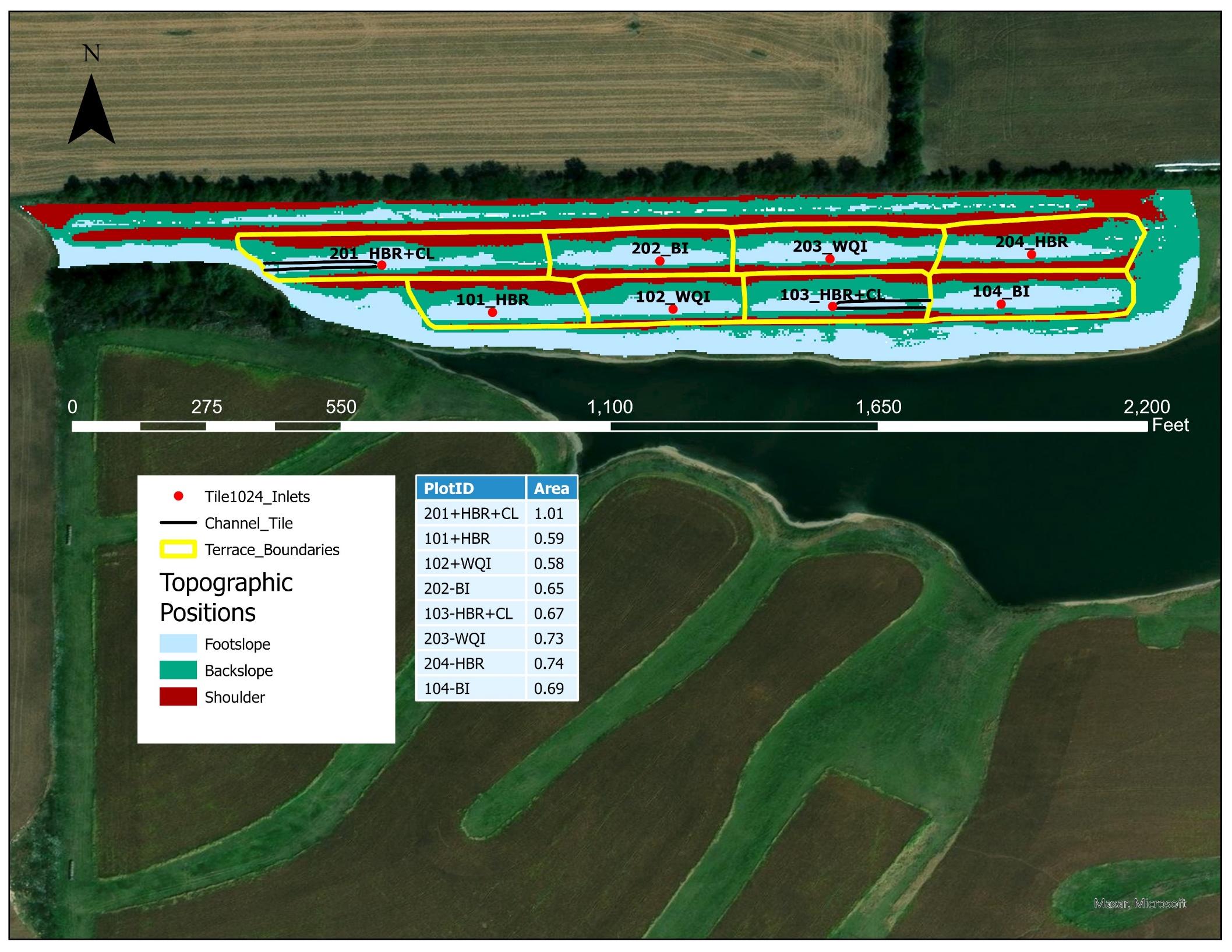
- Missouri researchers are measuring soybean yield on terraces after additional drainage tile is installed laterally along the terrace and tied into the main tile line.
- The multi-year project shows an increase in soybean yield in the terrace channels with targeted subsurface drainage.
By Carol Brown
In certain areas of the United States, farmers contend with hilly land that can be difficult to farm. Many have manipulated those hills to form terraces. Their most important benefit is reduced erosion on highly erodible land. In northern Missouri, where more than 40% of the land is considered highly erodible, terraces are a crucial infrastructure for long-term farming success.
Terraces are the proverbial double-edged sword. They are beneficial for soil protection, but water can be slow to drain from the structures, which could reduce crop yield in the low areas of the terrace.
“Tile drainage is installed in the terraces when they are built. The tiles deliver water to a grassed waterway or stream at the bottom of the hill,” Kelly Nelson explains. “Tile inlets are in the channel area of each terrace and they are built with a slope toward the inlet pipe. Water can accumulate in this low area. Over the years we’ve noticed that in the low part of a terrace, soybean yields have reduced up to 30%, compared to other parts of the landscape.”
Nelson is an agronomy professor at the University of Missouri and is based at the Lee Greenley Memorial Jr. Research Farm near Novelty. He is conducting research on tile drainage within a terrace to help increase soybean yield while keeping soil in place. Through a multi-year research project, supported by Soy Checkoff funding from the Missouri Soybean Merchandising Council, Nelson is adding perforated drainage tile to reduce the water table level in those portions of the field.
In 2023, Nelson and his team, Drs. Gurbir Singh and Gupreet Kaur, installed additional drainage tile on terraces at three cooperating farmer fields. They added three more on-farm sites in 2024. These additional tile lines connect to the main tile to offer additional drainage.
“We’re adding perforated tile in the high-risk, waterlogged area in the channel laterals of the terrace,” he says. “We’re focusing on about 15% of the field. In those areas where the laterals were installed, we’ve seen up to a 22% increase in soybean plant stand and an 11% yield increase.”
The ultimate goal is to improve soybean yield while reducing erosion and sediment loss in the terrace areas that tend to be saturated at times during the growing season.
“We’re looking at synergistic benefits,” comments Nelson. “We want to lower the water table in the channel or foot slope portion. This will help reduce soil moisture content, which reduces the opportunity for disease and enhances crop establishment. High soil moisture also means anaerobic soil conditions. Oxygen needs to get to the plant roots, otherwise they die.”
Under saturated soil conditions, other nutrients are being under-utilized. Denitrification occurs in anerobic conditions, which reduces nitrogen available for plant use. By enhancing terrace drainage, all of these aspects can improve crop growth.
Most of the fields in the project are under no-till and are in a corn-soybean rotation. One farmer added wheat with double-crop soybeans. Nelson says it will be interesting to compare the results over time in the fields with the different rotations and rotational crops.
The cost to enhance drainage in the terraces may be offset by the crop’s increased yield and Nelson is exploring these economic aspects. Results could inform how tile drainage is installed in terraces in the future as these lateral tile lines could be included in the initial installation.
Additional Resources
Northern Missouri Research, Extension and Education Center Field Day Annual Report 2025 – University of Missouri document
Exploring Soybean Performance Interaction With and Without Tile Drainage – SRIN article
Meet the Researcher: Kelly Nelson University profile
The Soybean Research & Information Network (SRIN) is funded by the Soy Checkoff and the North Central Soybean Research Program. For more information about soybean research, visit the National Soybean Checkoff Research Database.
Published: Feb 16, 2026


