

Research HighlightsHealthy Soil, Happy Soybeans: Insights from Multi-State Research
Highlights:
- A multi-state research project analyzed soil samples from 21 trial sites across the country to find how soil health impacts soybean yield.
- The team wanted to understand how soil health is influenced by crop rotations, tillage, tile drainage and cover crop usage.
- They analyzed many soil health parameters such as organic matter, soil organic carbon, total nitrogen, oxidized and mineralizable carbon, wet aggregate stability and more.
Adapted from Healthy Soil, Happy Soybeans: Insights from Multi-State Research – CoolBean publication, University of Wisconsin-Madison
By Tatiane Severo Silva, Spyros Mourtzinis, Matthew Ruark, Fabiano Colet, and Shawn Conley
Healthy soil isn’t built overnight, but the choices farmers make each season can move the needle. Healthy soils improve nutrient cycling, retain water more effectively, and help crops withstand extreme weather better.
In a recent multi-state study1, a research team analyzed soil samples from field trials across the U.S. to understand how management practices influence soil health and soybean yield. Specifically, the team investigated whether crop rotation, cover crops, tillage, and tile drainage were associated with changes in soil health parameters, soil fertility, and inherent soil properties. They then looked at how these affected soybean yield.
The project was led by Shawn Conley, professor and State Soybean Specialist at the University of Wisconsin-Madison, and funded through Soy Checkoff support from the Wisconsin Soybean Marketing Board, United Soybean Board, as well as USDA-National Institute of Food and Agriculture (NIFA).
The team used soil samples collected in 2023 from 21 experimental agricultural research trial sites in nine states. The sites ranged from short-term cover crop trials (4 years) up to long-term soybean management trials (50 years). The sites compared the effects of at least one of four practices: cover cropping, crop rotation, tillage, and artificial drainage. To look at how these practices affected soybean yield, the team used a subset of 17 agricultural research trials from the larger dataset (Fig. 1).
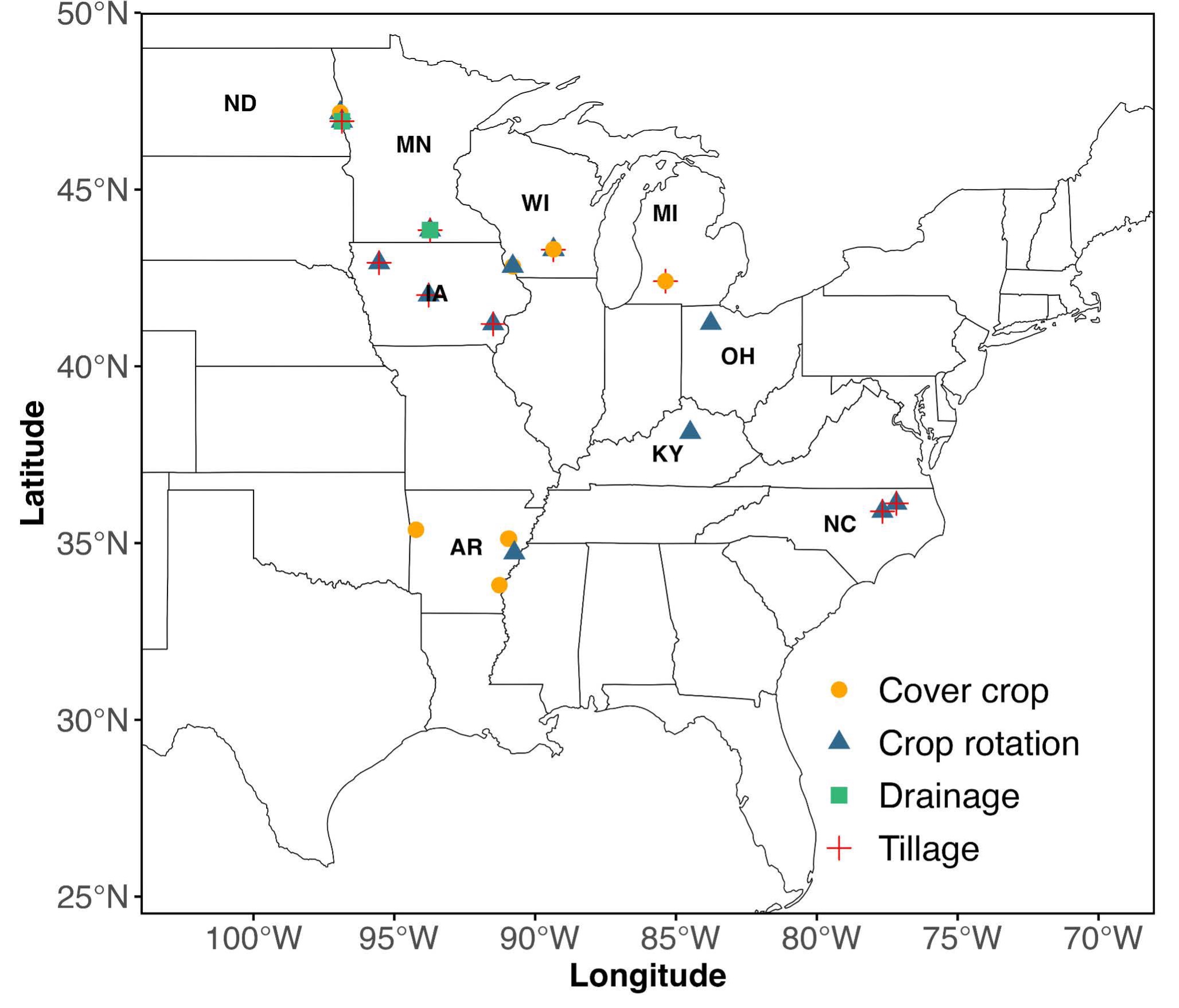
The field trials ranged from two-crop and three-crop rotations with no-till and conventional tillage; trials with lower tillage intensity such as strip-tillage or reduced tillage in a two-crop rotation; and cover crops in no-till or reduced tillage with one, two or three crops in rotation.
Soil Sampling
Soil samples were collected at 6-inches deep, between mid-April and mid-June near or at crop planting time, according to each location’s schedule. These samples were used to evaluate soil fertility, soil health, and basic soil properties.
The team measured soil fertility by testing phosphorus and potassium levels, and recorded inherent soil properties of pH and texture.
They also tested soil health parameters including:
- Organic matter (loss-on-ignition, OM-LOI)
- Soil organic carbon (SOC)
- Total nitrogen (TN)
- Soil protein (autoclaved citrate-extractable nitrogen, ACE-N)
- Permanganate oxidizable carbon (POXC)
- Mineralizable carbon (Min-C)
- Water-extractable organic carbon (WEOC)
- Wet aggregate stability (WAS).
Soil Health and Management Impacts
The team analyzed the vast amounts of data and found several interesting results of how management practices influence soil health. Soils under cover crops had greater organic matter, including 18% more microbial carbon, which reflects active microbial life and nutrient cycling. They also found 7% more water-extractable organic carbon, the readily available carbon that feeds soil microbes, than soils without cover crops.
Other findings include:
- Two-crop rotations were associated with more phosphorus compared to a single crop.
- No-tillage slightly lowered soil pH.
- Tile drainage did not significantly affect any of the measured soil health parameters.
Modeling for Soybean Yield Drivers
The team then built a model from the collected data to further understand how soil health and management practices drive soybean yield. The model included management practices of the number of crops in rotation, years in rotation, previous crop, planting date, maturity group, seeding rate, tillage type, cover crop, artificial drainage, irrigation, and P and K fertilizer. They included the same soil health parameters and soil properties in the study, as well as location-specific factors of latitude, longitude, precipitation and temperature.
The model allowed the team to determine which factors were most important for soybean yield, and explained 73% of soybean yield variability. Key findings include:
- Trials planted before mid-May had the greatest average yield (72 bu/ac).
- For soybeans planted between mid-May and late May, fields with higher ACE-N (>5.73 g/kg) produced about 8 bu/ac more than fields with lower ACE-N.
- In the same planting window, if longitude was at or greater than -91.26, higher potassium (>139 ppm) resulted in higher yield (58 bu/ac) compared with lower potassium levels (52 bu/ac).
- Planting after late May resulted in the lowest yields (39 bu/ac), regardless of other soil or location factors.
Additionally, the team ran a simplified model using only the main management factors and key soil and location variables. The results include:
- Planting date and soil organic carbon were the strongest predictors of soybean yield.
- Fields planted in mid- to late-May with soil organic carbon above 2.3% tended to produce the greatest yields.
Overall Results
Cover crops improved important soil health metrics such as mineralizable carbon and water-extractable organic carbon, whereas artificial drainage did not affect soil health. Soybean yield was strongly influenced by soil organic carbon, soil protein, longitude, and potassium levels. While in-season management practices have a more immediate impact on yield, long-term monitoring of soil carbon and nitrogen is essential for sustaining soil health and ensuring consistent, high soybean yields.
Additional Resources
1 Impacts of rotation, tillage, cover cropping, and drainage on soil health in soybean-based cropping systems: evidence from 4–50-year trials across the US. Agriculture, Ecosystems and Environment, 395, 109950. https://doi.org/10.1016/j.agee.2025.109950
Soybean yield response to management practices (4–40 years) and soil health parameters. Field Crops Research, 329, 109959. https://doi.org/10.1016/j.fcr.2025.109959
Healthy Soil, Happy Soybeans: Insights from Multi-State Research – CoolBean publication, University of Wisconsin-Madison
Meet the researcher: Shawn Conley SRIN profile | University profile
The Soybean Research & Information Network (SRIN) is funded by the Soy Checkoff and the North Central Soybean Research Program. For more information about soybean research, visit: National Soybean Checkoff Research Database.
Published: Dec 15, 2025


