

Research HighlightsDetermining Need for Insecticide Insurance
Highlights:
- When soybean insect pressure is below treatment thresholds, research shows no value from low-cost, in-season insecticide “insurance.”
- An Ohio State research team monitored soybean plant and pod damage and found no statistical yield difference between treated and untreated plots.
By Laura Temple
“You have to spend money to make money.”
This common phrase traces back through George Eastman, founder of Kodak, in a New York Times interview, to an ancient Roman playwright. But it could have started with a farmer.
Few business owners understand investing and waiting for the return like farmers. However, when crop margins are razor-thin, farmers also need to pay attention to related business advice about being intentional in investments. Spending, even a small amount, on something that doesn’t make a difference, cuts into profits — or increases losses.
Foliar insecticide applications, even when tank mixed with fungicide, often fall into the category of investments without a return, according to Laura Lindsey, professor of soybeans and small grains at Ohio State University.
Lindsey led trials to evaluate the value of foliar insecticides during reproductive growth stages as cheap insurance for soybeans, with support from the Ohio Soybean Council.
“We looked at any insect damage during reproductive soybean growth in 10 environments over two years,” she reports. “If insect pressure is below treatment thresholds, insecticide applications make no difference in soybean yield.”
Stink bugs, bean leaf beetles and other insects commonly show up in Ohio soybeans while the crop blooms, sets pods and fills them.
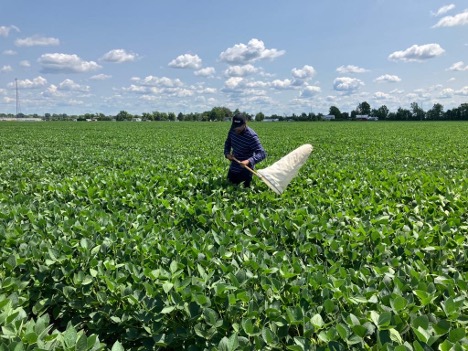
Lindsey’s team conducted small plot, on-farm trials in 2022 and 2023 in multiple locations around Ohio. Plots received applications of alpha-cypermethrin, sold as Fastac insecticide, a cost-effective, broad-spectrum pyrethroid. The team compared R3 and R5 application timings.
“We regularly monitored insect pressure and leaf defoliation,” Lindsey says. “Even combining species, insect populations never reached threshold levels.”
Her team regularly reported the percent of leaf surface lost to insect feeding, using a 3D scouting tool the second year to ensure accurate estimates. Right before harvest, her team also evaluated pod damage and checked for shriveled soybeans in pods that could have been caused by insects.
“We saw no statistical difference in yield with any type of damage or any insecticide applications,” she says.

Even when applying insecticide adds minimal cost to a planned fungicide application, Lindsey encourages farmers to save those few dollars per acre.
“Using insecticides when needed is important to protect crops, so farmers need to scout — and not just the field edges,” she explains. “I know it isn’t pleasant to scout at that time of year, but if pressure is below thresholds, fields don’t need insecticide.”
Lindsey adds that using unnecessary insecticides increases the potential for the few insects present to develop resistance, which decreases the effectiveness of future applications. At the same time, such applications also control beneficial insects that serve as pollinators or prey on crop pests.
Low soybean prices and strong input costs create an environment where the “cheap insurance” of adding an insecticide in-season is simply spending more money, not helping the spender make more money. Pencil it out to protect the bottom line.
“Unless there’s a true insect outbreak, insecticide isn’t protecting yield,” Lindsey says.
Additional Resources
Soybean yield was not influenced by foliar insecticide application at R3 and R5 stages – Crop, Forage and Turfgrass Management journal
3D Scouting Tool Improves Accuracy of Soybean Defoliation Estimates – SRIN article
Unintended Consequences Link Seed-Applied Insecticides to Slug Pressure – SRIN article
Soybean Invertebrate Pest Loss Calculator – Crop Protection Network
Soybean Invertebrate Loss Estimates from the United States: 2024 – Crop Protection Network article
Meet the Researcher: Laura Lindsey SRIN profile | University profile
The Soybean Research & Information Network (SRIN) is funded by the Soy Checkoff and the North Central Soybean Research Program. For more information about soybean research, visit the National Soybean Checkoff Research Database.
Published: Jan 26, 2026


