

Research HighlightsAnother Reason to Plant Early: Carbon Intensity Score
Highlights:
- Carbon intensity represents greenhouse gas emissions, and the score for emissions per bushel of soybean production influences demand for soybeans as a feedstock for biofuels, including biodiesel and renewable fuel, or as a raw material for other industrial uses.
- Field trials and modeling research show how planting longer-season soybeans early reduces greenhouse gas emissions and increases yield, improving carbon intensity score.
- Planting cover crops and managing crop residue may also reduce greenhouse gas emissions and boost yield.
By Laura Temple
Research gives farmers compelling reasons to plant soybeans earlier, including yield potential, harvest timing and profitability.
End-user and energy program demands are adding another reason to that list: carbon intensity score.
“Carbon intensity is a modeled number representing greenhouse gas emissions,” explains David Krog, co-founder and CEO of Salin 247.
For crops like soybeans, carbon intensity, or CI, converts any greenhouse gas emissions to grams of CO2 equivalent per bushel grown.
Demand for low CI soybeans is growing. The Department of Energy’s assessment of renewable energy uses CI scores to compare the environmental impact of energy sources. This metric informs how renewable energy options fit into overall carbon reduction strategies. Companies that have set carbon emission reduction goals may also use CI scores as they evaluate raw materials and process changes that move them toward those goals.
“A significant proportion of the CI score for biofuels comes from growing crops like soybeans,” says Mike Castellano, a professor with the Iowa State University Department of Agronomy. “About two-thirds of soybean production emissions come from the loss of nitrous oxide from the soil.”

Greenhouse gas emissions for crops typically get figured per acre. These emissions include inputs and field traffic, roughly one-third of the emissions from growing crops. That projection is added to the nitrous oxide, or N2O, soil loss. The emissions total is divided by yield to get the CI score, as the graphic shows. Reducing emissions reduces CI. However, another effective way to lower the CI score is to increase yield.
Together, Krog and Castellano are investigating how earlier planting, which tends to boost yield, impacts soybean CI scores. Their work considers other management practices, as well. The Iowa Soybean Association supports early planting trials managed by Krog, alongside biophysical process modeling work led by Castellano. The modeling work also is funded by the United Soybean Board.
Link Between Planting Date and Nitrogen Loss
Soybeans fix most of the N they need from the atmosphere, but the plants take up about 40% of their N from the soil. As soil microbes process nitrogen in the soil from fertilizer, manure or organic matter, some N2O leaks into the air. Rain causes runoff that carries some soil nitrates away from crops through waterways.
“All warm-season annual crops lose nitrogen due to the mismatch of timing between microbial N production from soil organic matter and crop growth,” Castellano says.
Improving timing between when soybeans take up N and its availability within the soil addresses this challenge.
“Soybeans are often planted weeks later than the optimum physiological timing,” he explains. “We looked at moving planting date up dramatically from the average to the insurance date, and even earlier.”
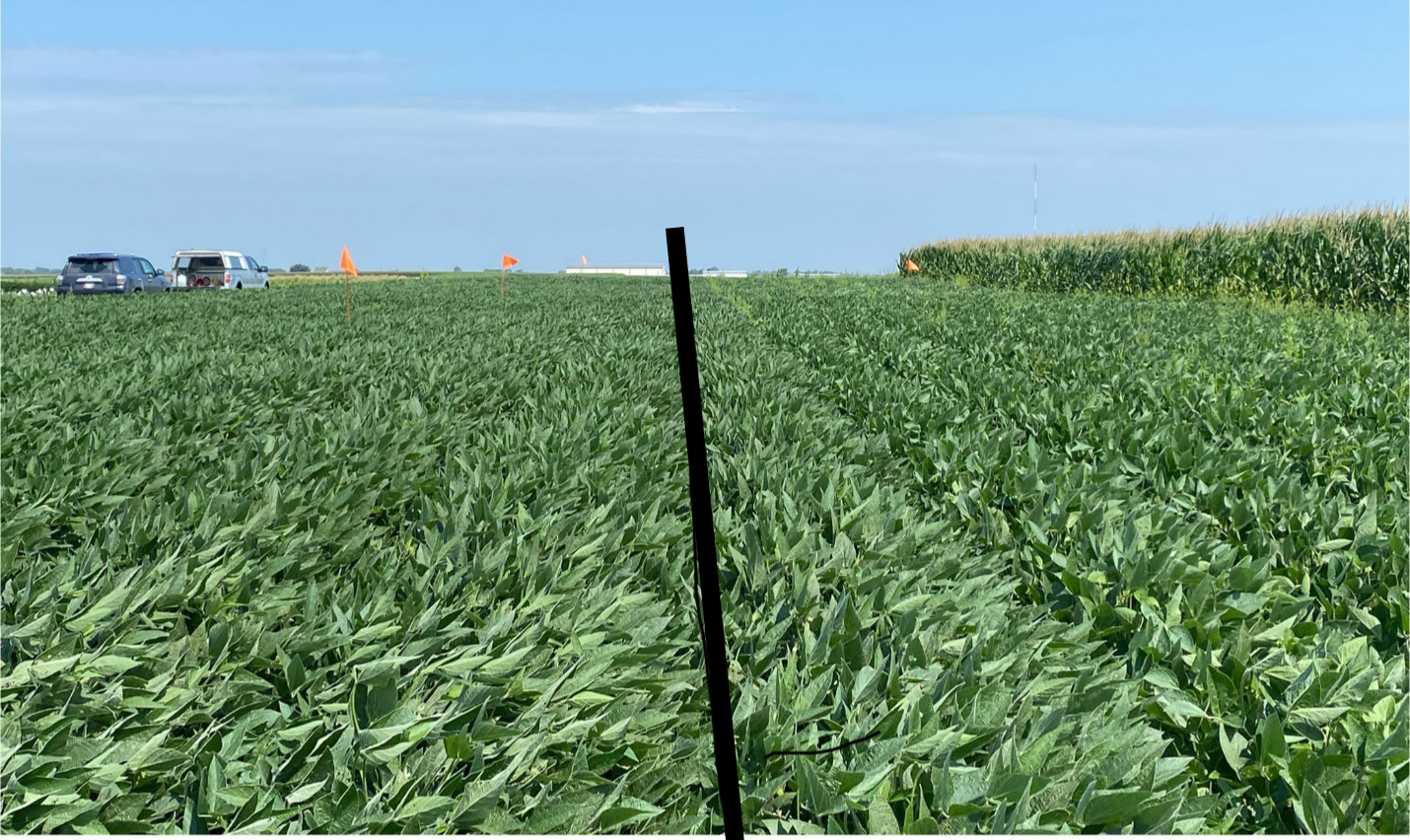
For example, in 2025 Castellano reports planting soybeans in Ames, Iowa, on March 30. Though it took three weeks for the crops to emerge, they looked good late in the season.
Planting early expands the window for crop growth. Earlier planted soybeans use naturally available soil N more efficiently, increasing update and reducing losses. And, research shows that the longer window for growth boosts yield. That’s a win on multiple fronts for farmers and soybean CI scores.
Field Trials + Mathematical Modeling
Measuring greenhouse gas emissions is difficult and costly, especially under field conditions where environmental variability adds complexity.
“Models provide a first approximation of how a change in practices impacts emissions,” Castellano says. “They provide an initial, cost-efficient evaluation to guide field trials.”
He equates the simulation model developed to evaluate changes in planting dates to the models used for weather forecasting. Putting an abundance of data about soybean growth, weather, planting date and more into a biophysical process model provides a mathematical representation of what is expected to happen.
“With the model, we looked at the expected greenhouse gas emissions from planting earlier across 40 weather years,” he says.
Castellano and his team applied the model to early planting field trials managed by Krog in 2024. The eight on-farm trials compared soybean plantings about three weeks apart, the first near the local initial crop insurance planting date, and the second closer to average soybean planting timing.
“The modeled results predict a 17% decrease in nitrous oxide emissions from the soil and a 10% reduction in leaching when soybeans are planted early and farmers change to a longer-season maturity group,” Castellano reports.
Those numbers reduce the numerator in the basic CI score equation. Increasing yield per acre, the denominator in the basic equation, also decreases the final score.
Krog notes that the measured yield from the plots, which came from combine yield monitor data, aligned with the model predictions in most cases.
“Field data has been consistent with model predictions in three out of four locations the last couple years,” Castellano adds.
Impact of Related Management Practices
Modeling and field trials also investigated the impact of management practices closely linked to planting.
Castellano says increasing the maturity group of soybeans used in early planting improved soybean yields 16%.
“In addition, the model shows that combining cover crops with early planting delivers a 28% reduction in nitrous oxide loss from the soil and a 36% reduction in nitrate leaching,” he says.
These numbers project notable changes in CI score. Castellano reports that early planting cut soybean CI score 25% per bushel. Adding cover crops to early planting reduced CI score 33% per bushel.
The field trials have removed corn residue from the previous crop in some plots to allow earlier soybean planting and encourage earlier emergence.
“Removing corn residue does improve yield,” Krog reports. “However, we don’t yet know how the higher yield and higher energy requirement to remove residue impacts CI score.”
While CI score isn’t a factor soybean farmers consider, it plays a role in soybean demand, especially for biofuels.
“The bottom line is, should farmers plant soybeans early?” Krog says. “This research provides more evidence that planting early pays, both directly and indirectly.”
Additional Resources
The Best Soybean Planting Date – Science For Success fact sheet
Planting Soybeans Early – Science For Success fact sheet
Corn–Soybean Planting Order Could Impact Farm Revenue – SRIN article
Evaluating Early Soybean Planting to Fit Fieldwork Logistics – SRIN article
Breeding Climate-Smart Soybeans Starts at the Roots – SRIN article
Meet the researchers: Mike Castellano SRIN profile | David Krog SRIN profile
Published: Dec 1, 2025


