

Research HighlightsConservation Tillage Protects Soil and Nutrients for Long-Term Productivity
Highlights:
- An Illinois researcher is diving into soybean yield results under no-till and strip tillage with promising results.
- Soybean yields were similar between no-till, strip till and conventional tillage.
- Illinois acres under no-till are low and researcher Giovani Preza Fontes hopes the results from his trials can help farmers when considering the adoption of this conservation practice.
By Carol Brown
The 1930s Dust Bowl is a familiar lesson in U.S. history books. But dust storms have occurred in central Illinois as recently as 2025. A 2023 dust storm near Springfield caused accidents involving more than 70 cars and resulted in seven deaths. History examples like this don’t need to be repeated as agriculture experts have learned how to keep soil in place and protected from wind erosion.
Reduced tillage and no-till, or conservation tillage, are common practices that guard topsoil, but many farmers have not adopted this practice, mainly due to perceived lower crop yields. According to the USDA, approximately 15% of Illinois corn acres and 35% of soybean acres are no-tilled (Figure 1).
In 2023, Giovani Preza Fontes, assistant professor of crop sciences and extension agronomist at the University of Illinois, began a research project evaluate whether growers can maintain soybean productivity and profitability while using reduced tillage and cover crops.
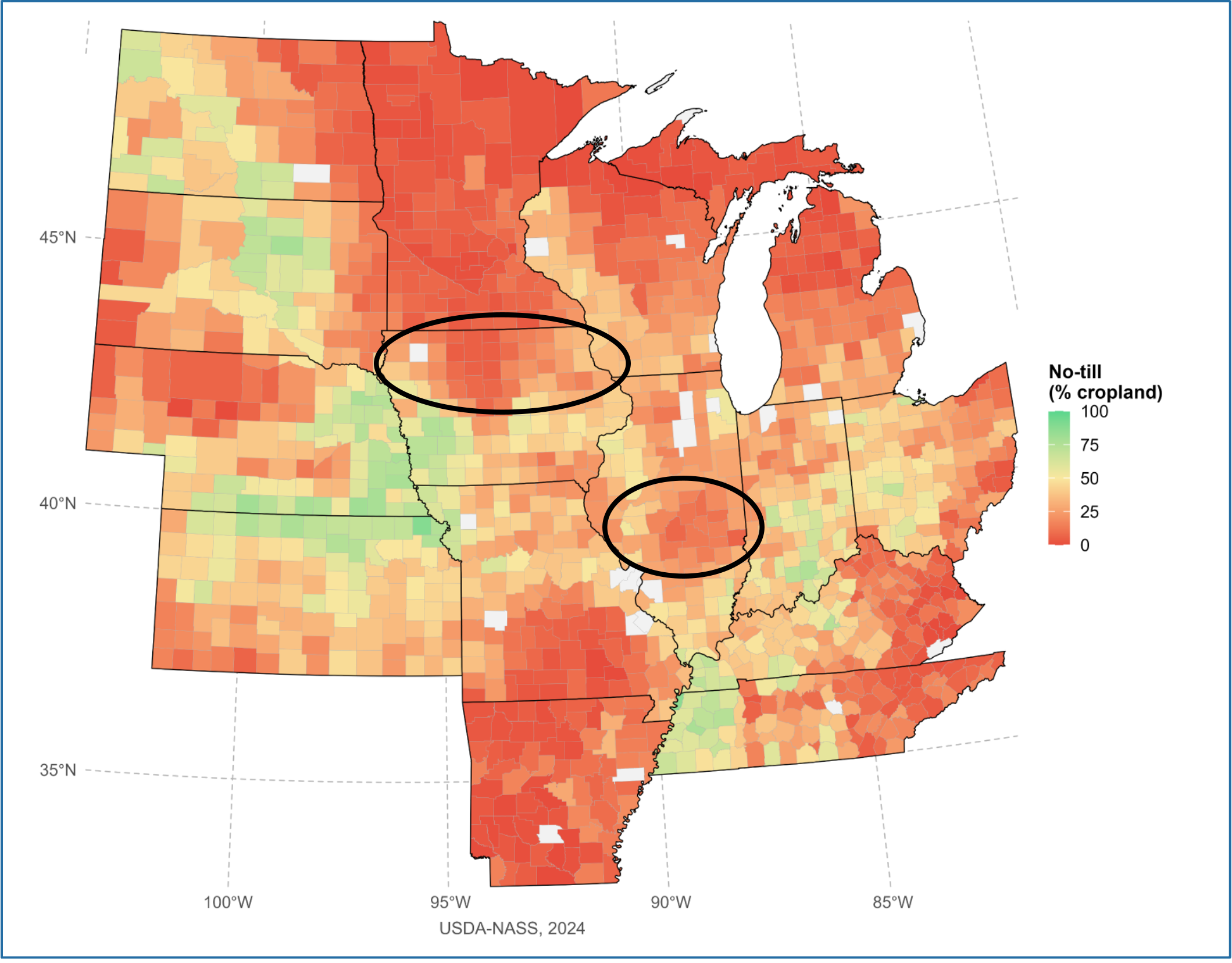
Data source: USDA-NASS 2024. Map: Fredrico Rolle
“We started this project as a response to the dust storm events that took place that spring,” he comments. “There is a body of research that shows reduced tillage can decrease erosion, suppress weeds and disease along with other benefits.”
Soils under conservation tillage have crop residue from the previous year, which can delay drying and warming, Preza Fontes says. This in turn, delays planting and lowers nutrient availability early in the season. Colder, wetter soils can limit organic matter mineralization, therefore nutrient availability to the seedlings.
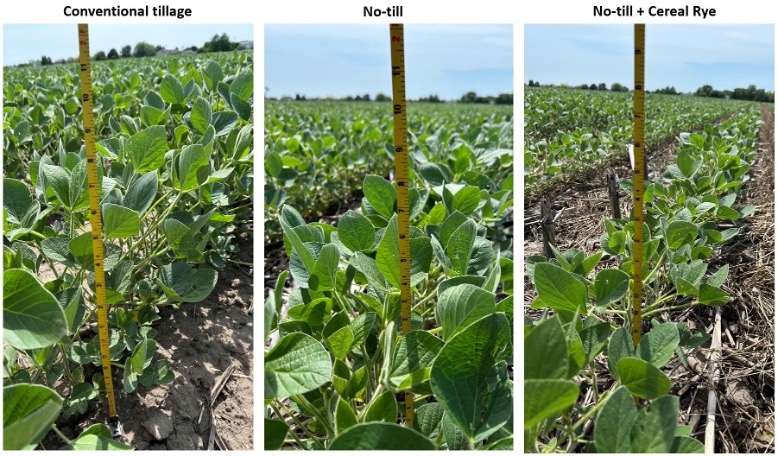
To address these disadvantages, Preza Fontes and his team established trials in six locations in Illinois and Iowa through Soy Checkoff support from the Illinois Soybean Association. Master’s student Federico Rolle helped manage all the field and lab work activities. The sites are on university research farms and cooperator fields and includes four tillage treatments:
- conventional tillage with one pass in the fall and one in the spring
- strip tillage
- no-tillage
- no-till followed by a cereal rye cover crop.
Each tillage system was paired with three starter fertilizer treatments: nitrogen applied at planting as urea ammonium nitrate (UAN), nitrogen (N) and sulfur (S) using a blend of UAN and ammonium thiosulfate, and an unfertilized check plot.
“Early in the season, we saw that the starter fertilizer helped the soybeans produce more biomass and the canopy was greener than the soybeans without fertilizer, but these disappeared by mid-season,” he says. “We tissue tested at R2 growth stage, and the N and S concentrations were not statistically different among treatments and were above the critical level, which indicates that none of the treatments were deficient.”
Another aspect of this research was row spacing, comparing 15- and 30-inch rows under the N and S applications. This trial was conducted near Monticello, Illinois, in 2024 and 2025. Preza Fontes found that 15-inch rows increased soybean yields approximately 9% in comparison to the 30-inch rows. He also recorded that the rows with applied fertilizer reached canopy sooner than the non-treated soybeans.
Conservation Tillage and Yield
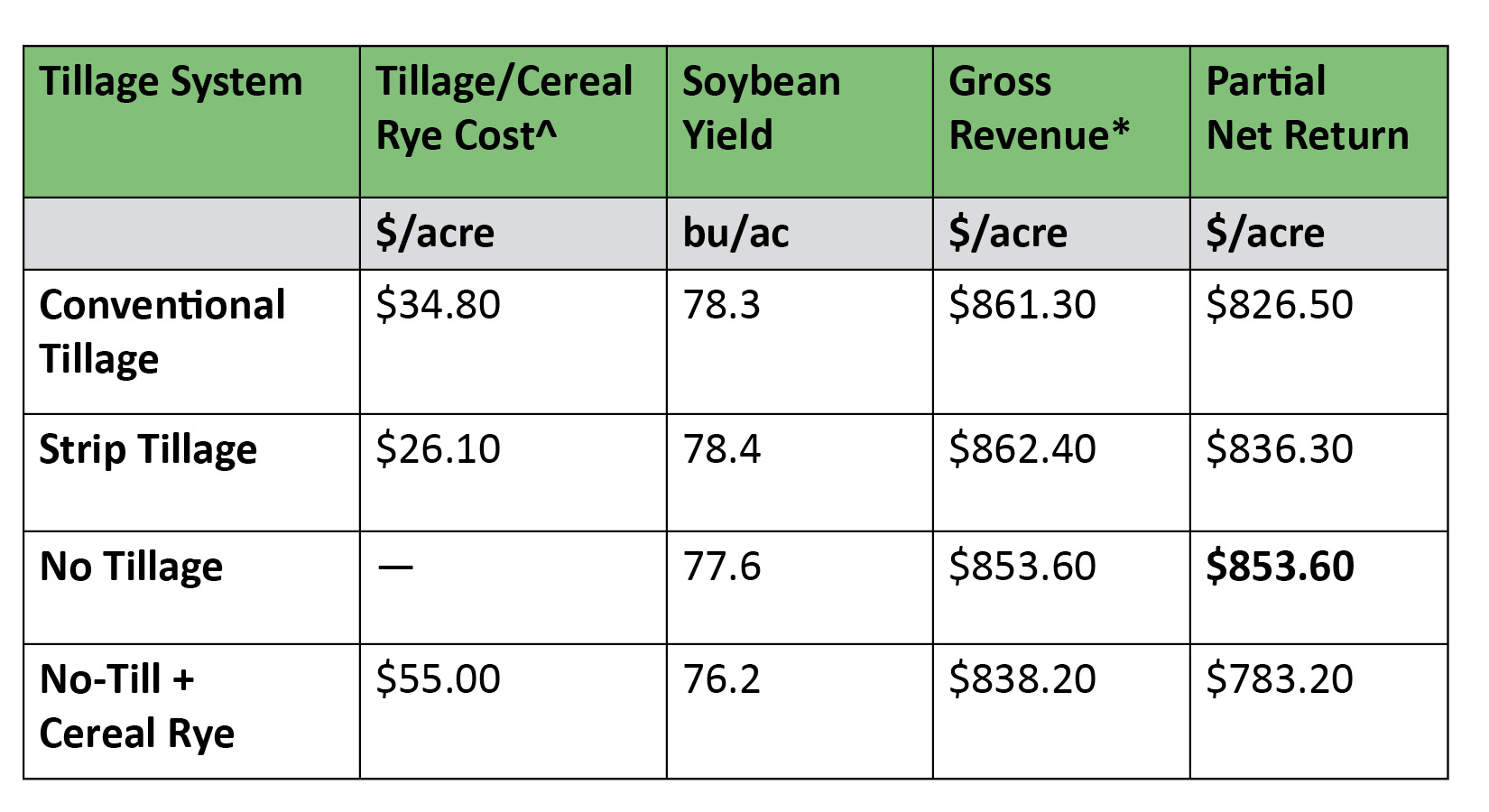
^https://farmdoc.illinois.edu/handbook/machinery-cost-estimates-summary
*Soybean price = $11/bushel
Soybean yield data was recorded across two years in all the locations. Yields ranged from 60-95 bushels an acre. Preza Fontes and his team found the starter fertilizer didn’t significantly affect yields — but tillage did. The strip-till and no-till yields were statistically the same as those under conventional tillage, and they saw slightly lower yields in the plots with no-till and a cover crop. Preza Fontes is encouraged by these results as he can show farmers that they can transition to a reduced tillage system while maintaining yield.
“Plus, there are hidden costs of extra tillage passes,” he comments. “Researchers at the university have done crop budgets and machinery cost estimates. We used those numbers to look at a partial net return on tillage. We saw highest profits with a no-till system, followed by strip-tillage and then conventional tillage (Figure 2).”
With the many soil health benefits of conservation tillage coupled with little to no yield loss, farmers may find their production costs improved on top of the environmental advantages of adopting a strip-till or no-till system. Future generations of farmers will also benefit from preserved topsoil as well.
Additional Resources
Can Conservation Tillage Work for Soybeans? New Research Says Yes—With the Right Adjustments – Illinois Soybean Association Field Advisor article
Evaluating Soybean Performance in Conservation Systems – University of Illinois Farmdoc project report
Long-Term Conservation Practices Improve Soil Chemistry – SRIN article
Meet the Researcher: Giovani Preza Fontes SRIN profile | University profile | University web page
The Soybean Research & Information Network (SRIN) is funded by the Soy Checkoff and the North Central Soybean Research Program. For more information about soybean research, visit the National Soybean Checkoff Research Database.
Published: Mar 23, 2026


