

Research HighlightsA Fresh Look at Soybean Maturity Recommendations
Highlights:
- Advances in soybean genetics and changes in management practices cause farmers to question decades-old maturity group recommendations.
- Recent Pennsylvania research indicates more flexibility in maturity group selection than previously determined.
- Within the appropriate maturity range, farmers can prioritize characteristics like herbicide resistance traits, yield potential and disease resistance over targeting one ideal, specific maturity group when selecting soybean varieties.
By Laura Temple
In 1991, a gallon of gas cost about $1.20, a gallon of diesel about $0.65, and intended soybean planting dates ranged from mid-May to mid-June.
Much has changed, including soybean genetics, target planting dates and weather patterns. That raises questions.
Daniela Carrijo, assistant professor and extension specialist for grain production with Penn State University, reports one question farmers posed when she took her role in 2022: “Are we planting the right soybean maturities?”
“The map with extension recommendations for soybean maturity groups in Pennsylvania was put together in the early 1990s, and it has not been updated,” she says.
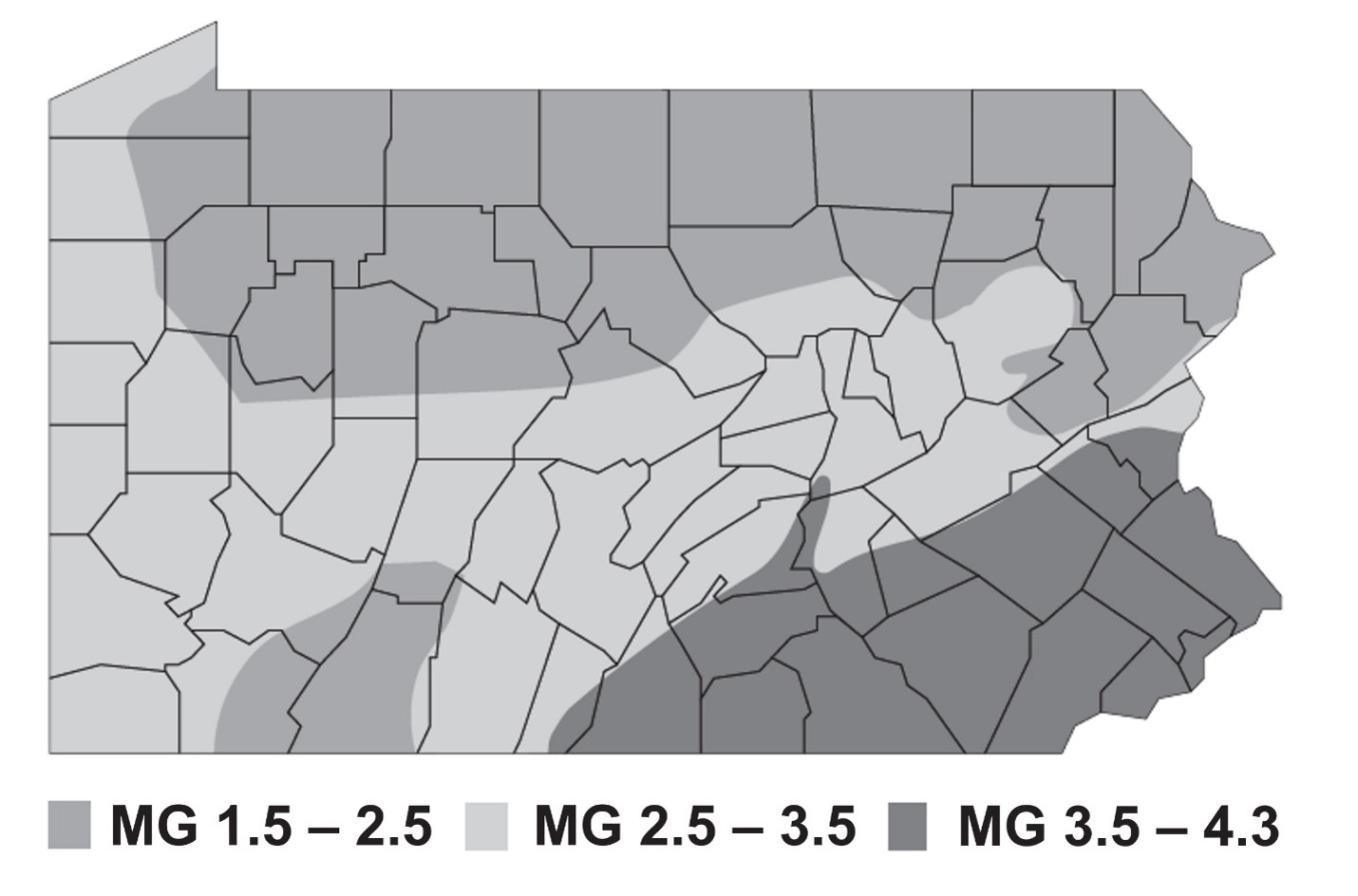
Those recommendations range from MG 1.5 in northern Pennsylvania to MG 4.3 in the southeast, where most soybeans are grown. Soybean planting in Pennsylvania now ranges from whenever conditions allow in April to late June or early July for double-crop soybeans following wheat or barley.
To provide guidance for maturity group selection based on current management practices, Carrijo tackled research with an investment from the Pennsylvania Soybean Board. She tapped into the state’s official variety trials to get started.
“We plant these trials in four locations around the state, using the varieties seed companies submit,” she explains. “We added a few more varieties to expand the maturity range, and then we looked for trends in the data based on maturity group.”
Genetics First
The preliminary trends from the variety trial data align with the recommendations made in the early 1990s, according to Carrijo. However, the range of maturities for an area appears to be wider than what was determined few decades ago.
“Soybean maturities can be more flexible than we thought,” she reports. “Our trials show that as long as the maturity group is within an appropriate range, which can be quite wide, it is more important to get the right variety than the ideal maturity group.”
She recommends that when selecting soybean varieties, farmers prioritize what works in each field, including weed control system, disease resistance, drought tolerance and yield results in similar environments. If varieties that meet those needs have a maturity rating that is slightly lower or higher than average, the variety will likely still perform well.
“Yield differences between varieties were often larger than differences between maturity groups,” Carrijo says. “Shorter-season soybeans can yield as well as longer-season varieties most years.”
Those results reinforce the flexibility farmers have in selecting varieties. For example, for a field that typically uses MG 3.2, they can be comfortable choosing varieties with the right genetics between MG 2.8 and 3.6.
Planting Date Interaction
Maturity group influences when soybeans flower and set pods, and day length drives soybean development. As a result, soybean planting date impacts how the crop will develop, which ties to variety selection.
“We know that interaction happens, but we don’t know at what point farmers should switch to a different maturity group,” Carrijo says. “That’s what we are trying to learn.”
In 2025, she added a planting date component to the research to help address this unknown. Some farmers aim to both plant and harvest soybeans early to allow more time for cover crop establishment. Those double-cropping need to know what maturity works for mid-summer planting.
She planted two similar varieties from MG 2.1, 3.1 and 4.1 at each of three planting dates: late April, mid-May and early June. The conditions in central Pennsylvania were unusual for the area in 2025. The April planting looked fine. However, a cold, wet May caused the May plantings to look worse than the June plots.
She plans to repeat the trial in 2026 in two locations, if logistics allow. Based on initial observations, Carrijo wants to gather multiple sets of data before developing recommendations.
Until that information is available, she stresses variety fit for a field and system over exact maturity group. That concept hasn’t really changed since 1991.
Additional Resources:
Penn State Field and Forage Crops Official Variety Testing Program
Delineating Optimal Soybean Maturity Groups Across the United States – SRIN article
Keys to Success: Choosing the Right Soybean Variety – Science For Success fact sheet
The Best Soybean Planting Date – Science For Success fact sheet
Soybean Variety Trials – SRIN resource
Meet the Researcher: Daniela Carrijo SRIN profile | University profile
The Soybean Research & Information Network (SRIN) is funded by the Soy Checkoff and the North Central Soybean Research Program. For more information about soybean research, visit the National Soybean Checkoff Research Database.
Published: Jan 12, 2026


