

Research HighlightsInoculating Soybeans for Drought Tolerance
Highlights:
- Soybean inoculants typically contain rhizobia to support nitrogen fixation, but some strains could also promote drought tolerance.
- Some rhizobial strains could limit availability of a chemical soybeans use to produce excess ethylene under drought stress.
- Producing less ethylene may help soybeans tolerate drought conditions better.
- Auburn University research is identifying and testing strains of rhizobia that support both nitrogen fixation and improve soybean drought tolerance.
By Laura Temple
Drought conditions dry up soybean yields as the plants react to stressful conditions.
Like probiotics support gut health to improve how people manage stress, soil microbes hold potential to improve how soybeans handle stress.
“Drought could become a more frequent issue as weather patterns change,” says Yucheng Feng, soil microbiology professor at Auburn University. “In the Southeastern U.S., we get enough rain per year for soybeans, but it doesn’t necessarily come at the right time of year. Farmers need strategies to manage this challenge.”
She notes that breeding drought-tolerant cultivars is a slow process that requires years. Irrigation is expensive, and water is a limited resource.
Feng has identified soil bacteria that could help support drought tolerance in soybeans. With a Soy Checkoff investment from Alabama Soybean Producers, she leads research to explore its potential, collaborating with Alvaro Sanz-Saez, associate professor of crop physiology at Auburn, and Yi Wang, assistant professor of biological and agricultural engineering at University of California-Davis.
“Our goal is to develop an inoculant using bacteria that helps soybeans tolerate drought,” she explains. “It would work for all cultivars. Development would be faster than plant breeding and using it would be cheaper than irrigation.”
Slowing Response to Stress
Under dry conditions, soybeans produce more ethylene, a hormone also known for ripening fruit. It causes soybeans to speed up development and move toward the end of its lifecycle. Excess ethylene leads to browning leaves, aborted blossoms, shriveled pods and other symptoms associated with drought stress.
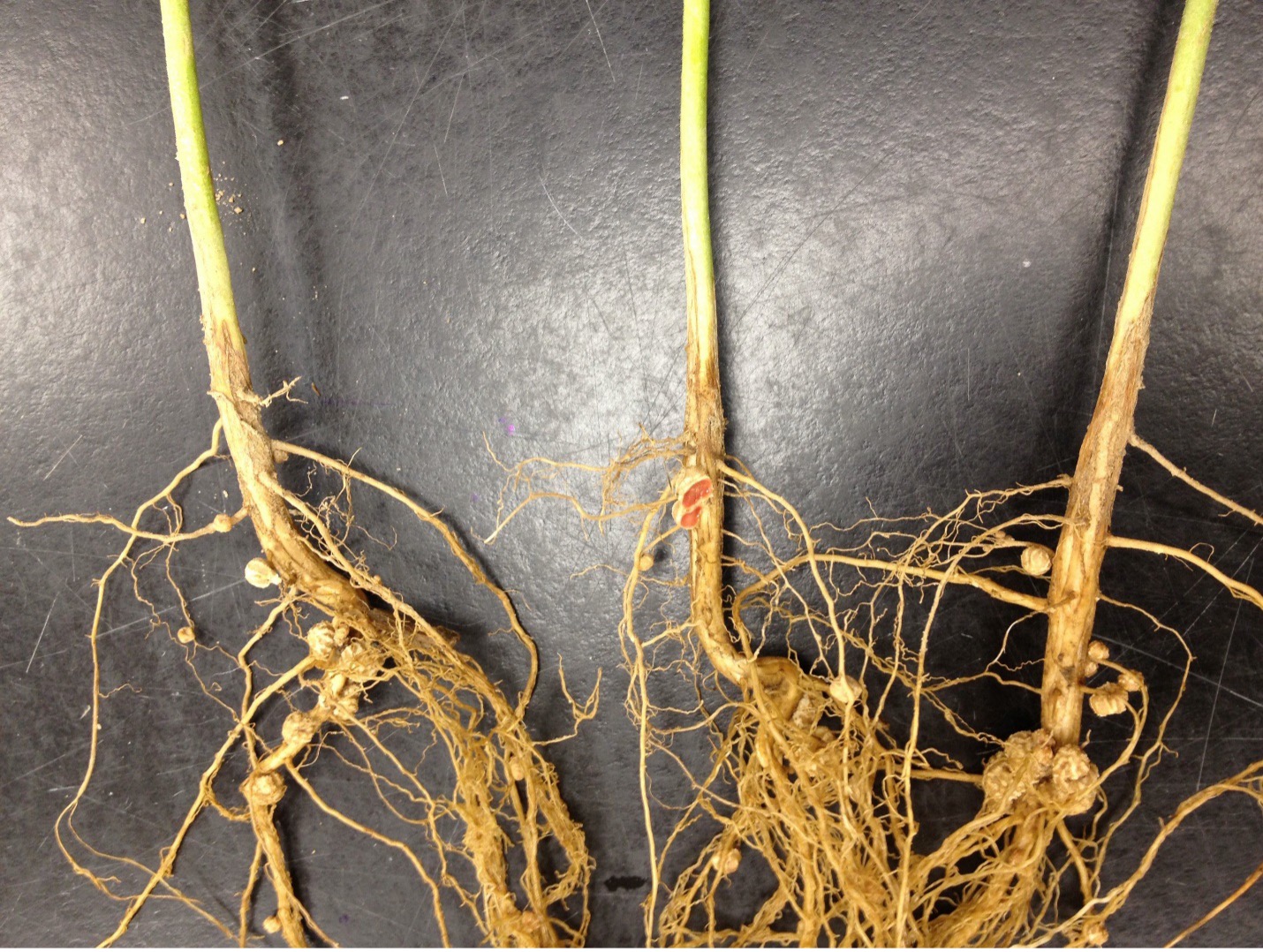
Feng explains that one chemical soybeans use to make ethylene is 1-aminocyclopropane-1-carboxylate, or ACC. Rhizobia, the soil bacteria that soybeans need to fix nitrogen, also use ACC.
“Soil microbes like rhizobia use the enzyme ACC deaminase to break down ACC as a carbon source,” she says. “Different rhizobial strains have different levels of ACC deaminase activity, so they differ in the amounts of ACC they can metabolize.”
Farmers already can choose to plant soybeans inoculated with strains of rhizobia to encourage development of root nodules to fix nitrogen. Feng and her research team hypothesize that choosing rhizobia with high ACC deaminase activity could reduce the availability of ACC, preventing or limiting soybean production of excess ethylene even under drought conditions. That would translate to improving drought tolerance.
“We could create inoculants with rhizobia that reduce ACC availability and support nitrogen fixation,” she says. “This could encourage soybeans to keep developing under stress, rather than shutting down.”
Identifying Inoculant Candidates
Feng’s team, including one of her graduate students, Kasun Thilina Wanninayaka, started the quest to identify rhizobia to support that hypothesis by screening in the lab. They isolated rhizobia from the root nodules of soybeans growing in three different fields. Each root nodule contains several types of rhizobia.
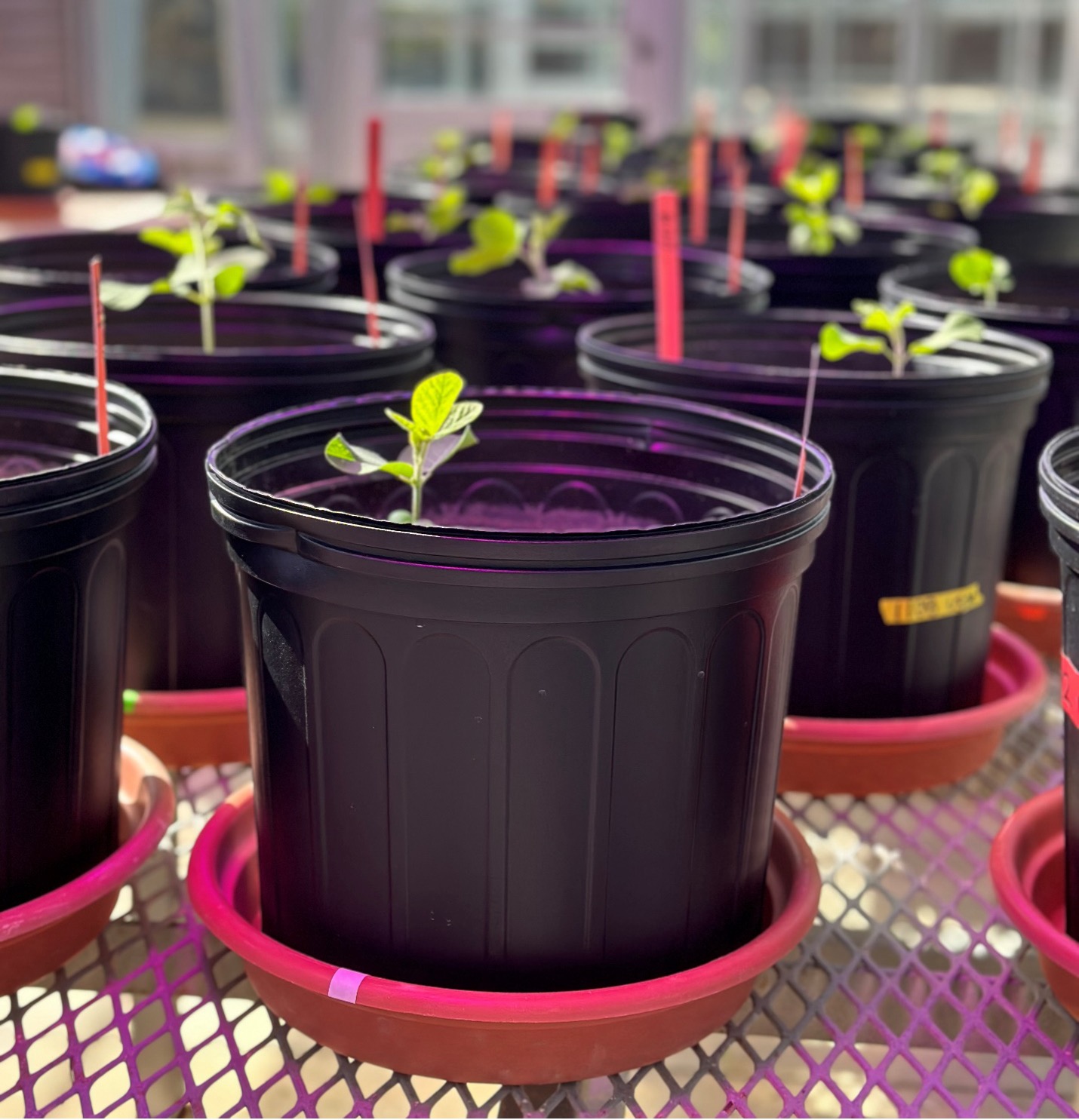
After obtaining 49 rhizobial isolates, they tested each one for ACC deaminase activity. Then they selected six strains with very high or very low ACC deaminase activity to inoculate soybeans growing in sterile sand in growth chambers to see if these strains would nodulate soybeans again. The test strains were applied as seed treatments initially, and then to roots of young growing plants a week later.
“We observed soybean nodule formation and compared shoot and root growth,” Wanninayaka says. “We saw differences in how these rhizobia influenced nodule mass.”
They also simulated progressive water loss in pots to mimic drought stress in the greenhouse. For two weeks, soil water loss was controlled at a daily rate of 5% of the soil’s water holding capacity. Then for two more weeks, they held soil water in the pots at 30% of water holding capacity until the experiment was terminated.
“Rhizobia strains with higher ACC deaminase activity led to more root biomass, higher root to shoot ratios and greater accumulation of an osmoprotectant [stress management compound], proline, under drought stress,” he reports.
These results show promise for developing inoculants that improve drought tolerance. Feng plans to repeat the greenhouse tests to verify results. Then her team will conduct in-field trials with these strains of rhizobia as inoculants.
“Inoculants provide a practical way to support plant health — including stress tolerance,” Feng says. “But as we develop them, realize that studying soil microbes is complex. They have lots of potential, but there is much we don’t know yet.”
Additional Resources
Soybeans that ‘Sweat’ Less Tolerate Drought More – SRIN article
Meet the Researcher: Yucheng Feng SRIN profile | University profile
Published: Oct 20, 2025


